Ian Irvine has been running a series of guest posts by writers, and this time it was my turn: I fail to come to terms with art vs society and apologise, kind of, for being a deadline snob. But I’m happy to report that, since that post was written, Smudge is a happier cat now that regular lap time has been resumed.
Archive for November, 2011
Why this cat is not happy
Posted in writing with tags craft, ian irvine, snarky cat, writing on November 25, 2011 by jason nahrungNo hope for Thoraiya and other writerly stuff
Posted in news regurgitation, writing with tags anywhere but earth, book trailers, dropbox, fairytales, jay kristoff, karen brooks, kristen stewart, louise cusack, michael pryor, snow white, spin, stephen m irwin, thoraiya dyer, writing tips on November 24, 2011 by jason nahrungJason Nahrung, as usual, wrote beautifully, but handed me horror in sci-fi clothing. One day, he’ll gift me with a glimmer of hope!
A glimmer? I *think* I could do that. In fact, I did try once, and the jury’s still out on that story, but I *guess* I could try again…
Read Thoraiya’s thoughtful and generous review here.
…the entire sequel had flipped out and been eaten by gremlins. Every draft. All my notes. My diary of a madman scribbles about where the trilogy was headed. Everything.
Act 1: make it matter
Act 2: make it messy
Act 3: make it meaningful
I can’t help feeling that it’s Act 3 that lets a lot of stories down. Boom, crash is all very well and lots of fun, but the stories that linger are the ones that reach down deep and make us ask those ‘what if’ questions.
Back to the fairytales, then, and one of the coolest Disney villains: magnificent Maleficent!
Dragons, love and lights that shine after the final sunset: vale Anne McCaffrey
Posted in books, fantasy, news regurgitation with tags Anne McCaffrey, death, dragons, obituary, pern on November 23, 2011 by jason nahrungAwoke to the news that Anne McCaffrey has died, aged 85, and I imagine all around the world readers are looking up and waiting to see if any dragonriders take flight to stave off the threads of dark the news has struck. Of her books I’ve read, from her famous Pern universe, one passage still rings clear, in which and a boy and a girl meet and fall instantly in love, and the narrator tells us there are two kinds of love, the one that creeps with time and subtlety and comfort, and this second one, the lightning bolt. Oh, yes.
No doubt McCaffrey’s words linger still in the minds and hearts of her fans, and will continue to do so as long as those words are available, for generations to come. We will always have dragonriders to stave off the dark.
Fly safe.
Wendy Rule at the Caravan Music Club
Posted in gothic, music, review with tags caravan music club, don't be scared, guided by venus, pagan, wendy rule, wolf sky on November 21, 2011 by jason nahrungMelbourne’s Wendy Rule played ‘south of the river’ on Saturday night when she took to the stage at the cosy Caravan Music Club, at Oakleigh’s RSL Club. With a cemetery for a backyard, it was a suitable venue for the pagan singer-songwriter, given a cabaret air with the red-and-white checked table cloths and candles.
Saturday’s gig drew a small but appreciative crowd on a wet night on a soaked day — my sister had retreated, saturated and mud splattered, before the main act at a vineyard concert earlier in the day — and it was a shame there weren’t more on hand to hear a wonderful performance.
With the air scented with white sage and red wine on stage, the gig was engagingly laid back. Rule was effervescent as always but with an extra sparkle in the wake of her recent wedding, and husband Timothy on stage with guitar alongside regular companions William Llewellyn Griffiths on percussion and Rachel Samuel on cello. I love the cello in particular, such a great accompaniment to Rule’s hybrid brand of folk/rock/world/jazz, the notes penetrating all the way to the spine.
There were several highlights over the two sets, timing in at around an hour and a half and leaning on latest album Guided by Venus: an a capella Celtic ballad in ‘John Riley’, stirring ‘Wolf Sky’ and ‘Artemis’, a fetching rendition of ‘Horses’, two promising fairytale-inspired tunes being worked up for side project Don’t Be Scared, and Rule and guitar providing the encore, ‘La Vie En Rose’ (I think).
The sound was superb and the lighting rig sufficient to embellish the dark, romantic mood evoked by Rule’s music.
The night was well worth venturing out into the rain for, well priced and well presented. Blessed be, indeed.
Spot the Christmas gift idea…
Posted in art, fantasy, gothic, musings with tags christmas gift, lisa snellings, macbeth, poppet planet, present, readers niche, shakespeare, tea towel on November 20, 2011 by jason nahrungCute Macbeth tea towel, for the writer, reader or theatre lover who has everything? From Readers’ Niche. They have the same pattern on erasers, too — *chortle*.
And while I’m throwing shopping suggestions around for the festive crowd, one of my happiest hunting grounds for pressies for my Significant Other is Poppet Planet. We fell in love with Lisa Snellings’ work at World Fantasy in San Jose a couple of years back: writer poppets, Halloween poppets, Dr Who poppets, cute and melancholy and downright adorable poppets… oooh. Awesome service, too.
Emilie Autumn at the Espy: so Victoriana!
Posted in music, review with tags asylum, dead is the new alive, emilie autumn, espy, fight like a girl on November 16, 2011 by jason nahrungThe Gershwin Room at St Kilda’s Espy (aka the Esplanade hotel) was the perfect setting for last night’s ‘Asylum’ gig by Emilie Autumn, a sideshow to her tour with the Harvest Festival. The American performer loves her Victoriana, melding lace and feathers with lashing of goth and steampunk, and the Espy’s peeling paint, pressed metal ceilings and ageing blemished mirrors suited the show to a tee. Or perhaps to a ‘tea’ might be more appropriate …
Emilie is a powerhouse, at home on the keyboard and the violin, with a decent range in her vocals and oodles of expression, and a deftness when it comes to interacting with her adoring audience, most done up to the nines.
She also has her support crew — Captain Maggot, voluptuous Veronica and dotty Contessa — to keep things lively on stage, including tea parties, lesbian pantomime and a girl-on-girl kissing sideshow called the Rat Game. Contessa and Maggot are adept at fire twirling, and Veronica plays a mean keyboard, too. Maggot is a particularly cool character, piratical in nature and small of stature, but possessed of wicked expressions and a top sense of balance, appearing as she does at one stage on stilts.
But there’s no doubt this is EA’s show, and she’s a fascinating ring mistress for this vaudevillean presentation set inside an asylum for wayward girls. Last night’s gig felt much tighter than when I last saw her in late 2009 doing much the same. Last night’s set also featured the title song of her forthcoming album, ‘Fight Like A Girl’, which suggests a similar musical direction to the winning Opheliac.
There were a few minor sound glitches, particularly early on, but songs including ‘Liar’, ‘Opheliac’, ‘I Want My Innocence Back’ and ‘Dead is the New Alive’, performed to thumping backing tracks, evoked effusive responses from the phone-wielding crowd. The only place the show seemed to slip away was towards the end, with a series of might-have-been final tunes proving false.
The encore was a cheeky singalong to a recording of Monty Python’s ‘Always Look on the Bright Side of Life’, with EA promising a speedy return to Oz. Keep your dance card open for that one!
The Melbourne Museum: now with added Tut
Posted in things to do in melbourne, travel with tags akhenaten, carlton gardens, csirac, garden view cafe, melbourne museum, nefertiti, phar lap, things to do in melbourne, tutankhamun on November 15, 2011 by jason nahrungSo we succumbed, and despite having seen it in San Francisco already, we hit the Tutankhamun exhibit at the Melbourne Museum. And I’m glad we did, because my sieve-like memory had forgotten much of the awesome and remembered only the vague disappointment about there not being that much Tut there (in particular, sarcophagai or the famous death mask), and the information being fairly thin when it came to the details of this slice of Ancient Egyptian history.
The bas relief of Akhenaten and Nefertiti worshipping the Aten is damn cool, as is the bust of the infamous monotheist, but it’s the quirky bits I’d somehow let slip that excited me once again: a wee ‘animated’ ankh holding Tut’s staff while he’s out hunting ostrich, and the amazingly different animal art (Bes, apparently, but rendered in ways I just haven’t seen before) on the chair of Sitamun, so fresh you could sit in it today (sadly, I can’t find a decent pic of the animorphs in question). There’s also a delicious statue of Sekhmet, though her eyes have had a rough time of it.
As usual, the colour and the detail of Egyptian art leaves me astounded. To think of the people who lavished so much effort on these works, to have them in such good order thousands of years later…
The Tut ticket gave us entry into the other areas of the museum, which we explored after a tasty lunch at the Middle Eastern-themed Tcheft Restaurant. The museum, and we didn’t have time to see all of it, is astoundingly good. The dinosaur and animal area is chock full of fun and informative interactive displays and is attractively presented, although the stuffed animals filling floor-to-ceiling ledges in one room did make me feel a little like an extra on a weird adaptation of The Birds. My only hope is that young’uns will see the poor glass-eyed critters and resolve to not let them go the way of the thylacine, of which there is a preserved specimen.
A walk-through forest section includes live animals — turtles, lizards, bower birds, tawny frogmouths and finches — and elsewhere there are more live fish and spiders and lots of stick insects.
And yes, race horse Phar Lap is on show, and it’s an awesome taxidermy job.
Also of note is the display outside the Tut exhibit of a replica of his mummy and the efforts made to finally solve the puzzle of his death at age 19 — nope — and, nearby, on a totally unrelated topic, CSIRAC, Australia’s first computer: about as big as your lounge room.
Tips: Tut is open only till December 4. The early bird parking is a good deal: $14 if you’re in before 9.30am and out after 2.30pm. Filling the time at the museum is not a problem, and the Garden View Cafe has great coffee if you want to while away the half hour till the museum opens at 10am. Or the Carlton Gardens are right there for a slow wander — I still am surprised to see massive Moreton Bay figs this far south. Don’t ask me why.
Remembrance Day at Fort Nepean
Posted in photograph, travel with tags cemetery, cheviot, fort nepean, harold holt, point nepean, quarantine, remembrance day, ticonderoga on November 14, 2011 by jason nahrungDespair is too strong a word. It’s not as if I’ve been confined to a sailing shop in the ravaging grip of typhus, or stationed in a hovel with kerosene water to drink and nothing to fight but mosquitoes and each other. Still, after a day of too much sun and not enough coffee, the sight of my car vanishing behind us as the last transport of the day trundles out of the Point Nepean National Park is morale destroying. The thought of trudging 2km from the next stop to collect the vehicle is not high on my list of favourite things to do. Fortunately, a gentleman in our transporter cab overhears my plight and offers a lift from the information centre to collect my wheels: only a thermos could’ve been greeted with more effusiveness. For future reference: when the tractor stops at the road gate at Gunners Cottage, dismount and look lively about it.
Friday was Remembrance Day, and by fortunate happenstance I was at the Point Nepean National Park where war and sacrifice are enshrined in concrete. Despite our end-of-day setback with the transporter stop, the park is well worth the visit. No more than 90 minutes drive from Melbourne, there are several areas of historical interest inside the park, which occupies the toe of Victoria’s Mornington Peninsula. A self-guided tour is available and the mp3 audio tour is highly recommended — the historical broadcasts and first-person recollections more than outweigh the very occasional naffness.
Quarantine Station
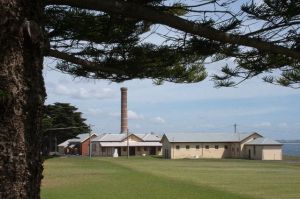
About 50 buildings are set out around the former quarantine station, also used as a military training camp and, most recently, home to Kosovar refugees. Many of the buildings are closed to the public, but a couple have been turned into interpretative displays. The most striking is the fumigation building, where belongings were treated on arrival in massive steam boilers. Many of the buildings have been re-purposed over the years, but this one retains its original fittings, right down to the tram tracks that ferried the goods in. The quarantine area brings to life tales of disease and yellow flag ships, burials and resumptions, leprosy and typhus.
Gunners Cottage
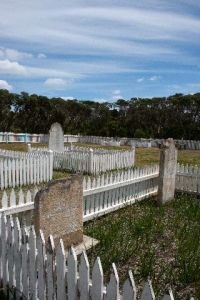
The cottage itself is devoted to ecology and junior ranger programs, but a short walk through the striking Moonah woodlands is the old livestock jetty and a view of Port Phillip Bay, and farther west, the cemetery, where some 300 lay interred, most without headstones. Those monuments that remain include several from the tragic diseased ship Ticonderoga. Gunners Cottage is the farthermost point to which you can drive; after this, you’re on Shanks pony to the other points of interest (or, you can hire a bicycle or buy a ticket for the people-moving tractor-pulled transporter). The Coles Track cuts through the scrub to Cheviot Hill.
Cheviot Hill
The hill is the highest point in the park and retains several gunnery posts looking out to sea. Two searchlight shelters are located closer to the beach. The beach was the site of the wreck of the Cheviot, and also the disappearance of Prime Minister Harold Holt. One look at the rocks and waves and it’s no surprise that someone could drown there.
Fort Pearce
Serious entrenchments here for naval guns, and a barracks on the landward side reduced to foundations. A highlight was an echidna nosing around the walls, apparently feasting on the black ants.
Fort Nepean
The centrepiece of the area’s fortifications, from which Australia’s first shots of both World War I and II were fired, to stop vessels from leaving after the declaration of war. This is an amazing set of buildings, wonderfully lit and illustrated with placards and recorded information including sound effects. The first we heard on our visit was a person whistling from somewhere in the depths …
The buildings reach down several floors inside the earth. It’s hard to imagine the tension in there as men worked to lift munitions from the depths to the cannons above. There remains the workings of a ‘disappearing gun’ and two of the long range six-inchers. The engineering shed still smells of diesel.
Alongside the road at one point is a rifle range, but it’s just one of several. Signs still warn of unexploded bombs in the scrub due to the army days. The other ranges, and also the Monash Light, a shipping beacon named after the Australian general, can be accessed via a walking track.
The buildings are stark, sombre reminders of not only Australia’s military history, but its foreign affairs and social evolution, with fortifications marking the fears of the populace and attitudes to the world wars. Information about the basic living conditions for servicemen and women also gives pause for thought.
Drinking fountains are placed only at Gunners Cottage and the quarantine station, and there are no food outlets inside the park. Toilets are available at Fort Nepean, Gunners Cottage and the quarantine station. Tractor tickets can be bought only at the information centre – one-way or returns. We spent from 10.30am till 4.30pm at the park and didn’t quite see everything; those entering by foot or bicycle can stay after the road gates are closed. The transporter makes its last run from Fort Nepean at 4.30pm.