
 Friend Andrew Macrae launched his novel Trucksong last night — an excellent, crowded launch with psychedelic David Lynchian underpinnings — and in the spirit of multimedia shenanigans, has a soundtrack to go with it! The book is a postapocalyptic tale of a fella in the Australian wilderness looking for a kidnapped woman with an INTELLIGENT TRUCK for an ally. Mad Max on cyberpunk steroidsd or what? The soundtrack sounds like just the thing for a Nullarbor road trip. Here’s hoping Andy gets plenty of mileage from Trucksong!
science fiction
Speculative fiction fest in Sydney
The New South Wales Writers Centre has released the program for its one-day festival of speculative fiction, curated by Kate Forsyth, and it’s a doozy.
The guest list includes Garth Nix, Marianne de Pierres, John Flanagan, Ian Irvine, Sophie Masson, Kim Wilkins … and more! Russell B Farr is launching a new collection by Juliet Marillier. There are publishers (Random House, Momentum, Ticonderoga and Chimaera, to name a few) talking about getting published, and publishing yourself. That’s a hell of a lot of industry muscle for $80 (non-members).
And yes, a few of us are talking about weird and dark fiction, too.
The festival is on March 16, starting at 10am, with drinks on the verandah at 5pm to wind down. Sounds lovely, doesn’t it!
Aussies on Locus’ recommended list of 2012
Pleasing to see Aussie writers make the cut on Locus magazine’s recommended spec fic reads of 2012.
Some that my eye found were Kaaron Warren and Margo Lanagan for Twelfth Planet Press yarns, and Margo for Sea Hearts and her collection Cracklescape as well, and the Slatter/Hannett Midnight and Moonshine collection — doubly great to see a small presses from Down Under making an impression — and Sean McMullen and Terry Dowling and Anna Tambour and Greg Egan, and editors Amanda Pillar (Ishtar) and Jonathan Strahan (three books!).
Dealing with aliens, and humans, in Hunter’s Run
 Hunter’s Run is a novel that took some 30 years to get to the shelf. Brainchild of Gardner Dozois, it’s had help from his friends George RR Martin and Daniel Abraham to get it across the line. And it’s so good that they persisted.
The story involves a Hispanic colony on a planet way out in the black, and a rather nasty man, the prospector Ramon Espejo. He has a mercurial relationship with his lover Elena, doesn’t play well with others, has to self-medicate to handle the stress of being in town. He’s most at home in the wilds, digging for minerals, living off the land.
But on this one trip, he discovers a secret: the real reason the alien Enye are helping spread humanity across the stars. It isn’t pretty.
There are a few aspects of the novel that make it a cut above. The first is the way it depicts the new world, drawing on the settler’s analogues and superstitions and how they adapt without adapting much at all, really. The second is how aliens are depicted, in both biology and culture. And the third is how it explore the sense of identity, because Ramon gets a chance to examine his life and the direction in which it’s headed and make some decisions about that. It’s handled superbly.
I’ve always been troubled with how a villain with amnesia, say, given that chance to redefine themselves, often make the decision to veer towards the social norm than their previous predilection for villainy. It’s an interesting nature vs nurture exercise. Hunter’s Run delivers are far more satisfying examination than most.
The prose is clean and the world well drawn and the action unpredictable, and Ramon and Elena are alive on the page, compelling if not likeable.
There are interviews with each of the three authors at the back of the book that reveal its drawn-out path to publication and some of the issues they dealt with, such as alien construction and the motivations of their characters. Illuminating stuff!
Highly recommended, even if you’re not looking for hints on planning your own alien civilisation and offworld colony.
GenreCon — worth doing all over again

So we’re back home, and now that the work has been caught up on — well, kind of — it’s worth reflecting on the good oil that came from GenreCon in Sydney this weekend.
Twas an intimate gathering of writers from across the spectrum of crime, romance and spec fic — a melding of minds, techniques, loves and aspirations. And there were agents and publishers (Hachette, HarperVoyager, Momentum, Xoum, Clan Destine, Dark Prints … to name a few) with an interest in those genres. There were international guests Ginger Clark and Sarah Wendell and Joe Abercrombie:
Ginger let us know about the tough times in publishing and how agents are stepping up to fill the gaps left by publishers, in terms of editing, marketing, production … the line is blurring, the publishers cash-strapped and unable to offer the full suite of resources that has, in the past, made them such a powerful cog in the publishing wheel.
Sarah addressed author platform — the pros and cons of various social media, the importance of politeness — be a person, she said; converse, don’t declare.
And Joe: he’s a damn funny, easy-going fantasy writer who seems just a touch bemused to be selling oodles, but highly appreciative, to be sure. It’s all about getting down and dirty with the characters for him; gritty realism over shiny heroics, though he admits there’s room for both, and more, in fantasy’s huge field.
There was pitching for those with something to pitch — a 70 per cent hit rate for call backs shows some serious quality in the offing, and of the 30 per cent that dipped out, there was a praise for the pitch, even if the actual book didn’t hit that particular agent or publisher’s want list.
The panels were compelling, ranging from industry to craft to workshop topics — Peter M Ball’s business model for writers gave me pause for thought.
LA Larkin described plot as skeleton, characters as flesh and mood as blood: I like that, as you might expect.
There was an awesome debate between planners and pantsers: there was a symbolic glass of water, and a smooch, some of the best insults since Monty Python …
There was catching up and meeting social media pals, making some new friendships and reinforcing some existing ones. It was relaxed but draining. There was morning and afternoon tea and lunch as well, all of which enhanced the social aspect of the event.
As usual with conventions, the hotel didn’t quite come to grips with the bar situation, but the staff were wonderful and, from this outsiders’ viewpoint, apart from the race day madness in the bar, all went to plan.
Martin Livings launched his collection, Living with the Dead, as part of an Australian Horror Writers Association presentation, one of four by various genre groups.
The opening night cocktail party was a hoot of an ice breaker, and it sounded as if we’d missed out by skipping the banquet and a presentation of romance titles, one featuring a platypus that created quite the stir.
The good news: plans are afoot for GenreCon 2013, to be held in Brisbane. The calendar is richer for it.
GenreCon — too much for two days!
GenreCon has just put its program online, and — ARGH! — I need two of me. Maybe three.
This program really pops my cork: writing stuff such as ‘how to’, villains, and subtext, and then there’s industry stuff like finding the right publisher and life without advances. It’s very cool to see Romance Writers, Sisters in Crime, Conflux and the horror writers hosting ‘community’ events. I keep hearing how damn professional and, ahem, well-oiled a convention machine the RWA is, so it will be great to get an insight into that, and with Conflux hosting the natcon next year (yep, already booked), the timing is right to fly the F&SF flag.
Bottom line, though, is the number of experienced writers, publishers and agents on the program. For an emerging writer such as myself, the osmosis learning will be in overdrive. This is going to be a hoot!
I’m also quite looking forward to publicly picking the brains of Joe Abercrombie at our ‘in conversation’, and talking ‘setting the mood’ in a session on the Sunday. But damn, there’s good stuff on then, too! Too much!
Blake’s 7 remake: liberating, or a Federation of dunces?
 No sooner had we just finished watching the last episode of Blake’s 7 than the announcement hit the interwebs that an American outfit was interesting in remaking the cult British television show. First thought: this could be wicked, what with modern special effects and all. Second thought: another UK show mangled by Americans missing the point. Verdict: torn.
I loved Blake’s 7 as a kid; the 1978-81 show offered something different. A crew who were together by desperate convenience, who weren’t jumping each other’s bones but rather each other’s nerves, and who could lose just as easily as win. And, as io9 points out, led by someone who might just be a zealot dangerous to all around him.
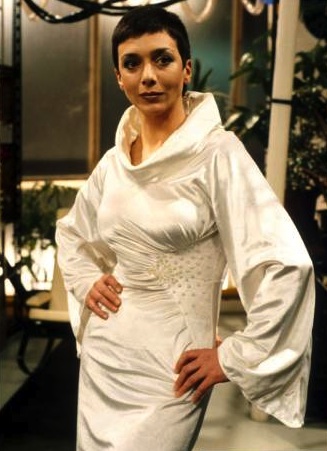
The villain wears white … Servalan
Add in some bold decisions: killing off a cast member mid-season, dropping the titular character for two seasons, destroying the uber-starship Liberator and replacing it with a far less ostentatious and well kitted out ship… Indeed, by the end of the final, fourth season, only two original cast members remain on the bridge. And then there’s the conclusion, of course: it’s hard to imagine an American television show in which the heroes totally and utterly lose.
If it does get up, it will be interesting to see in which direction the remake goes. Let’s just hope it doesn’t poke science fiction in the eye the way the remade Battlestar Galactica did.
AWWNYRC#9: Meg Mundell’s Black Glass is so very shiny
This is the ninth book I’m reading as part of my list of 10 for the Australian Women Writers 2012 National Year of Reading Challenge.
Black Glass
by Meg Mundell
Scribe, 2011, ISBN: 9781921640933
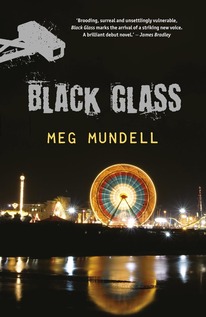
This is Melburnite Meg Mundell’s debut novel, and it’s a cracker. Once again*, we have Melbourne being gloomified in a near-future dystopia in which that mighty gap between the haves and the have-nots is bringing the city to the brink of anarchy. In the glass towers, the government manipulates its embedded media to try to keep a lid on. On the streets, the undocumented lower classes slink through the shadows, dodging security cameras and police patrols to earn a crust through corporate sabotage. And then there’s the young turks, looking to draw attention to the corruption at the top and the suffering at the bottom through increasingly violent demonstrations.
Into this tense social battlefield come two sisters, divided by an unfortunate incident, one seeking the other, and both forced to engage with the world beneath the veneer of identity cards and taxable wages.
The sisters provide the emotional thrust of the story, while other points of view are offered by a journalist delving into the underworld and a ‘moodie’ — a cross between tech and artist who uses lights, sounds and smells to exert subtle emotional control over people, usually in a crowd: say, keeping gamblers happy, helping concert-goers get frenetic without being destructive.
 And then there are the walk-ons, often undescribed, mere transcripts of conversation as their conversations offer extra explanations and bridge scenes.
It’s a fetching combination of character-driven narrative and reportage, as shiny as the black glass that hides the corporate shenanigans, but not dark enough to be opaque.
All the pieces fit together and the ending is sublimely satisfying. It reminded me a little of the most excellent Moxyland, by South African Lauren Beukes, with its ensemble exploration of social strata.
Black Glass has figured in a bunch of Australian awards short-lists this year; it wouldn’t surprise if Mundell goes all the way in the future.
* cf The Courier’s New Bicycle, below.
Previous Challenge reviews:
- Debris by Jo Anderton, fantasy
- The Resurrectionists, by Kim Wilkins, horror.
- Sea Hearts, by Margo Lanagan, fantasy.
- Burn Bright, by Marianne de Pierres, fantasy.
- The Courier’s New Bicycle, by Kim Westwood, fantasy.
- The Road, by Catherine Jinks, horror
- The Shattered City, by Tansy Rayner Roberts, fantasy.
- Frantic, by Katherine Howell, crime.
Prometheus: crash and burn
Prometheus, Ridley Scott’s latest movie:
In other words, it’s as unsatisfying as the Creationism it appears to espouse. So bitterly disappointing in so many ways, the nicest thing I can find to say about it is that it looked nice. Ben Peek offers a more detailed analysis.
Me, I’m off to watch Alien, when Ridley knew how to tell a story with heart, and then Aliens, to be reminded how you can actually give a damn for a multi-character movie.
Snapshot 2012: Scott Robinson

QUEENSLAND writer Scott Robinson grew up reading and writing science fiction and fantasy — he was writing ‘novels’ when he was 10 years old. “It was never short stories, strangely enough,” he says, “but at 13 was sure I was going to make my living as a poet when I had poems published in Quadrant. Twenty-five years later, and I’ve barely made a couple of weeks’ worth of wages from any sort of writing at all.”
Last year, he made one of his books available for free as an e-book and has since self-published four on Amazon — the first three books of Tribes of the Hakahei (The Space Between, Singing Other World and When the Times Comes), as well as a stand alone crystal-punk fantasy call The Brightest Light. The final book in the Hakahei series, A Different Kind of Heaven, is pending.
Scott lives with his pregnant wife and two children. His website is www.scottjrobinson.com.
What have been the joys and sorrows of the self-publishing route?
Joys: my books is out there in the world for people to read. I’ve had some great feedback from readers and really can’t get enough. The sorrows: not as many people are reading them as I would like.
Marketing has always been a problem for self-published authors, but these days I have to be compete against the good stuff out there as well as fighting the negative image created by the ‘writers’ who decided to knock up a book over the weekend and make their fortune. At least in the old days, the wife or husband or other keeper of the funds was something of a gatekeeper. Now, it takes no time or money as all to publish a book. Apparently, for some, it doesn’t take any effort, either. So, I just keep hoping for some word of mouth to kick in (The Brightest Light got a great review on Amazon the other day) while I work on the next book.
Some varmint tried to purloin your free book through Amazon. How did you handle that and has it affected the way you look at e-publishing?
My first port of call in that instance was an email to Amazon. I received an auto reply saying someone would contact me in three working days. When that didn’t happen ,I sent another email. Eventually, after a week or two, I initiated a live chat with Amazon customer service (or someone like that) and spoke to them. The book was taken down a couple of days later.
I don’t think it changed my view on self-publishing. I actually brought forward my move to Kindle because of that. Piracy is something that could happen to everyone and it may have been a bit of a compliment that someone went to the effort (though not a lot — the conversion was terrible) to steal my work.
You like to mix ‘n’ match your genres: has this worked for you or against you when shopping around the stories?
Against me, of course. 🙂 The writing and the stories and everything else are great — it’s just that the editors can’t fit them into an easily marketable niche. It sounds nice and I’ll keep telling myself that.
What Australian works have you loved recently?
I actually haven’t read a lot of anything recently. I’ve been working on novels pretty solidly for about six months — getting ‘completed’ one’s ready for Amazon and finishing off No 4 in the Tribes of the Hakahei series. Unfortunately for me, I do my writing and reading in the same head space so they can interfere with each other quite dramatically.
The last one I read was probably Business of Death by Trent Jamieson. It’s not really my kind of story, but I flew through it anyway (by my standards) and could definitely see the quality.
Some of my favourite Aussie stuff from years ago would be Souls in the Great Machine and sequels by Sean McMullen. Or the Parish Plessis books by Marianne de Pierres. I also enjoy most of the stuff by Sean Williams.
I have also been trying to get around to The Sentients of Orion series and King Rolen’s Kin <by Rowena Cory Daniells> for a while. And recent releases Roil (by Jamieson) and Debris (by Joanne Anderton). Just not enough hours in the day
I can’t wait to make use of my Kindle and try to support some indie writers, hopefully some of who will be Australian. It’s always great to discover someone new and if nobody else knows them, it’s even better.
What have been some of the biggest changes in Australian speculative fiction in the past two years since Aussiecon 4?
Because of my slow reading (slow even when I’m not writing) and the fact that I don’t attend cons (or Vision Writers) any more (lack of money and two young kids to look after and feed), I probably don’t really follow Australian spec fic as something separate to spec fic in general. I just read what I read without thought to where it came from. But the changes here are probably the same as everywhere else and stem from the ease of self-publishing e-books. Or publishing them even if they aren’t yours. I think it’s a great thing but will be even better when the world comes up with a way to weed out the ‘first draft, I don’t need an editor’ type writers because they make it much harder for those of us who do care.
* * *
THIS interview was conducted as part of the 2012 Snapshot of Australian Speculative Fiction. We’re blogging interviews from 1-8 June and archiving them at Australian Speculative Fiction in Focus. You can read interviews at: