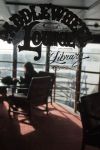
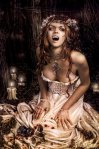
Looking for words in the rabbit hole


Queensland Writers Centre CEO Kate Eltham played the white rabbit, and a bunch of we Alices gave chase: the goal, 30,000 words in three days. Some gathered in Brisbane while others of us, the diaspora of Queensland writers and other interested parties, joined in online, sharing totals and motivational mentions of caffeine.

How liberating to be given permission to abandon all but the most major of priorities in order to devote three solid days to wordage. For wordage was the goal; quality could come later. The aim was to get that story down, or at least a solid chunk of it.

My goal was a little different, though. I’d already hammered out a bit over 90K of a novel, but I had to write and insert a second point of view character to help fill in some gaps, add some suspense and provide some contrast. It’s a fairly brutal story, this one; moments of levity are to be grabbed wherever they can be had!
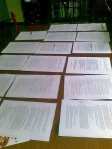
ms pages on a kitchen table

There's a story in there somewhere: grappling with scene progression.

I thought I had eight scenes to write, expecting no more than 1000 to 2000 words for each, and it turned out I had 10 to write, and they amounted to about 11,000 words. It took two days, averaging maybe 500 words an hour. Some of the other rabbit holers did meet their 10,000 words a day quota — w00t!

The third day of the rabbit hole was devoted to smoothing out those new scenes, reconfiguring the existing text to accommodate the new material and ensuring continuity. As is the way of things, a whole new character emerged, with enough legs to play a bigger role in a follow-up should such a thing occur. I’m tempted to call her Alice, in honour of the rabbit hole, but I’ve already got a character with that name tucked away waiting for her chance in the spotlight, so for the moment she’s Felicity because A. she’s felicitous and a felicitator but, ironically, not particularly happy, and B. I still owe two sisters a character named after them after inadvertently slipping an Amanda cameo into The Darkness Within. I have managed to slip in an Alice nod to the rabbit hole, though; I hope it survives to the final cut.

In tribute, here’s a cool clip of the Sisters of Mercy performing Alice, one of my favourite SoM songs and the inspiration for the aforementioned character in waiting. Note: The Sisters are touring with Soundwave Revolution: this is very exciting.

So, three days of fairly solid wordsmithing later, what have I got other than square eyes and a slight case of jetlag?

About 108,000 words of first draft manuscript littered with notes and sporting a most satisfying cross-hatch at the end (the mystical The End only comes when the draft is ready to be subbed — that is truly The End). And the possible beginning for a short story: what could be the second to come out of this universe.

Will the MS go anywhere? Well, that’s always the question, isn’t it? But the story feels good — rough but good — and, regardless, I enjoyed myself in my plunge down the rabbit hole, bumped into some new writers online and learnt some stuff along the way. Would I do another rabbit hole? Most definitely. It’s a three-day trip, man. Just ask Alice.
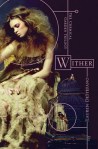
Disparate dystopian adventures: Wither and America Pacifica

Dystopia is hot, especially in young adult fiction where The Hunger Games is probably the leader of the pack. I’ve read two new additions to the field recently, and these two debut novels could hardly be more different.

I don’t normally bother to post negative reviews. I don’t think they do anyone much service, either the book nor the reviewer. After all, most stories will find an audience, and it makes more sense to me to promote good reading rather than deride less satisfactory experiences. Which leads me to Wither, by Lauren DeStefano, with which I’ve made an exception.

wither by lauren destefano

My review is somewhat withering, and I thought long and hard about posting it (in hindsight, I should’ve not used the word bullshit; I do regret any snarkiness). But at the end of the day, the book annoyed me so much, I felt opening the discussion was worth it.

I have three core beefs with the book. The first is in the world building: a shambolic thing, coming across as shallow and ill-conceived and paying little attention to what could have been, and should have been, an examination of a society in which people barely live past their teens. What does this do the economy, to social cohesion, to the very psychology of those living with built-in expirations?

The second source of disgruntlement was in the heroine, a passive creature, admittedly caught in a rough spot but not being proactive enough in trying to extricate herself.

And the third, the thing that really stuck in my craw and induced me to write that dually damning review, was the fact that I just could not get past the fact that this book is built on a foundation of sexual slavery. Not arranged marriage, not some kind of celebrity matchmaking, but slavery; slavery with the apparent purpose of genetic experimentation through procreation. What a dire situation — one existing today — this could’ve been. And as I say in the review, the real pity of it all is that DeStefano can write, and her characters are beautifully drawn and the romantic elements are deftly handled.

america pacifica by anna north

By contrast, America Pacifica by Anna North is a dark, gritty visualisation of a world gone down the gurgler. I had a few qualms with the world building here, also — the story is set on a Pacific island where refugees from a new ice age struggle to retain the vestiges of the civilisation they have lost — but found the heroine engaging and gutsy — there was no romance in the sacrifices she had to make to uncover the truth of her mother’s disappearance — and, most satisfactorily, enjoyed the social examination that North brought to the story. It doesn’t hurt that the final scene is to die for. The full review is here.

Stake Land: getting its point across

stake land vampire movie poster

This is the apocalypse with fangs, indie-style, as envisaged by director and co-writer Jim Mickle. Stake Land tracks young Martin, orphaned by a ravaging vampire, who is taken under the wing of solitary hunter Mister (co-writer Nick Damici). Shotguns, arrows, spears and stakes (no fire) are their arsenal against a zombie-like plague of vampires who have turned the USA and, it is suggested, the world, into a wasteland. The pair have a plan — to drive to New Eden, an idyllic, vampire-free zone (once again, the American fascination with Canada as a haven is front and centre).

Along the way, they pick up passengers including a nun, a pregnant singer and an ex-marine. The group scavenge food and fuel on their way north via a series of fortified towns, which try to maintain the conventions of society amidst the carnage.

A map of America reveals a number of zones of control, each posing dangers to travellers, and none moreso than the realm of the Brotherhood: a fanatical bunch of religious nutters who not only think the vampire plague is a sign of the apocalypse, but revel in it, seeking to make it worse, not better. Rape and murder are their tools of trade and they pose the greatest obstacle to the travellers.

The story meanders a bit, struggling to find a high level of suspense and direct conflict. This is largely due to it being a road journey linking various separate set action pieces which don’t always serve the plot. The characters do make some overly stupid mistakes towards the end. However, it does carry a mood of melancholy and desperation you’d hope to find in such a bleak scenario, and is pleasantly understated — there isn’t too much chatting and the performances are restrained.

Stake Land is a gritty, realistic film where the vampires are very much monsters, essentially zombies with a vulnerability to sunlight and dicky tickers, if you can get a hunk of wood through their reinforced rib cage. The actual rules by which the vampires are created remain obscure, and this does weaken the credibility of the premise a little. While a degree of confusion about the origin of the plague is to be expected in a world gone to hell, and it isn’t necessary within the context of the film, I’d have liked a clear indication as to how the vampirism spreads so I could better appreciate the threat to the characters, who do engage in a lot of hand-to-hand combat.

There is a suggestion that there are different generations — some are too tough to stake and can only be stopped by a stake to the back of the head, for instance — and indeed there is mention of mutations of vampire — some are capable of higher thought, most seem to be little more than animals. But yet, a bite appears to be a likely way of making a vampire, which suggests vampirism as contagion.

But this movie is not about the vampires; in fact, a zombie plague would’ve worked just as well, and there is little difference between the two as depicted here.

No, the sharp end of the flick is aimed at the religious right as Mickle tests society’s thin veneer when it’s brought under stress, and vampires were just a handy critter for some cool effects and fight scenes. All that blood, and there is something cool about an ornery mysterious stranger riding into town and popping a bag of extended canines on the bar, isn’t there?

In some ways, the story has the mood of The Road, but that slice of post-apocalyptic America has far more intensity. Stake Land does, however, deliver a well-acted, good-looking and above-average adventure where the humans can be just as inhumane as the monsters. Tasty, but not overly filling.

Things to do in Melbourne #6: get in the Brunswick Street groove

polly cocktail barMelbourne’s Brunswick Street is one of happening precincts where sub-cultures come together and drink coffee — possibly with soy milk. We had a taste test last night, hitting a couple of hot spots: Brunswick Street Gallery, Polly, Polyster records and books, and Grub Street Bookshop. Ah, kulcha!

The gallery is established in a three-storey house and boasts narrow stairs and two floors of exhibition rooms of varying colour, lighting and space. Last night’s selection of opening exhibits was reasonably eclectic: a photographic display of the zodiac using friends of the photographer and another showcasing the female form in a largely empty room; pop art protests; still lifes perhaps aimed at the cafe set; a projected installation; big photos of kids in cages with A Message; an ode to Kodachrome using a Chinese scene. My favourite showing, though, displayed in a delightfully red room with defunct fireplace where its black and white drawings really popped, was Transform by Hannah Mueller: her pictures had narrative, dimension due the overlaying of cutouts, and lots of skeletons and other repeating motifs, including birds, vivisection and masks. Mueller’s bio, if I remember it accurately, said she was a Sydneysider still at art college or uni, in which case, whoa! Sadly, no web presence that I could find to point you to (I don’t think this Hannah is the one in Assassin’s Creed, though it might explain some stuff!), and the BSG website is kind of obtuse and annoying.

Anyway, within staggering distance of the gallery and on opposite sides of the street are the two Polyster stores, one dealing in alternative books — lots of tattoos and art, social commentary and Interesting Stuff, and the other in alternative cds and vinyl. Nearby is Grub, complete with secondhand bookstore smell and narrow aisles, a minuscule genre fiction section but a truly drool-worthy non-fiction section heavy on the arts and the humanities.

The jewel in the crown of last night’s stroll was Polly. Oh, Polly! With its concrete floor and red velvet couches, its classy nekkid ladies upon the stressed red walls, its funky brass handles on the door of the loos, and its separate smoking antechamber at the front. It offers a fine array of absinthe and cocktails, and the tastiest little $6 pizzas, and pretty darn good service, too. Its decadent lavishness would suggest it to be the natural environment of a goth/burlesque crowd, but I think the hipsters might’ve outpriced them. I haven’t been in town long enough to know the tides of the sub-culture drift. Regardless, it’s a comfy space and one of my favourite Melburnian drinking holes so far.

A Golem Story: here’s mud in your eye

a golem story theatre poster

A Golem Story is playing at the Malthouse Theatre in Melbourne’s Southbank district, and what a grand theatre it is. The Malthouse is a reconditioned industrial building, dating to 1892, with a sensitive touch given to that history. So lots of exposed beams and raw brick and a mezzanine level giving access to one of the theatres. And a long bar (as you’d expect from a former brewery), and a separate coffee counter with scrumptious desserts. And a separate restaurant, which I haven’t sampled. There’s even a typically Melbourne laneway area for those who want to take the air, or pollute it with their noxious nicotine habit. There’s even a wee bookshop with titles theatrical and dramatic.

Golem was staged in one of the downstairs theatres — there are three in total — and the set was spectacular. With seats ranged around three sides of the central stage, the rear wall of slatted timber was fronted by a grid sporting candles. The central stage was a rough timber floor which could be lifted away to reveal a mud hole — just what you need for making a golem.

The play is set, for the most part, inside a synagogue in Prague where the authorities are responding to the disappearance of some children by threatening a purge of the scapegoat Jewish ghetto. The opening scene has a young woman prone under a low-hanging candelabrum that is to die for. It gets cranked up and down by a winch at the back of the stage: it clunks most atmospherically and is one of the few physical props used in the play. At times, light beams through the rear wall to make criss-cross patterns on the floor; a spotlight weaves to show the golem’s location but it is left to the audience to fill in the details of the creature, created by the Rabbi to defend his people.

The aforementioned young lady is the centre of the piece; a rather mysterious woman employed as the maid who has undergone a severe trauma at the hands of one of the Rabbi’s former students who has shuffled off his mortal coil. There is magic and intrigue, and lots of discussion about humankind’s right to create life in the shape of itself a la God, and humour from an almost farcical emperor who is more dangerous than his camp demeanour might suggest. And of course there’s the faithful of the synagogue, primarily the driven Rabbi and his diffident, doubting student.

One of the most striking elements of the play is the music: male choir, at times joined by the young woman (the only female actor), and one over-long solo as actors scramble up ladders to light that impressive wall of candles though the lag — at least for those of us who can’t appreciate the drama of the song due to it being sung in, presumably, Yiddish — perhaps isn’t quite justified by the eventual effect.

The story itself is engaging, thanks to the power of the actors and their splendid singing voices, though there’s a wee logic bounce that, well, despite the explanation, kind of sticks in my throat in much the same way as a stone tablet inscribed with the secret name of God sticks in the mouth of a golem: we both find it hard to swallow. I can’t say more about that because it would ruin the attempted twist in the tale, though really, the twist is not that unexpected. Fortunately, it doesn’t really matter to the overall impact of the story.

Golems rule, okay?

It’s the Murray, darling

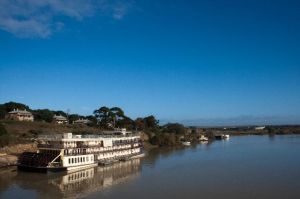
murray princess docked at murray bridge

Murray Princess docked at Murray Bridge

The Murray-Darling river system is the closest thing Australia’s got to the Mississippi, an inland highway paved with muddy water and boasting more chicanes than an F1 circuit. But she ain’t what she used to be. Not only is the river no longer a conduit for transporting people and supplies, but its very future is on the line. At the moment there’s a bunfight going on as four states who have an interest in that watery flow try to work out how they can all continue to profit without either sinking its dependent communities or totally destroying the imperilled environment they rely on. Fortunately, flooding rains that devastated some regions of those states earlier this year have bought the beancounters an extension by refuelling the river, removing the urgency that years of drought and dwindling water supplies had caused.

Last weekend, I got to take a float on a South Australian stretch of the Murray, churning our way by diesel-driven paddlewheeler — the largest in the southern hemisphere, the company boasts — from Mannum downstream to Murray Bridge, where we had a wander through the historic Round House, then upstream to the vicinity of Walker Flat before heading back down to Mannum.

The PS Murray Princess is operated by the Captain Cook line. It was a very pretty boat, built in 1986, with lots of dark timber interiors in its common areas. Our cabin was just big enough: a wardrobe, small ensuite in which I had to stork-bend to get under the shower head, a single bed on either side of the door that opened directly onto the deck, a heating vent in the bathroom that meant barely any blankets were needed, a wee window to let in some cool winter air. Twenty-four hour coffee and biscuits (Arnotts, a once-Australian icon, a little like the river in its riverboat heyday) and refills of drinking water were available in the lounge.

sunset on the murray

The lounge was a lovely space, two floors linked by spiral staircases in timber and brass, and a floor to ceiling window that showed the paddle doing its thing. When the sunlight was right, little rainbows would appear in the paddle’s spray. The ground floor had an unused bar and lots of tables and chairs; the upstairs mezzanine had a library and games box and more tables.

The bar was a small space at the nose, with the actual bar servicing both it and the adjacent dining room, the largest room on the boat. Its chief features were a timber strip down the centre for dancing and a two-sided breakfast bar.

Meals were safely Australian: various meats and veges, pasta and quiche and cheese platter with one lunch, buffet breakfast. Sensational seafood, including grilled barramundi.

The boat was at perhaps two thirds of its 120 passenger capacity and we were the youngest. The complimentary bus to and from Adelaide could’ve been mistaken for a retirement home outing, a veritable bowling alley of grey hair and bald spots when seen from the rear seats. We were surprised by the demographic but the cruise company had better insight: the entertainer was in his seventies, adept at clarinet and electric organ, spicing up the old-time tunes with a touch of Michael Buble and saxophone as the party lights rotated on the mostly vacant wooden dance floor into the early evening.

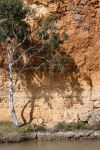
tree on the murray river

The river itself was the star attraction, usually showing one steep set of cliffs on one bank, the other flat land most often given over to agriculture but consistently dotted with towns and small outposts of rather fancy holiday shacks. Holiday houseboats were common, moored like mile markers in the reeds along the banks. At night, our boat would simply nudge its way into a berth and tie up to some handy gum trees — what magnificent specimens those river gums were. We went ashore a couple of times for a closer look. One stroll revealed a midden, canoe trees and the ongoing dysfunction the white middle class suffers in dealing with race relations. We walked away before the compulsion to jab the guide in his jaundiced eye became overwhelming.

The cliffs — they become more dramatic the farther upstream you travel, apparently — were vertical in places, with tenacious saplings sprouting along their bases. They were often dotted with bird nest holes, and circling hawks were common company for the duration of the journey. The birdlife was abundant — ducks, egrets, cormorants, pelicans downstream and black swans, a cheeky willy wagtail who might’ve been a fellow passenger, swallows. The birds were coming back, we were told, after the drought had forced them to relocate elsewhere. Many were still over at Lake Eyre enjoying the big wet.

library on the murray princess

We spent much of the voyage with our laptops and souvenir coffee mugs in the lounge or with a glass in the bar, where the prices were very fair indeed ($12 cocktails, $8.50 Coronas, wine about $8 a glass), making occasional dashes outside to photograph something gorgeous sliding by.

We were fortunate to have timed our flights in a window between the air traffic disruption of volcanic ash clouds drifting in from South America; a number of fellow passengers had brought the train across from Perth or Melbourne, praising the comfort and the food but a bit wary of the swaying motion. No such trouble on the Murray: it has a placid surface, though muddy and dotted with leafy detritus from the recent fresh. You can shower in it, but you wouldn’t want to drink it.

Three nights was probably enough time to spend largely constrained to the Princess’s decks and lounges, but it was a leisurely exploration that empowered laptop time and casual conversation and offered a glimpse of Australia’s history and geography. I’m glad I went, but I’m not checking All the Rivers Run out of the video store any time soon. Though I am tempted to jump ship and read Fevre Dream yet again!

  • More pictures.
  • clouds over the murray river

    Patricia Piccinni’s fantastic body of work

    patricia piccinini vespa sculpturepatricia piccinini sculpture

    And I thought Ron Mueck’s sculptures were amazing…

    And fair enough, they are. But Patricia Piccinni’s work, on show at the Art Gallery of South Australia in Adelaide, blew my socks off. Not only are her sculptures incredibly life-like, right down to the dimples, the hairs in the moles, the subtle blue veins under the skin, but they take us into the future. Strange critters imbued with incredible personality inhabit this vision, a vision largely made in a human laboratory. Cloning and gene splicing are among the issues that Piccinni’s sculptures examine, and most carry more than a hint of melancholy. A purposely spliced pig-like creature carries a litter destined to be spare parts; another creature is made as a breeding ground for hairy-nosed wombats. A young girl plays with over-sized stem cells as though they were blobs of plasticene. Two boys play with a hand-held game machine, but they wear the faces of old men.

    Also in the exhibit are some cool trucks and even cooler mopeds given animalistic life, photography and audio-visual displays.

    But it was the incredible emotion that Piccinni fostered in her fabulous future creatures that elevated this exhibition into the truly remarkable.

    Will we — can we — still love our creations tomorrow?

  • Lisa Hannett also saw the exhibit and describes it with far more eloquence here.
  • Bluegrass Symphony hits the right note, y’all

    bluegrass symphony by lisa hannett

    If you like your spec fic with a Southern flavour — lots of Tabasco, mebbe some grits on the side — then Bluegrass Symphony should hit your literary taste buds. The collection, published by Ticonderoga Publications, is the first from Adelaide’s Lisa Hannett (via Canada — their loss is our gain!) and offers 12 juicy tales set in a faux Southern Gothic setting.

    Hannett, who shared the Aurealis Award for best fantasy short story with Angela Slatter for their co-written ‘February Dragon‘, knows her recipes. There’s just the right amount of fantasy in the dozen shorts here to make a very tasty meal indeed: it all looks very normal but the flavour, it really hits you.

    Bluegrass Symphony an amazingly consistent and accomplished debut, and due out in August. A full review is at ASiF.

    Continuum’s dark fairytale magic

    vampire woman by victoria frances

    Continuum is over, my throat is sore, I’m a little tired: standard convention hangover, then. Kirstyn has a new Chronos award — for Madigan Mine. There was much talk of vampires, fairytales and steampunk. A debate about the pros and cons of immortality…

    In short, it was an excellent con, with long dinners and impromptu panels at the bar, great company, some slivers of inspiration amongst the panels. Catherynne M Valente was an amazingly giving and erudite and witty guest who cut a hell of a rug on the dancefloor. Her comments about reviewing, made during a Writer and the Critic podcast, are worth catching up with.

    Two of the most affecting panels I attended were both, not surprisingly, darkly themed, and I’ll single them out from what was a very strong line-up.

    The first was late on opening night, Friday, and involved the attraction between horror and beauty. Kyla Ward read a superb poem in her inimitable, theatrical fashion; Kirstyn read from her spooky-sexy short story ‘Monsters Among Us’; and Talie Helene lifted the roof with an acapella rendition of a ghost folk song. Discussion was informed and interested and on-topic and reluctant to stop.

    The next morning, Talie and Kyla backed up on a dark poetry panel with Earl Livings and Danny Lovecraft. Kyla blew the room away with an excerpt from ‘The Raven’ and Talie pretty much felled anyone left standing with some truly wrenching World War I poems. Great stuff. And do note that P’rea Press is releasing a collection of Kyla’s poetry later this year!

    In my absence, the last short story I had roaming in the wild found a home — very happy about that! — and Devil Dolls and Duplicates in Australian Horror received a fetching review. Add in a splendid night last night with friends from up north and the good time vibe has definitely lingered…

    We’ve already bought our memberships for next year’s Continuum, which is the natcon and boasts the awesome paring of Kelly Link and Alison Goodman as guests of honour. And then there’s the bid from Canberra for the 2013 natcon (at Anzac weekend) and London’s push for the 2014 Worldcon … Let the good times roll!

    Chronos winners

    (the awards are for Victorian residents)
    Best Long Fiction: Madigan Mine, Kirstyn McDermott (Pan MacMillan Australia)
    Best Short Fiction: ‘Her Gallant Needs’, Paul Haines (Sprawl, Twelfth Planet Press)
    Best Artwork: Australis Imaginarium cover, Shaun Tan (FableCroft Publishing)
    Best Fan Writer: Alexandra Pierce
    Best Fan Written Work: Review: The Secret Feminist Cabal by Helen Merrick, Alexandra Pierce
    Best Fan Artwork: Continuum 6 props, Rachel Holkner
    Best Fan Publication: Live Boxcutters Doctor Who at AussieCon IV, Josh Kinal and John Richards
    Best Achievement: Programming at AussieCon IV, Sue Ann Barber and Grant Watson (lovely to hear these guys pay tribute to the non-Victorians who also contributed to the programming, an awesome effort all-round)

    Note: the amazing Conquilt of signatures is up for grabs on eBay till 20 June.

    Continuum: sex, violence, vampires

    vampire circus movie poster

    It’s almost Continuum time, the great gathering of the clan in Melbourne to celebrate all things speculative and often fictional, and there will be vampires. On Saturday, I’ll be talking sex and the undead with Emily Derango, Narrelle Harris and Peter Marz. On Sunday, I’ll be discussing the role of the rest of the supernatural horde in the ‘vampire circus’ (but are they invited guests, or are they gate crashers?), with a bumper panel of Narrelle, Kirstyn McDermott, Heath Miller and Julia Svaganovic.

    Also on Sunday, I’ll be giving a wee reading, though whether it’s sex from More Scary Kisses or violence from Dead Red Heart I haven’t decided yet.

    The official guests for the convention are Catherynne M Valente, who had most interesting things to say about writing, publishing and moral sensibilities at last year’s Worldcon, and local Dave Freer, who certainly knows his way around the publishing landscape (a sense of direction being a valuable asset when one lives on an island).

    Also worth noting is that A. Friday night attendance is FREE and B. the Conquilt, bearing 100 signatures from Worldcon attendees including, well, all of the folks below, comes up for auction on ebay on Friday night, closing on June 20.

    Alan Baxter, Alastair Reynolds, Alisa Krasnostein, Alison Croggon, Amanda Pillar, Andrew J. McKiernan, Angie Rega, Bill Congreve, Bob Eggleton, Carrie Vaughn, Cat Sparks, Catherynne M. Valente, Charles Stross, China Mieville, Chris Miles (an associate of H. I. Larry), Chuck McKenzie, Cory Doctorow, Deborah Biancotti, Delia Sherman, Dirk Flinthart, Duncan Lay, Fiona McIntosh, Foz Meadows, Gail Carriger, Garth Nix, George Ivanoff, George R. R. Martin, Gillian Polack, Glenda Larke, Grace Duggan, Howard Tayler, Ian Irvine, Ian Nichols, Jane Routley, Jason Nahrung, Jay Lake, Jean Johnson, Jenner, Jennifer Fallon, Jetse de Vries, John Scalzi, Jonathan Strahan, Juliet Marillier, K. A. Bedford, K. J. Taylor, Kaaron Warren, Kaja Foglio, Karen Haber, Karen Healey, Kate Elliot, Kate Paulk, Kathleen Jennings, Keith Stevenson, Kim Stanley Robinson, Kirstyn McDermott, Kyla Ward, Lara Morgan, Leanne Hall, Lisa L. Hannett, Lucy Sussex, Marianne de Pierres, Mary Victoria, Matthew Hughes, Michael Pryor, Michelle Marquardt, Narrelle M. Harris, Nick Stathopoulos, Nicole R. Murphy, Paul Collins, Paul Cornell, Paul Haines, Peter M. Ball, Peter V. Brett, Phil Foglio, Richard Harland, Rjurik Davidson, Rob Shearman, Robert Hood, Robert Silverberg, Russell B. Farr, Russell Blackford, Russell Kirkpatrick, Seanan McGuire, Shane Jiraya Cummings, Shaun Tan, Sue Bursztynski, Tansy Rayner Roberts, Tehani Wessely, Tracey O’Hara, Trent Jamieson, Trudi Canavan.