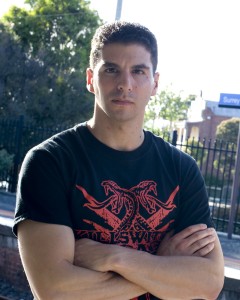
Snapshot 2014: Jason Franks

jason franks by denh layJASON FRANKS is the author of the Aurealis-nominated horror novel Bloody Waters, as well as the graphic novels The Sixsmiths and McBlack. His short fiction has appeared in Aurealis, After the World, Ignition and many other places.
You can find out more about Jason at www.jasonfranks.com or follow him on Twitter at @jasefranks.

 
1. You already had a respectable CV in comics and graphic novels (harking back to about 2005?) before your debut novel, Bloody Waters, hit the shelves in 2012. Was there a reason you got your start in the graphic side of things?

My first published work was actually a prose short story, back in 2001. The sale happened while I was in the process of moving to the States and I was quite preoccupied with that for a while, so I didn’t manage to publish much of anything for several years to follow. I was working on Bloody Waters already, and I more-or-less stopped writing any prose that wasn’t part of that or my other big project at the time. The comics thing started out as a lark – I hooked up with my first artist-collaborator while stuffing around on the internet. In 2005 I found I had enough shorts to self-publish a comic (self-publishing didn’t have the same stigma in comics that it did in prose) and suddenly I was a comics guy. From there I progressed to graphic novels and to editing anthologies. I had no plan, really; I just did whatever seemed like fun.

 
2. You’ve been hitting Supanova and Oz Comic-Con this year. How have you found the experience? It seems to have done good things for your latest collaboration, The Left Hand Path

Supanova and Oz Comic-Con have been great! In 2007, when I returned to Australia, the whole convention scene was really tiny. The shows are still smaller than most US conventions, but attendance is growing hugely. Now we have multiple cons in every major city. The number of people making comics in Australia is growing – it’s really been incredible to watch.

Supanova was a great launchpad for Left Hand Path. Pat from Winter City Productions did an amazing job getting the book in print in time for Sydney Supanova and the response has been really gratifying. The first print run sold out before I even got to see a copy!

 
3. What experience or lessons have you taken from your career so far to apply to your next project/s? What are those projects?
Early on, when I was pitching Bloody Waters, an editor told me ‘I don’t like the story, but I like your prose’. The next editor said ‘I like your prose, but not your story’. I knew that there were always going to be people who didn’t like my stories, but I decided that I never wanted to hear that my prose wasn’t good enough again. So I went back to the woodshed and now … now most of the complaints are about my characters being unlikable. I dunno, man.

Another lesson I apparently have yet to learn is not to take on too many projects at once. Right now I’m working on a multi-genre novel called XDA Zai, a dark fantasy novella called Shadowmancy (coming from Satalyte Publishing in 2015), the second half of The Sixsmiths, five more issues of Left Hand Path, more McBlack, and numerous other small commitments. I have been trying to streamline my workload over the last couple of years, but with limited sucess, it appears.

 
4. What Australian works have you loved recently?
There’s so much amazing Australian work coming out right now it’s hard to narrow down a list. Some of my recent favourites have been Nina D’Aleo’s genre-bending thriller, The Last City; Dirk Flinthart’s ridiculously assured Path of Night; Amanda Bridgeman’s blazing space opera Aurora: Darwin; Jason Fischer’s end-of-the-earth-awesome Everything is a Graveyard; Jason Nahrung’s beautiful and fraught vampire novel Salvage (why thank you, Mr Franks!); Adam Browne’s strange and gorgeous short story collection ‘Other Stories’ and Other Stories; Narrelle M Harris’s hilarious and big-hearted Lissa and Gary novels; Kirstyn McDermott’s Caution: Contains Small Parts … I know I’m missing a lot of good stuff, and I haven’t even mentioned any comics.

I’m currently looking forward to Alan Baxter’s Bound, Jo Anderton’s Debris, Marta Salek’s Reticulum, Andrew McKiernan’s Last Year, When We Were Young and … I have a to-read pile that’s growing like a tumor. A delicious, juicy tumour.

 
5. Have recent changes in the publishing industry influenced the way you work? What do you think you will be publishing/writing/reading in five years from now?

The publishing business continues to be as vexatious and confusing for me as it is for everybody else. Digital digital digital – I think that’s clearly the way it’s all going, given the prices of freight and printing. That isn’t news to anyone, I’m sure. ‘Going digital’ has probably had a bigger impact on my comics work than on my prose, since the various devices change the way that you can tell stories in that medium. I actually think it improves the experience – most comics are created with digital tools now and they just look better on the screen than they do in print.

In five years’ time, I’m sure I’ll still be writing fiction. Novels and comics, most likely. In my day job I work in software, and to me it feels like tech and the creative arts are now really starting to converge. Designers can code now. Coders can design. I have this mad-scientist idea that I would orchestrate something that integrates prose, comics, videogames, music, travel … if I had the time and the funding. The technology is getting cheaper, the bandwidth is becoming available (well, everywhere except in this country). There are already a lot of small operators starting to do this stuff and I’d love to be part of it.

What will I be reading? Everything. EVERY THING.


2014 aussie spec fiction snapshot

* * *

THIS interview was conducted as part of the 2014 Snapshot of Australian speculative fiction. We’re blogging interviews from 28 July to 10 August and archiving them at SF Signal. You can read interviews at:
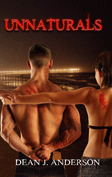
Snapshot 2014: Dean J Anderson

unnaturals by dean j andersonDEAN J ANDERSON began his professional writing career in 2008. Living with his wife and son on the Central Queensland coast in Australia, Dean draws inspiration from striking local landscapes and everyday people. His transformation from avid reader to author is ongoing and one that has seen him come alive within the realms of dark urban fantasy where every character gets their hands dirty. Relationships are multilayered; challenging. Dark urban fantasy is not a genre he set out to choose; he says it chose him. He is a passionate member of the Bundaberg Writers Club. Find him at www.deanjanderson.com.au


1. You’re based in Yeppoon, a place I remember for fish ‘n’ chips on the beach and houses clinging to the cliff. How has that coastal landscape informed your writing, in particular your Unnaturals series?

Sand, salt and water formed the crucible where the spark for Unnaturals flickered into life. Under the stars, sand underfoot, volcanic headland at my back with the rhythm of the ocean resonating deep. From the very first concept draft to the finished novel, that connection flows strong through both the setting and my people… my characters in Unnaturals. Like myself, Mason and his family are never far from water.

Time spent near water always seemed to feed my muse, stimulate ‘What if’ questions and of course provides me with a story setting that I have a deep connection with.

2. The first book of the Unnaturals, your debut novel, came out last year through Clan Destine Press, and as well as being a supernatural romp, it challenges some of the usual gender binaries. Was that a conscious decision or did it flow naturally from the story?

There is a line of dialogue between Nikki and Mason in the very beginning of the novel that shows the level acceptance of the person within the story:

‘Love does not discriminate against sexes and the longer you live the less it cares whether you’re male or female.’ She sat down beside Ruth. ‘You could be one of the few men who would understand this.’

‘It’s not easy.’ He let his eyes wander on her; her small dress flimsy and the whiteness of her thighs highlighted by Ruth’s hand. It was Ruth he desired, not Nikki.

Acceptance of the person plays a powerful role within the story. Sexual plasticity between characters such as Mason’s acceptance and understanding that Ruth, his wife, can love more than one person underpins the power of acceptance of just the person. Not their sexual status.

Same for Ruth: Mason is her rock, accepts who she is, and has no interest in any of her partners. But there is a part of him she has never been able to connect with and doesn’t wish to. This dark part of Mason’s personality is both frightening and exciting for Ruth. More so when she finally meets another woman who craves the darkness within Mason.

As a mainstream modern family unit they would not survive, they never were. The natural progression to a clan-like family structure with intense intimate relationships between two or more characters creates a powerful dynamic. One that will give them a realistic chance at living, loving each other as who they are while protecting their family.

 
3. As you proceed with the remainder of the series, what lessons are you taking from your experience with the release, and writing, of the first?

‘Say more with less’ is something I stick to now. No distractions, like falling in love with a secondary character and going off on a storyline that you write just to feed that obsession. For six months.

Also editors are awesome. Seriously, they do things I cannot with words. Yes, you can argue but I’ve found that by taking their advice and applying it you grow as a writer. Even if the advice makes you scream and hurl objects at the walls, windows and trees. Try it, find a balance and understand it’s not about you. All that matters is the story.

Finally, write a speech for the book launch. Winging it on the back of a stiff scotch only works for the likes of John Connelly, Chuck Wendig and John Birmingham.

 
4. What Australian works have you loved recently?

In the last year I have found myself hooked on sci-fi again with Perth-based author Amanda Bridgeman and her Aurora series. Love her voice, characters and of course the story itself.

The Blood She Betrayed, a gritty Oz YA from Cheryse Durrant rekindled my faith in YA after being battered for years by a flurry of YA merging into paranormal.

Also I have fetish for Oz vampire so I discovered The Opposite of Life and Walking Shadows by Narelle M Harris based out of Melbourne late in 2013. Which led me to RC Daniels from Brisbane, The Price of Fame, not vamp but a wicked paranormal read. Plus hanging for The Big Smoke, the follow-up from Blood and Dust by a Oz writer by the name of Jason Nahrung (cheers, Dean; cheque’s in the mail!).

 
5. Have recent changes in the publishing industry influenced the way you work? What do you think you will be publishing/writing/reading in five years from now?

People love to read, whether it be ebook or hard copy, readers are always looking for their next book. Whether the book be self published, indie or from the big publishers, readers will read what they like. So I write, when I can.

What I write is changing. Started out with dark urban fantasy but my publisher poked and prodded me to develop the flair for erotica I never knew I had. A novella and a series of short stories are now published and more are on the way and … wait for it … a straight, non-paranormal romance is being toyed with, in between the erotica and book 2 of Unnaturals. I like to exercise the muse by writing outside what comes naturally, the muse does protest a lot though …

 
2014 aussie spec fiction snapshot

* * *

THIS interview was conducted as part of the 2014 Snapshot of Australian speculative fiction. We’re blogging interviews from 28 July to 10 August and archiving them at SF Signal. You can read interviews at:

Snapshot 2014: Janeen Webb

Janeen WebbJANEEN WEBB is a multiple-award-winning author, editor and critic who has written or edited 10 books and more than 100 essays and stories. Her short story collection, Death At The Blue Elephant, was released by Ticonderoga in June 2014. Janeen is a recipient of the World Fantasy Award, the Peter MacNamara SF Achievement Award, the Aurealis Award and the Ditmar Award. She holds a PhD in literature from the University of Newcastle, and divides her time between Melbourne and a small farm overlooking the sea near Wilson’s Promontory, Australia. Find out more at her website: janeenwebb.com.au


1. When we spoke two years ago, you had a couple of longer works on the drawing board; Sinbad, an Arthurian work, and an alternative history. How’s progress, or are you on to something different?

Writing is a slow process for me. Since we last spoke I have been concentrating on short fiction. I’ve put a lot of time into my story collection, Death at the Blue Elephant, a mix of original and reprinted stories just released by Ticonderoga. I’ve also written stories for anthologies, most recently ‘Future Perfect’, for Use Only As Directed (ed. Simon Petrie & Edwina Harvey).
I am still digging away at the alternate history, which turns out to be a much bigger project than I had anticipated. The third of the Sinbad books is still on the back burner, though I have not by any means given up on it – there’s a certain amount of guilt about that one. The mooted Arthurian novel remains very much just an idea at this stage.

 
2. What is it about the likes of Sinbad and Arthur that keeps us coming back for more – what is their relevance for, or perhaps resonance with, this current age?

Italo Calvino once remarked that stories live longer than people (and stars live longer than stories). As I see it, the old, archetypal tales are always with us – they inform our culture, and their narrative patterns influence the way we think, the way we write. Sometimes the old stories are camouflaged, but scratch the surface and they are right there. There is a universality about them that functions as a kind of narrative shorthand for storytellers everywhere, allowing us to meld them together into new shapes, new forms.

My own most recent foray into the Arthurian mythos is ‘The Sculptor’s Wife’, the long story that closes Death at the Blue Elephant (and is probably my favourite story in the collection). This piece combines Ovid’s classical tale of Pygmalion with Malory’s Arthurian story of the enchantress Nimue, to produce a truly monstrous modern celebrity: for me, at least, the traditional sources somehow make the story feel right. I guess that’s how the resonance works.


elephant by janeen webb3. In the forward to your debut collection, Death at the Blue Elephant, you remark that your broad travels have informed numerous of your stories. In what way does location influence your stories? What are the things writers on the wallaby should look for?

Writers need to be able to represent perspectives other than their own, and for me it has been travel that has taught me how to look at the world in very different ways. I’ve lived in various countries, and a lot of my stories are set in exotic locations. But the stories are not just about place – they bounce off the histories and mythologies as well as the physical characteristics of their settings: as, for example, ‘Red City’ is located in India’s Fatephur Sikri, but it plays with the legendary predictions of the astrologer who lived there – so the setting is integral to the plot. I couldn’t write it any other way.

There’s an old adage that travel broadens the mind, but it only works if you are prepared to be open minded about it. Too many tourists take their own atmosphere with them, seeing different scenery from an air conditioned bubble that keeps out all the really important things about being in a strange place – the people, the animals, the vegetation; the smells, the sounds, the tastes, the touch – the things that I think make writing come alive. I prefer an immersion approach, to live in another place for a decent length of time, to absorb the sensory input, to engage with a different culture. In other words, to take myself way out of my comfort zone, just for the hell of it.

The downside for writers on the wallaby is that you can never go home again, not really – once you’ve lived outside the cultural box you can never quite fit comfortably back inside it.


4. What Australian works have you loved recently?

I’ve been reading mostly history lately. In genre fiction, the books I have enjoyed most recently are Robert Hood’s Fragments of a Broken Land: Valarl Undead, and Kim Wilkins’ The Year of Ancient Ghosts.

 
5. Have recent changes in the publishing industry influenced the way you work? What do you think you will be publishing/writing/reading in five years from now?

The move to e-books has changed things for me in that I am still writing short stories for anthologies, but because those anthologies are now published in print and e-formats simultaneously the turnaround is faster. The publishing industry is in flux, and it is hard to keep up with all the changes: I honestly can’t begin to guess how things will play out, or what to expect in five years. All I can do as an author is to keep writing the things I am passionate about, produce the best work I can, and seek to place it as best I can when the time comes.
 

2014 aussie spec fiction snapshot

* * *

THIS interview was conducted as part of the 2014 Snapshot of Australian speculative fiction. We’re blogging interviews from 28 July to 10 August and archiving them at SF Signal. You can read interviews at:

Snapshot 2014: Angie Rega

angie regaANGELA REGA is a school librarian who spends her days telling stories and reading to teenagers. She has had long love affair with folklore, fairy tales and furry creatures but often falls in love with poetry. She drinks way too much coffee and can’t imagine not writing. She keeps a very small website here: angierega.webs.com


1. Many of your stories have been based in folklore and fairy tales. What draws you to work with these stories?

Both folklore and fairy tale are as important to me as my morning coffee.

I was raised in migrant story-telling household where nobody finished a sentence in the same language. My grandmother couldn’t read so she would tell us stories. My sister and I were the first people in our family to get a secondary and tertiary education; this was a big deal for us but as the written word took over and so does the language and the world you live in, so much of how I was raised is now forgotten in terms of language and how meaning is made. I think this is why I am still deeply entrenched and in love with that oral tradition that stems from folklore.

Folkore and folk tales contain disappearing histories. Fairy tales delve into experiential archetypes. This is what draws me to these stories, I guess. I go to them for comfort, for understanding, to make sense of the world, and sometimes, just to be entertained.

 
2. In one of your most recent stories, ‘Shedding Skin‘ (Crossed Genres), your heroine and the object of her interest, if not desire, are a shapechanging dingo and crow. Is the idea of transformation important to your work? Ideas of body image and identity are probably things you see often as a school librarian …

The idea of transformation is important to my work. The shedding of skins, feathers and scales appear all deal with, in essence, a return to the true, authentic and instinctual selves. Working as a school librarian I’m also often intrigued at how it is these tales of transformation that draw teens like magnets. I think it is because these tales deal with personal identity and body image in a symbolic and metaphorical way.

Transformation tales are, in essence about deep truths. I guess they keep reminding us to be honest with ourselves. As we get older, this becomes harder and harder to do. Guess that is a benefit of working with teens on a daily basis. They keep you honest, authentic, true and open.

 
3. Your beautiful book The Cobbler Mage came out last year in two languages. In what ways do you find your heritage appearing in your work? Do you have anything similar coming up (what’s next?)?

Thank you for the lovely compliment! The Cobbler Mage came out in English and Italian and may also be translated into French given its setting and subject matter. I was very moved to read the Italian translation of the text because Italian was my first language whereas now I barely use it all. It was a strange experience reading my story back in my first language!

I don’t have anything similar coming up next – I’ve written the first of a series of short stories about ‘totem girls’ and I’m working on a novel that is not speculative but deals with the Australian migrant experience, exile both self-imposed and imposed by another force, and the dispossession of personal memories and reconciliation in family dysfunctional relationships.

Although, having said that, I do have a few stories drafted set within the Cobbler Mage’s world that may get pulled out of the drawer and given a spit-polish.

 
4. What Australian works have you loved recently?
I have loved quite a few stories recently not all speculative but all Australian. My top five for the moment would be:

  • Christos Tsolkias’s novel Barracuda because Tsolkias gives a voice to the Australian migrant experience and reading his work over the years validated my experiences in so many ways.
  • Questions of Travel by Michelle De Krester.
  • Juliet Marillier’s short story collection Prickle Moon published by Ticonderoga Publications.
  • Janeen Webb’s collection, Death at the Blue Elephant, published by Ticonderoga Publications.

  • My dear friend, Suzanne J Willis’s short story ‘No.34 Glad Avenue’, published by Fablecroft in One Small Step which will be appearing in the anthology Time Travel: Recent Trips by Prime Books edited by Paula Guran.
  • And of course, I adore ANYTHING written by the amazing Angela Slatter who writes some of the most lyrically dark fairy tales I have ever read. My favourite collection being The Girl With No Hands.

     
    5. Have recent changes in the publishing industry influenced the way you work? What do you think you will be publishing/writing/reading in five years from now?

    I have tried the e-book thing – as a school librarian it is a great motivator for getting hesitant readers to engage with a book. You know, give them a gadget and they’re sold.

    For me, personally, I am a romantic at heart – my love for books is in volumes (pardon the pun). Bound within that is my love for the three dimensional object the book. I like the way a book smells and how a once very much loved book feels. And I like the fact that if I deeply love a book, and want to say how much I love the story, then I can hold it close to my chest and press it against my heart. Sorry! I am a hopeless romantic!

     
    2014 aussie spec fiction snapshot

    * * *

    THIS interview was conducted as part of the 2014 Snapshot of Australian speculative fiction. We’re blogging interviews from 28 July to 10 August and archiving them at SF Signal. You can read interviews at:
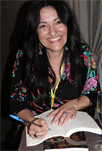
  • Snapshot 2014: Jack Dann

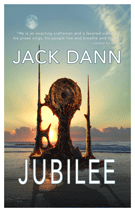
    Jubilee-HJACK DANN is a multiple-award winning author who has written or edited more than 75 books, including the international bestseller The Memory Cathedral. His latest anthology, Ghosts by Gaslight, co-edited with Nick Gevers, won the Shirley Jackson Award and the Aurealis Award. He is the publishing director of the new imprint PS Australia. Forthcoming in August 2014 from Satalyte Publishing is an e-book edition of Jack’s retrospective short story collection Jubilee*: more titles from Satalyte soon to be announced. A collection of Jack’s holocaust stories entitled Concentration will be published by PS Publishing in the United Kingdom. In her introduction to the volume, critic and scholar Marleen Barr writes: ‘Dann is a Faulkner and a Márquez for Jews. His fantastic retellings of the horror stories Nazis made real are more truth than fantasy.’
    You can visit Jack’s website at www.jackdann.com, and follow him on Twitter [@jackmdann] and Facebook.
     

    1. This year marks 20 years since you came to Australia. What has been the biggest change in the speculative fiction scene here over the course of that time?

    Man, 20 years doth go fast! I can hardly believe it. Off the top of my head, I think the biggest change is the general integration of our writers into the international science fiction scene. The relative isolation of the 1990s is gone and the great talents of Australian authors are appreciated as a matter of course.

    The other great change, perhaps the greatest, is technological: the shift to electronic publishing, which affects writers and publishers worldwide. The paradigm seems to be shifting from publisher-pays to author-pays, and many middle-range writers are making even less money than before. And the ‘gatekeepers’ have virtually disappeared: by that I mean that virtually anyone can get published online and in print-on-demand format. However, it has become almost impossible for many of these writers to gain any kind of an audience and be taken seriously.

    Previously writers sent their work to established publishers and in a sense went through an apprenticeship: the traditional journey from form rejections to written notes at the bottom of rejection slips, to acceptance letters … and payment for the work. That’s how many writers over time learned their craft. That’s how I leaned the craft. This kind of publishing certainly still exists and is vital, but it exists within a much larger chaotic environment.


    2. At the national science fiction convention Continuum X in June, you ran a workshop for writers about how to write professional fiction. What’s your top tip?

    I’m going to do a cop-out here because I did a five-minute video for a master class I conducted for the Queensland Writers Centre. It points out what I believe writers need to do to write ‘readable’ fiction. As an old buddy of mine from Louisiana used to say: ‘I don’t chew my cabbage twice.’


    3. With a whole swag of your back catalogue being re-released in digital format by Satalyte Publishing, what’s next for the Dann oeuvre — both as a writer and an editor?

    Well, the wonderful Stephen and Marieke Ormsby are releasing my retrospective short story collection Jubilee with a new cover by Nick Stathopoulos, one of my all-time favourite artists. The next release will be one of my novels: we’re still deciding which one, but the time between releases will be short. To quote Satalyte: ‘Jack is back!’

    And I have a new collection coming out from PS Great Britain, which Pete Crowther bought, called Concentration. It’s a collection of my Holocaust stories with a terrific introduction by author and critic Marleen Barr. How’s this for an extracted quote?:

    In Jack Dann’s Holocaust visions, ‘imagination is used to enrich reality, not to escape from it’. His ‘invented, alternate worlds’ are related to the ones Faulkner and Márquez create. But Yoknapatawpha and Macondo are not Jewish neighbourhoods. Dann is a Faulkner and a Márquez for Jews. His fantastic retellings of the horror stories Nazis made real are ‘more truth than fantasy’.


    4. What Australian works have you loved recently?

    Ah, that’s a loaded question! Okay, most recently read work I loved: The Year of Ancient Ghosts by Kim Wilkins and Black Mountain by Venero Armanno.


    5. Have recent changes in the publishing industry influenced the way you work? What do you think you will be publishing/writing/reading in five years from now?

    Actually, given my responses above, I must say that the fluctuations of the publishing haven’t influenced what I write … or the way I write. I sit with a notebook or a laptop on my lap and try to capture those incandescent images and narratives flashing in my head.

    As to the second part of your question, as you know I’m spearheading PS Australia, an Australian imprint of the UK-based PS Publishing. I anticipate bringing some wonderful work into print in fabulous folio-style slip-cased limited editions.

    As to writing: if all goes according to plan (he says, propitiating all the various gods), I’ll be writing the next book in my Dark Companions series (the first book, in progress, is called Shadows in the Stone). And, man, there’s so much I want to do: stories, novels, collections, anthologies. I do so love this insane, future-shocked business of being an author. It’s like standing on a motorcycle with one foot … and travelling at a cool 150mph!


    * Edit 30/7/14 to remove mention of first e-book edition; a Tor edition was previously published.
    &nbsp:
    2014 aussie spec fiction snapshot

    * * *

     THIS interview was conducted as part of the 2014 Snapshot of Australian speculative fiction. We’re blogging interviews from 28 July to 10 August and archiving them at SF Signal. You can read interviews at:
    Snapshot 2014: Australia’s speculative fiction scene

    2014 aussie spec fiction snapshot
    The Aussie Spec Fic Snapshot has taken place four times in the past 10 years. In 2005, Ben Peek spent a frantic week interviewing 43 people in the Australian spec fic scene, and since then, it’s grown every time, now taking a team of interviewers working together to accomplish!

    In the lead up to the World Science Fiction Convention in London, I will be part of this team blogging interviews for Snapshot 2014: Tsana Dolichva, Nick Evans, Stephanie Gunn, Kathryn Linge, Elanor Matton-Johnson, David McDonald, Helen Merrick, Ben Payne, Alex Pierce, Tansy Rayner Roberts, Helen Stubbs, Katharine Stubbs, Tehani Wessely and Sean Wright.

    Last time, in 2012, the Snapshot covered nearly 160 members of the Australian speculative fiction community – can we top that this year?

    To read the interviews hot off the press, check these blogs daily from July 28 to August 10, 2014, or look for the round up on SF Signal when it’s all done:

    And you can find the past Snapshots at the following links: 2005, 2007,  2010 and 2012.