
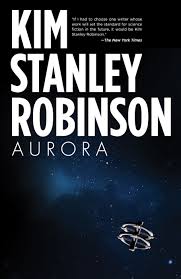
 Aurora (Orbit, 2015) by Kim Stanley Robinson is named after a planet on which humanity hopes to found a colony; it’s a long way away, so far it’s a multi-generational voyage in a time without fancy stasis chambers. Instead, the spaceship, simply called ship, is composed of biomes representing different terrain types on Earth, big enough for lakes, glaciers, forests, critters of all kinds. Maintaining the balance of inputs and outputs necessary for agriculture — for life — occupies much of the humans’ time, in cooperation with a quantum computer. Starvation is never far from the horizon. It’s a delicate see-sawing balance, both scientifically and socially.
Things don’t go to plan, of course. And while I can’t reveal too much, it’s not spoiling things to say the colonists have decisions to make about the best way forward — or backward, even.
The first section, detailing the trip and the travails to Tau Ceti, is told in the third person centred on a young girl, Freya. The central story is narrated by the computer, allowing a great deal of info dumping — mostly painless — leavened with humour as the AI grows. It also allows scope for commentary on human foibles, one of the delights of the story. The final scenes are again in our protagonist’s viewpoint, reflecting on Freya’s experience, on the space program, on humanity.
There is a singular moment, a single line of description relating to ship, that defines the power of KSR’s prose, but I can’t repeat it here, because spoiler. It is beautiful, poignant, pragmatic, elegant. It made me love this book.
This is the first KSR book I’ve read — I know, I know — but based on this, it won’t be the last. Note even dubious amounts of repetition in the text can overshadow the deft handling of technical terms and processes; the sheer imagination that manages, mostly, to keep humanity at its centre, even when ship is narrating at some emotional distance.
KSR has something to say, and for the most part he says it well.
For me, Aurora is not just a superbly unromantic story of space colonisation, but also an allegory — would ship agree, I wonder, given its interest in metaphor and the like? Hell, maybe it’s not even — best summed up by this translation of a poem that captures the attention of two characters, talking to how we need to look after this world as man-made climate change threatens to radically change our biome, how we are ‘kleptoparasites’, stealing from our descendants:
‘There’s no new world, my friend, no
New seas, no other planets, nowhere to flee–
You’re tied in a knot you can never undo
When you realise Earth is a starship too.’

