Moira Finucane, does it again

glory box la revolucion


The milk was good, but it was the tomato sauce that took the prize.

There on Collingwood’s Melba Spiegeltent catwalk, Moira Finucane in a white gown, tearing out her heart — only her heart was a family-size bottle of tomato sauce, dribbling and spurting in time with her anguish. Exit to Hollywood blonde Clare St Clare taking that dripping container while singing Blue Velvet.

Yes, it’s Finucane & Smith, strutting their art — some new, some old — in Glory Box La Revolucion (until 13 September 2015).

The troupe provide about 90 minutes of entertainment: another highlight, one of the best covers of Bowie’s Wild is the Wind you’ll ever hear, by Mama Alto accompanied by piano.

That same piano that keeps our table, only a row back from the catwalk, safe from flying milk as Finucane empties two 2l bottles over plastic-wrapped audience, self and stage in wild abandon.

Elsewhere, she’s nude under witchy fingernails and black diaphanous cape, and rockin’ it out to Garbage (if memory serves) in jeans and leather jacket with St Clare.

There’s acrobatics involving chairs, rope, trapeze, cork screw … this is 18+ wine drinking. A bewigged industrial thrash dance. A song about more than coffee in Paris, an ooh la la to equality and respect.

Boobs, chuckles, politics, art: always entertaining. All in the luscious surrounds of the Spiegeltent with its Innocent Bystander pinot noir at the bar.

The card on the table tells us that Finucane & Smith are heading off to Cuba and may be some time. NO, we say. For all that we’ve seen of Moira Finucane, we still haven’t seen enough.
Melba Spiegeltent at Collingwood

SIDE DISH

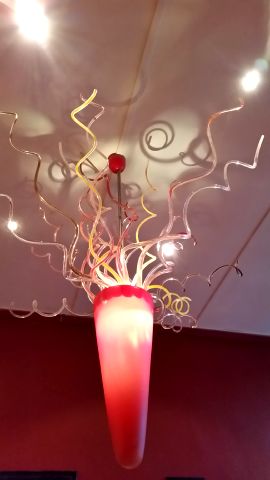
lamp at savanna ethiopian eritrean restaurantBefore the gig, we had dinner at Savanna, an Ethiopian and Eritrean restaurant. Check out this funky ceiling lamp! Check out the delicious menu — we shared a platter of various veg and meat with injera for $45, washed down with organic Ethiopian shiraz at $6 a glass, and walked out pleasantly stuffed. Highly recommended.

Ballarat International Foto Biennale (BIFB): a quick snap

Home by Nightfall, by Angela Bacon-Kidwell

Home by Nightfall, by Angela Bacon-Kidwell

The Ballarat International Foto Biennale officially opened on Saturday night — pizza, wine (Langi Ghiran, no less! oh so noms) and a whole lotta people checking out the exhibits in the Mining Exchange.

We managed to roll two other venues on Saturday — one before and one after. The first was Stacey Moll‘s ‘Frankenstein Atomic Frontier’ at wonderful comic shop Heroes HQ (darn, the latest Saga trade isn’t out yet) — I particularly like a gloomy alley shot of a woman with book, like an urban mage with grimoire. The second was ‘Silver’, by a collective of non-digital aficionados, which included some nice black-and-white industrial decay, hosted at Sebastiaans, the cafe, which included a pretty decent fisherman’s basket.

There are about 80 venues this year, many of them eateries — you could easily put together a food tour based on the exhibits.

My favourite so far, at the Mining Exchange: ‘Home by Nightfall’, an exquisite narrative of dust, sunlight and birds from Texan artist Angela Bacon-Kidwell, in which she reflects on her emotional journey during her father’s fatal illness. Also striking, some of the refugee photos from Maltese news photographer Darrin Zammit Lupi — incredible captures, brimming with emotion.

We moved to Ballarat in time for the previous biennale, and found it an intriguing way to explore the town. We hope to spend a few more days this time around. Sadly, we missed out on participating in the ‘Ballarat Through My Eyes’ contest, because it runs in the lead-up to the biennale itself. The event asks photographers to present photos in three categories taken in the Rat — bit of a treasure hunt! Maybe next time.

The biennale goes until 20 September 2015. Look for the biennale lens logo outside venues, or check the website for who’s got what. Amazingly, most of the exhibitions, as was the opening-night shindig, are free.

Aurora: Earth is a spaceship too

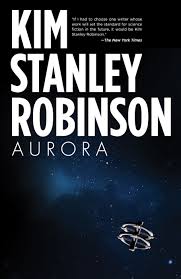
aurora by kim stanley robinsonAurora (Orbit, 2015) by Kim Stanley Robinson is named after a planet on which humanity hopes to found a colony; it’s a long way away, so far it’s a multi-generational voyage in a time without fancy stasis chambers. Instead, the spaceship, simply called ship, is composed of biomes representing different terrain types on Earth, big enough for lakes, glaciers, forests, critters of all kinds. Maintaining the balance of inputs and outputs necessary for agriculture — for life — occupies much of the humans’ time, in cooperation with a quantum computer. Starvation is never far from the horizon. It’s a delicate see-sawing balance, both scientifically and socially.

Things don’t go to plan, of course. And while I can’t reveal too much, it’s not spoiling things to say the colonists have decisions to make about the best way forward — or backward, even.

The first section, detailing the trip and the travails to Tau Ceti, is told in the third person centred on a young girl, Freya. The central story is narrated by the computer, allowing a great deal of info dumping — mostly painless — leavened with humour as the AI grows. It also allows scope for commentary on human foibles, one of the delights of the story. The final scenes are again in our protagonist’s viewpoint, reflecting on Freya’s experience, on the space program, on humanity.

There is a singular moment, a single line of description relating to ship, that defines the power of KSR’s prose, but I can’t repeat it here, because spoiler. It is beautiful, poignant, pragmatic, elegant. It made me love this book.

This is the first KSR book I’ve read — I know, I know — but based on this, it won’t be the last. Note even dubious amounts of repetition in the text can overshadow the deft handling of technical terms and processes; the sheer imagination that manages, mostly, to keep humanity at its centre, even when ship is narrating at some emotional distance.

KSR has something to say, and for the most part he says it well.

For me, Aurora is not just a superbly unromantic story of space colonisation, but also an allegory — would ship agree, I wonder, given its interest in metaphor and the like? Hell, maybe it’s not even — best summed up by this translation of a poem that captures the attention of two characters, talking to how we need to look after this world as man-made climate change threatens to radically change our biome, how we are ‘kleptoparasites’, stealing from our descendants:

‘There’s no new world, my friend, no
New seas, no other planets, nowhere to flee–
You’re tied in a knot you can never undo
When you realise Earth is a starship too.’

  • A review copy of Aurora was provided by the publisher. You can read an excerpt here.
     

  • Sense8: feeling the love

    sense8 posterThe Netflix show Sense8 has been called slow and clumsy, but for me, it’s a must-see.

    The globe-trotting 12-episode first season marks a coming together of Babylon 5 maestro J Michael Straczynski and the Wachowski siblings, who upped the action ante with The Matrix.

    It tracks the lives of eight people who are psychically linked, the link activated by the death of a character played by Daryl Hannah.

    They are, briefly:

  • A Kenyan with a Jean Claude Van Damme fixation running a bus in Nairobi and trying to make enough money to buy life-saving medication for his HIV-infected mother
  • A DJ in London, who runs afoul of criminals and returns to her native Iceland
  • A safe cracker in Berlin who didn’t get on with his dad, at all
  • A banker in Seoul who also specialises in martial arts, a good outlet for the frustration of being a daughter in a son’s world
  • A scientist in Mumbai who prays to Ganesh and is engaged to the perfect man, but does not love him, despite sharing a tendency to break into Bollywood
  • A macho actor in Mexico City, trying to hide the fact he is gay for fear of damaging his career
  • A Chicago cop whose dad is also a cop, haunted by a problematic case
  • A San Francisco trans woman, whose mother insists on calling her Michael still and is well versed in hacking and blogging.

    There is also an enigmatic sensate who is able to offer some oversight and insight of their predicament.

    Some, admittedly, are more interesting than others. Each has their own concerns, some seemingly more potentially lethal than others, but all are gradually pulled into a communal fight for survival nominally against a scientific cabal looking to restrict their freedom.

    Only Kala in India still has, it appears, interaction with both parents. Many have lost a parent; several have siblings. Only two have supportive partners, neither of whom are hetero (not including Kala’s fiance). Attraction blooms among some in the group, but all feel it — they feel more or less everything, in fact, although the why and the when is a little muddy.

    The acting is superb, which helps maintain interest as the story takes its own delicious time to introduce its cast and its concept. And the production shows an impressive use of resources and editing as the characters share feelings and sensations across the globe, cross-inhabiting each other’s beautifully, indulgently shot locations. Characters share an orgy at one point, but also combat, fast cars (there is a San Francisco fight-chase sequence that is remarkable as the sensates lend a hand), and the simple pleasure of a piano recital.

    This latter brings to stark relief one of the highlights of this show, and the reason that, despite the blips, I’ll be lining up for season 2: not since Treme have I been affected by such displays of honest emotion — such empathy. As my wife noted when we were talking about this, when was the last time we saw a male character cry unabashedly out of sheer joy?

    Sense8 should win awards for editing, for sure; a well as the shared-space scenes, the transitions between scenes is often deft. But it’s the pleasure of the slow immersion, the unveiling of story and character, and that pure emotion that has me hooked. It will be interesting to see if it is, like Treme, as affecting on rewatching. For now, though, bring on season 2.


  • Aussie Year’s Best Fantasy and Horror announced

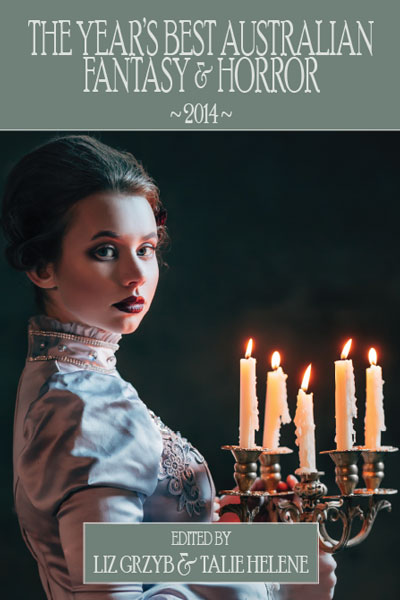
    years best australian fantasy and horror 2014Ticonderoga Publications has announced the line-up of its latest Year’s Best Australian Fantasy and Horror28 stories from 2014, curated again by Talie Helene and Liz Grzyb, to wrap your eyes around and fire your imagination. Or something like that.

    I’m thrilled and giddily surprised to find ‘The Preservation Society’, originally published in the first issue of Dimension6, among the selections. Vampires in Cairns, an exploration into one of the minor characters in my novel Blood and Dust. Hell yes, I’m chuffed.

    There’s some great reading in this volume — I’m particularly pleased to see ‘Shedding Skin‘ by Angie Rega in this line-up, one of those yarns that ticked all my boxes. The collection is due out in late October — OOH, HALLOWEEN! — but can be pre-ordered right now.
     

    Sunshine, darkness and the people we meet

    in sunshine bright and darkness deepThis book arrived in the post yesterday. In Sunshine Bright and Darkness Deep: An Anthology of Australian Horror collects short stories from 14 members of the Australian Horror Writers Association. “If you are unfamiliar with Australian horror, let this book be just the first step on a long voyage of dark discovery,” the blurb says.

    The anthology contains a reprint of my story ‘Triage’, from 2005 — the only reprint in the book. I offered ‘Triage’ because it’s a special story to me, and it had only a limited airing on first printing, in sf-envision, a magazine printed by Fantastic Queensland that came out of the EnVision writers workshop run in 2003 and 2004 in Brisbane.

    It was at this workshop that I largely met the people who would form the Writers on the Edge critique group, who remain good friends even though my departure from Brisbane spelled the ultimate end of the critique meetings. Some of us still share stories online.

    It was also where I got to know the tutors, and these industry contacts have become friends over the years: like minds, generous spirits.

    The message here: go to workshops, improve your craft, never stop learning, meet people. Be kind to one another. Pay it forward.

    sf-envision‘Triage’ is also important because it mined the death of a close friend; it tried to give him, on some ultimately inadequate level, what the story’s hero, Nosplentyn, tries to do for the dying patient: a memorial of the heart and mind. Nosplentyn, a name coined by one of my roleplaying game mates and used with his blessing, is a prototype for the Needle in my Vampires in the Sunshine State books. He has changed much, as have we all.

    We in the Edge Writers have since lost one of our own. Nea has a story in sf-envision, an excerpt of her then work in progress that, sadly, never saw publication. We hold them in our memories, these ageless loves, and the words take us back to them and the times we shared.

    So ‘Triage’ is both sunshine and darkness, a touchstone for bright memories and dark ones. It seemed to fit for the AHWA’s book. Bon voyage.

  • In Sunshine Bright and Darkness Deep is available* from Amazon.
    * ADDENDUM: the book is officially launched 18 September. Its appearance on Amazon beforehand was to allow contributor copies to be sent out. But, y’know, wishlist away!
     

  • A Girl Walks Home Alone at Night: a worthwhile stroll

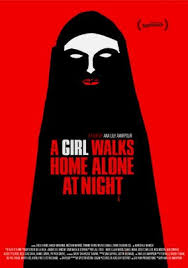
    girl walks home alone at nightIt doesn’t surprise that director Ana Lily Ampour, a Britain-born Iranian, grew up in the US: this debut feature film is steeped in Western celluloid, to the extent of a laugh-out-loud use of Leone-like soundtrack at one point.

    A Girl Walks Home Alone at Night (2014) might be set in Iran, or it might be set in Detroit (based on Ampour’s graphic novel, it was shot in California): its desolate streets and industrial backdrops and urban decay, a single crowded drug-fucked nightclub, bring to mind Jim Jarmusch’s Only Lovers Left Alive (reviewed here).

    The hero (Arash Marandi), or at least the protagonist — it’s hard to find heroism in a drug dealer — is a James Dean lookalike, though this rebel has a cause: to get out of ‘Bad City’, where his father is an addict and his horizon is strictly limited.

    Enter the titular heroine (Sheila Vand) — her hajib used to effect in one of the black-and-white flick’s best set pieces, skateboarding down a night-lit street, cloth flying cape-like. There’s a degree of feminist bent to our vampire; also loneliness and likely boredom, enlivened by pop music and the occasional murder.

    Part of the joy here is in the interaction: the actors convey much with little conversation; the quiet here is engrossing. The performances of the leads in particular are quite wonderful. Combined with the cinematography, that’s plenty of reason to check this out right there.

    The movie lacks the subtext of Lovers, the narrative cohesiveness, but it’s a stylish genre-clash and an affecting movie, well worth visiting for some arty pastiche of east meets west.

    Bell Shakespeare’s Hamlet: what a sweet prince this is, or, the award for best use of condoms in a Shakespearean play goes to:

    Hamlet-webOh my bard! I caught the two-and-a-half-hour epic that is Bell Shakespeare‘s Hamlet at the Melbourne Arts Centre last night, and I’m still reeling.

    One of the best Shakespearean productions I’ve seen? Without a doubt.

    The set design: a facade of doors and windows, shakily climbable, splits the stage. Behind this lit window, a spy, replaying dialogue just heard behind another, as the new king keeps an ear on his fellows. Behind this one, the boudoir. Look, the bed becomes a grave, Yorick! With dirt for the shovelling, a pit for fair Ophelia, complete with toe tag after she is wheeled in in a wheelbarrow. And see here, how the theatre bunting can lose some letters and have others changed to present a far more telling dramatic title! Best use of condoms in a Shakespearean play!

    The lighting, used to highlight the areas of the drama, whether by spotlight or torchlight or flickering wall lights, was sensational. One dramatic front-lit Dracula-like moment still blazes in my mind. Underpinning that, the music, just touches of thriller bass or gay song to enhance the mood, or the sound of rain, or the sound of fighter jets doing a flypast.

    Here a mobile phone captures a moment; there, an electronic listening device is disabled or revealed. And here, it’s halberds and foils, and the ensemble sharing a king’s joke as he dons a player’s crown.

    And here’s the thing of it, the thing that really elevated this production: the acting. Not just in delivery and emotion, and there was plenty of emotion, but in the interplay. In the interpretation of the lines. Bawdiness. Cheekiness. The use of repetition to telling effect. The use of props to add context to the lines, to illuminate character — the play with said condoms between Ophelia and Laertes as he prepares to leave at the airport (with Rosencrantz and Guildernstern hailed over the PA in the background!), the sister-brother relationship anchored around their doomed father. The physicality: Ophelia (Matilda Ridgway, divine), only days in to the play’s run, already sports scrapes and bruises revealed by her dishevelled night dress.

    They play them well (better than well; I love that to be fit to receive a guest still in her a nightrobe, Doris Younane’s Gertrude first slips on her shoes, then transforms her hair), but it is Hamlet’s show, and Josh McConville is amazing, physically and emotionally, seamlessly switching from rude imp to avenger to distraught son. Bravo!

    Hamlet plays at the Arts Centre till July 25.

    Vampires on the radio

    the big smoke by jason nahrungEarlier today I chatted with ABC Ballarat 107.9’s Prue Bentley about Australian vampires, fast cars — and how freakin’ cold it is!

    Producer Gav McGrath has posted a (stammer-free!) summary of the radio broadcast here.

    It’s taking two of the things I love – the Australian landscape, and vampires and the gothic more broadly – and trying to make them fit together

    The Dangerous Bride, by Lee Kofman: sex, love and belonging

    the dangerous bride by lee kofmanThe Dangerous Bride (MUP, 2014), by Lee Kofman, is a memoir of exploration: of relationships, of place, and of self. It’s candid but polite, and the prose shines with description and metaphor.

    It tells Kofman’s story of, as a child of Russian Jews, coming to Australia via Israel. In Tel Aviv, her generation of young people lived life as though there was no tomorrow, because in a land of bombs, that was the case.

    Melbourne was a sanctuary, with its bookshops and cafes and galleries — once she’d got the courage to explore, English not being her native language and the city filled with strangers. (The Dangerous Bride is her first book in English.)

    Overtaken by wonder, I vigorously, like a young horse, clacked my platform shoes upon the wide, friendly sidewalks. The public transport that operated during Shabbat, the cheap sushi, the absence of cockroaches — all these luxuries the locals took for granted filled me with joy. I was amazed at how in Melbourne even police cars drove by quietly. After a while, whenever their sirens did sound, I no longer thought about bombs.

    Kofman’s exploration of Australian society and landscape is a strong vein in this memoir, but the focus is on her sexual identity: is it possible to have a successful non-monogamous relationship? She gets caught up with an Israeli known in the book simply as J, who chases easy money in property and business. Escaping him, Kofman ends up with Noah: they have a loving marriage but one lacking in intimacy.

    Australian women writers challenge 2015Kofman turns to ‘famous dead people’ for inspiration: Anais Nin (the movie Henry and June was a watershed for her), HG Wells, Iris Murdoch. And she travels, to interview swingers, ‘hunters’ (couples who pick up sex partners), polyamorists, open marriages. She’s looking for the key to maintaining a relationship while still satisfying all-round needs of desire, intimacy, identity.

    The book shifts, the chronology of her time in Australia, the changing relationships and eventual second, stable marriage interspersed with flashbacks to relationships past. In particular, the awkward relationship with J takes some unravelling. There is room for rumination on the nature of love and relationships, society’s expectations versus natural impulse. She analyses the non-monogamy of others, looking for the reasons of success or failure, and trying on the templates to see which one best fits her experience. She visits modern social theorists, elements of her academic studies shining through. Arthur Rimbaud’s contention that the poet ‘consumes all the poisons in him’ is a theme.

    The honest self-awareness of Kofman’s voice makes this an engaging journey of exploration, at the end of which Kofman has found a comfortable understanding with her new country and — at least for now — her new love.

  • This review is part of my commitment to the 2015 Australian Women Writers Challenge.