Bluegrass Symphony hits the right note, y’all

bluegrass symphony by lisa hannett

If you like your spec fic with a Southern flavour — lots of Tabasco, mebbe some grits on the side — then Bluegrass Symphony should hit your literary taste buds. The collection, published by Ticonderoga Publications, is the first from Adelaide’s Lisa Hannett (via Canada — their loss is our gain!) and offers 12 juicy tales set in a faux Southern Gothic setting.

Hannett, who shared the Aurealis Award for best fantasy short story with Angela Slatter for their co-written ‘February Dragon‘, knows her recipes. There’s just the right amount of fantasy in the dozen shorts here to make a very tasty meal indeed: it all looks very normal but the flavour, it really hits you.

Bluegrass Symphony an amazingly consistent and accomplished debut, and due out in August. A full review is at ASiF.

Continuum’s dark fairytale magic

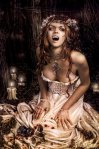
vampire woman by victoria frances

Continuum is over, my throat is sore, I’m a little tired: standard convention hangover, then. Kirstyn has a new Chronos award — for Madigan Mine. There was much talk of vampires, fairytales and steampunk. A debate about the pros and cons of immortality…

In short, it was an excellent con, with long dinners and impromptu panels at the bar, great company, some slivers of inspiration amongst the panels. Catherynne M Valente was an amazingly giving and erudite and witty guest who cut a hell of a rug on the dancefloor. Her comments about reviewing, made during a Writer and the Critic podcast, are worth catching up with.

Two of the most affecting panels I attended were both, not surprisingly, darkly themed, and I’ll single them out from what was a very strong line-up.

The first was late on opening night, Friday, and involved the attraction between horror and beauty. Kyla Ward read a superb poem in her inimitable, theatrical fashion; Kirstyn read from her spooky-sexy short story ‘Monsters Among Us’; and Talie Helene lifted the roof with an acapella rendition of a ghost folk song. Discussion was informed and interested and on-topic and reluctant to stop.

The next morning, Talie and Kyla backed up on a dark poetry panel with Earl Livings and Danny Lovecraft. Kyla blew the room away with an excerpt from ‘The Raven’ and Talie pretty much felled anyone left standing with some truly wrenching World War I poems. Great stuff. And do note that P’rea Press is releasing a collection of Kyla’s poetry later this year!

In my absence, the last short story I had roaming in the wild found a home — very happy about that! — and Devil Dolls and Duplicates in Australian Horror received a fetching review. Add in a splendid night last night with friends from up north and the good time vibe has definitely lingered…

We’ve already bought our memberships for next year’s Continuum, which is the natcon and boasts the awesome paring of Kelly Link and Alison Goodman as guests of honour. And then there’s the bid from Canberra for the 2013 natcon (at Anzac weekend) and London’s push for the 2014 Worldcon … Let the good times roll!

Chronos winners

(the awards are for Victorian residents)
Best Long Fiction: Madigan Mine, Kirstyn McDermott (Pan MacMillan Australia)
Best Short Fiction: ‘Her Gallant Needs’, Paul Haines (Sprawl, Twelfth Planet Press)
Best Artwork: Australis Imaginarium cover, Shaun Tan (FableCroft Publishing)
Best Fan Writer: Alexandra Pierce
Best Fan Written Work: Review: The Secret Feminist Cabal by Helen Merrick, Alexandra Pierce
Best Fan Artwork: Continuum 6 props, Rachel Holkner
Best Fan Publication: Live Boxcutters Doctor Who at AussieCon IV, Josh Kinal and John Richards
Best Achievement: Programming at AussieCon IV, Sue Ann Barber and Grant Watson (lovely to hear these guys pay tribute to the non-Victorians who also contributed to the programming, an awesome effort all-round)

Note: the amazing Conquilt of signatures is up for grabs on eBay till 20 June.

Emerging Writers Festival: the fun ‘slide’ of writing

Finally dragged my carcass down to the Emerging Writers Festival last night, thanks to Kirstyn being on a panel about speculative fiction and then the urging of EWF party animal Alex Adsett to see Not Your Nana’s Slide Night.

The panel went well if quietly, moderated by Rjurik Davidson with Alison Croggon (her Gift still ranks as one of my favourite fantasy books), Kirstyn and Paul Haines (his Last Days of Kali Yuga collection is out now, get it while you can because the publisher has folded*). There was talk of breaking taboos and other-worldly examinations of our own, and process. Apparently, Twitter commentaries are the new meter of popularity (?) for events: certainly, they illustrate how different people will home in on different things, and hear them differently.

The slide night at the Trades Hall, complete with bar, was a cracker. Nine writers talked to a series of 20 slides, each slide on screen for 20 seconds, and the diversity was wonderful and entertaining indeed. A dry-witted introduction to Scotland, a crayon-ish exploration of a small town devoted to museums (lost clothing, body discardations, bicycles in a bus masquerading as a museum of transport), a holiday in Barcelona bouncing off America’s Next Supermodel, Indian food, suggestions for what should’ve been Melbourne’s Fed Square, drawings from time spent in Asia… and so on. Some funny, some poignant, some informative: all entertaining. I mentioned there was a bar, didn’t I? A superb locus for the atmosphere of the event.

Folks we met were rapt in how egalitarian and warm the festival has been (it’s not over yet) and I saw plenty of evidence of that (good luck with that SF novel, Trish; with that creative writing course, James); I really must make the effort to get to more events next year and enjoy the bonhomie.

Last Days of Kali Yuga by Paul Haines* There a reported 300 copies of Kali in the wild. Look to a bookstore near you. The good news is, for those with an e-reader, the book is available in e-format (Amazon, Smashwords, et al)! This is Haines’ third collection, it includes the awesome novella Wives and a despairingly good new yarn about a man on a bridge with a child. I thought I’d be able to flit through the collection quickly, having read his previous two, but his writing just won’t let you do that. You read one par, then two, and then you’re stuck, dragged into a very human story with just the right amount of fractured reality to entrance and bedevil.

Gaiman’s Batman and two Kings: 20th Century Ghosts and American Vampire

A quick round-up of some recommended recent catch-up reading:

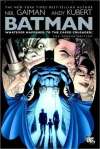
batman caped crusader

Batman: Whatever Happened to the Caped Crusader? (DC, 2009), written by Neil Gaiman, pencilled by Andy Kubert. Batman has always been my favourite superhero. There were others I enjoyed, but it was the Bat who’s stayed with me since the 1970s when I scoured the secondhand book stores for the Murray Comics’ collected issues of Batman and Detective. There’s something about him: the peak — maybe a little over the peak — of human excellence, but human. Using intelligence as much as brawn — the detective bit gets lost too often these days — and battling with that famous crime-fighting obsession. The battle between Bruce Wayne and Batman — who’s the real disguise here? It’s all so Gothic …

Gaiman tackles a bunch of this stuff in this tale, anchored around a funeral for Batman at which he is a ghostly observer and some of his greatest foes provide requiems. Catwoman features, naturally, another simply human (even with uber athleticism and kitty affinity) character with the most simple of motivations: she’s just a thief with a desire for a keen, bloodless getaway. The unresolved sexual tension is front and centre here.

Kurbert has risen to Gaiman’s challenge of capturing some great styles of past artists in the mini-stories. It’s a superbly realised tribute to the Dark Knight. The deluxe issue contains four other Gaiman Batman-universe stories, but for me, anchored in the black-and-white art of the ’70s, these don’t fly as high as the core collection. My pick would probably be the Poison Ivy origin story — a lovely, morally ambiguous villain — though the art isn’t quite to my taste.


American Vampire

American Vampire (Vertigo, 2010), Scott Snyder and Stephen King, drawn by Rafael Albuquerque. Stephen King weighs into the bloodsucker graphic novel ouvre in Snyder’s project about, well, an American vampire born in the outlaw times of the Wild West. The aim was to put the nasty back into the vampire genre and it succeeds well, givin’ them crusty ol’ Euro-vamps a taste of American independence. It casts the vampire as villain and gives the law back its star: not as camp as the film Billy the Kid vs Dracula, and with an air of old-fashioned values being dusted off. Vampires, vengeance, six-shooters: it’s entertaining stuff. Compare and contrast to the excellent Vamps, a 1996 Vertigo graphic novel penned by Elaine Lee, which tells the tale of a group of female biker vampires wanting to break free.


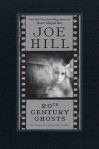
20th Century Ghosts by Joe Hill

20th Century Ghosts (William Morrow, 2005), Joe Hill. Joe Hill is Stephen King’s son, and he’s learnt a lot from his old man. Namely, character and voice. This collection of short stories is hugely entertaining, a real tour de force of style, most (but not all) using supernatural elements to put the pressure on. ‘Best New Horror’ is a gripping opening with its clever meta elements and ‘Abraham’s Boys’ visits vampire lore in an intriguing fashion. ‘The Cape’ is deliciously nasty, others hit the melancholy mark, one had me laughing out loud. A very few left me unsatisfied, belonging to the vignette camp whereby there is meagre beginning, mostly middle and no real end, but always the characters are spot-on. I still can’t believe it took me this long to get to this collection …

Gary Numan’s Pleasure Principle electrifies Melbourne

pleasure principle album by gary numan

Gary Numan: synth pioneer and resurrected man. And loving it.

Numan rose to fame at the head of the 1970s electronic music wave, then fell from grace as grunge and rock and other stuff took centre stage. And then the power of the synth was reharnessed and Numan rose again: heavier, darker and — if a packed house at Melbourne’s Forum is anything to judge by — once more hugely popular.

Last night’s gig showcased the past and the present. It opened with a playing of tracks from the album The Pleasure Principle, released in 1979 and the first by Numan as a solo artist. Numan took the centre console last night with two others also on keys plus a drummer and bass, and it was the rhythm section who underpinned the evening with their massive, um, rhythm. Add three or more layers of synth bass and soundscape over that and there were times when it felt as if the music was reaching inside to rip out lungs. Having a fake night sky arcing over the Forum’s faux ruins with Greek gods in attendance just made some of the tracks all the more surreal as the synths soared and the drum-bass combo thundered.

The album was put to bed with its hit single, ‘Cars’. A quick transition and two keyboards have been put to bed: Numan had the mic and there was an electric guitar and a gorgeously heavy rendition of ‘Down in the Park’ indicated a change of gear. That was then, this is now: great blasts of modern-day Numan, heavy on the Jagged album, brought the crowd and the gig alive as nostalgia was blown out the windows. Almost. The last tune of the main set was ‘Are Friends Electric?’ and oh, the answer had to be yes, or at least, at this point in the night, electrified. A three-song encore finished it off nicely.

Numan was in fine fettle: clad in black, mop of black hair over his pale face, and an artist at the top of his game. At the top of his game and loving it. He paid homage to late bassist Paul Gardiner who played with Numan on Pleasure Principle and in Numan’s preceding band Tubeway Army but otherwise had little to say other than ‘thanks for coming’. Sometimes a chat is nice, but sometimes it just as enjoyable to be able to sink into the music and let it do the talking, and last night was like that: the set flowed and enervated and enthralled, the band were energetic, the lighting superb, the crowd totally into it. And Numan, smiling, whether crouched over the keyboard or playing guitar or prowling with just the microphone, was the consummate performer. The pleasure principal.

Click here for a 2008 interview with Numan, ahead of his ’09 Australian tour.

Jeff Martin’s 777 live in Melbourne — FTW!

ground cries out by jeff martin and the 777Live, baby, live…

I’ve always thought the best route to peace, love and understanding was a Gibson and a Marshall stack. So here’s a thought: instead of sending SEAL teams prowling around the world to put bullets in ears, how about we send Jeff Martin and his 777 brethren instead? Line the anti-social motherfuckers up against a wall and blast them with good ol’ rock ‘n’ roll till they see the light? And if that doesn’t work, we could strap them to the bass drum and play, say, ‘The Grand Bazaar’ until their chests explode, because even evildoers deserve to die with a song in their heart..

Which is my way of saying that last night’s gig from aforementioned Martin and Co. was brilliant fun.

With long-coated Jay Cortez grooving on bass and Malcolm Clark working up a hell of a sweat on drums, and most effective guest appearances by a chap called Rory who played a damn mean harmonica, Martin unleashed his latest venture at Melbourne’s Prince Bandroom in St Kilda. It’s a great venue, with two bars and a terraced floor and an elevated stage, and my usual power for attracting dickwads flagged so it was only some fool drunk in a cap pestering other people near me and the usual twats with iPhone cameras causing distraction.

Despite a forthcoming tour in Canada, the Tea Party seems to be becoming a thing of the past, because last night’s gig paid very little attention to the catalogue (although, it seems Melbourne got quite a different set list to Brisbane): instead, the 777 played pretty much their entire debut album (I’ve reviewed it here). Admittedly, it carries a lot of signature Tea Party elements, so maybe the shift isn’t that great.

There wasn’t a great deal of chatter last night — Martin’s voice was scratchy thanks to days on the road with this tour — but the music did the talking, and it was talking about moving on. In a set that went for at least an hour and a half, there was only a handful of Tea Party tunes, popping up towards the end. ‘Grand Bazaar’ and a wonderfully rolling, rollicking ‘Black Snake Blues’ formed the encore. Other old and recent tunes included ‘The Messenger’, ‘I Love You’ and ‘Shadows on the Mountainside’.

Coming off the disc, The Ground Cries Out is a solid and engaging album, but yes, it’s covering familiar ground. Live, though, it’s a rock ‘n’ roll beast: anthemic title track, slinky ‘The Cobra’ with Martin taking to the guitar with a bow, string-pickin’ ‘Riverland Rambler’ for a quieter moment, shades of blues and Hendrix and India and Persia, sexy rhythms and Led Zeppelin shadings, of course, right down to the double-neck guitar. With added theremin.

It’s worth noting that those dirty rhythms were also on offer in the immediate support, The Eternal: hell of a sound for a three-piece and worth checking out.

Usually I come away from a Martin gig — whether Tea Party or Armada or solo concoction — with a touch of the profound buzzing somewhere deep inside — a connection — but last night I was left with a different buzz: more physical; external rather than internal. Still, there’s no argument: the 777 have truly taken flight. Ten hours since the gig finished and my ears are still ringing…

Power and Majesty: a right royal success

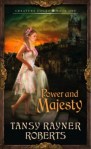
power and majesty

Power and Majesty (HarperCollins Voyager) came out last year. It’s the first volume of the Creature Court series by Tasmanian writer Tansy Rayner Roberts — the second volume, The Shattered City, is out now. I polished Power and Majesty off on the flight to Perth for Swancon at Easter, where it was awarded a Ditmar for best novel of 2010. It’s also up for an Aurealis Award, to be announced later this month.

The story is set in Aufleur, where Velody and two friends run a dress shop. Aufleur comes across as an Italian-style town — Renaissance with steamtrains — where festivals are a prime social and economic activity; even the calendar is set by the celebrations.

Behind the superficiality of the social calendar lurks a different reality, however. The sky is an enemy, raining death and destruction in a most creative way — the population is unawares of their peril from this extradimensional danger. It falls to a band of shape-shifting magic users to defend the plane, but they are far from a cohesive entity. Their number has been whittled down by combat and politics and they hunger for leadership from a king. Ashiol is the prime candidate, but abused and ashamed, he wants none of it. And so the jostling begins, and the fate of the world hangs in the balance…

It’s a superbly crafted world though the lens is focused on core features; there’s a pervading sense of gloom and hedonism, suitable for the end-of-days backdrop that informs the tale. The idea of having a battle for survival being played out in the sky above — of entire towns being erased from map and memory — without anyone much noticing is well handled given its difficulties. The magic also crackles on the page, with depictions of shape changers erupting into mobs of birds and animals, and psychic warfare in the sky, all underpinned by a well thought out science of how it all works.

While Latin is the language of choice for festivities, there’s a fair crack of Australian sensibility in the dialogue (drug users are, for instance, “off their face”), which is in the most part sharp and engaging.

The story itself is a little choppy in the early scenes as the ground is laid and characters set — large swathes of italic monologue and a lot of jumping about felt disorienting. But then the second act kicks off and the pace settles and the world rises up and the characters come into their own. Macready, for instance, brings a welcome dash of Irish humour while offering a pragmatic preparedness for swordplay.

It is in such characters that Power and Majesty truly shines. There’s a large cast, a dozen or more who get their time to strut and fret, each pursuing their own agenda. And the main players have wonderful points of distinction, clear motivations and intertwined histories that still resonate in their actions of the day. Politics and friendship, ambition and jealousy, love and desire, guilt and regret: very real human emotions that drive the narrative and breathe life into the characters and power the plot.

Amid the politics of the Creature Court, Velody is forced to assess just what she wants from her life — is being a dressmaker to high society enough? How much is she willing to sacrifice for her friends, her own happiness, and indeed the world?

I found Power and Majesty to be an enjoyable blend of fantasy and romance with entertaining characters who bring tension and intrigue to the story, all against a well-realised backdrop. Bravo!

Eona: a soaring sequel

eona aka necklace of the gods by alison goodman

It has been three years since Eon, aka Two Pearls of Wisdom, set alight the fantasy firmament with its faux-Chinese setting, gender blending and superb story-telling. The story involved a young girl who has to masquerade as a boy to have her shot at being a Dragoneye — one of a chosen few who link with a pantheon of celestial dragon spirits in order to tame the weather and bring prosperity to the nation, as well as garner significant powers. I reviewed it here.

And now we have the sequel, Eona, aka The Necklace of the Gods, and it’s been well worth the wait. It’s wonderful that Alison Goodman was able to get off the factory processing floor that dominates so much of fantasy publishing these days, trust that her readership would stick by her, and deliver such a quality read. Sadly, the economics of full-time (genre) writing don’t seem to be engineered that way — the focus remains on quantity, not quality, although one doesn’t necessarily negate the other!

I review Eona (Necklace of the Gods is such a more romantic title, isn’t it? The UK cover is delicious!) over at Asif, and highly recommend it as both a stunning sequel and a valuable case study for writers looking to roll out a series.

Review: Engineering Infinity

engineeering infinity by jonathan strahan (ed)

Usually, mention of ‘hard SF’ would make my eyes glaze over. I’m the kind of tech-zombie who is happy to just press the button and have the machine do its thing, without too much thought for the how. It’s only when it doesn’t work that I start to ponder, and even then it’s a case of hard Fs rather than hard SF. So when Engineering Infinity (Solaris) landed in my mailbox and editor Jonathan Strahan started talking about hard SF in his introduction, I started to sweat. But whew – as Strahan says in summarising his anthology, these aren’t necessarily hard SF stories in the classic mould, though they do all have humanity and technology bumping heads and seeing what happens. It’s a superb collection of 14 well-crafted and quite varied yarns. One of the most technical — Peter Watt’s ‘Malak’ — was one of my favourites, along with Greg Benford’s serial killers meet time travel yarn and Charles Stross’s space zombies. Definitely a book to keep an eye out for, regardless of whether you like your SF hard-boiled or runny in in the middle, with that tasty side of humanity. My rather more considered review is up at Asif.

Jeff Martin: The Ground Cries Out … for something new?

ground cries out by jeff martin and the 777

Jeff Martin has been wandering since the Tea Party split up in 2005 (see below for reunion news!): a solo album, then the Armada with Wayne Sheehy, and some touring — a lot of touring — with numerous collaborators as the fancy took him. In there was a move to Ireland and now to Australia. Bassist Jay Cortez has become a regular, joining Martin in his latest endeavour, the 777, which is completed by drummer Malcolm Clark.

The 777 album The Ground Cries Out (Riverland/EMI) is a gorgeous product with a gate-fold centre piece in the CD booklet that sets the tone before the stereo has even hit play. If you’re a fan, you won’t be surprised to hear Middle Eastern stylings, Indian stylings, some foot-stomping blues, and that Tea Party-style rock. There are lovers leaving, lovers yearning, meetings in gardens, angels, nefarious shadows, stars, fires and femme fatales … familiar rhythms, familiar scenes, familiar phrases. It’s all feels very … familiar.

Fortunately, Jeff Martin’s brand of familiar can still be engaging: the title track is as catchy an anthem as, say, ‘Line in the Sand’, and one of the standouts, ‘The Cobra’, is given an extra touch of ominous by Cortez’s deep bassline.

Cortez has a big hand here, playing a bunch of instruments and penning ‘The Mekong’, an instrumental with a strong Vietnamese/Thai vibe. It’s one of two instrumentals, the other a more standard guitar piece.

‘Santeria’ and ‘Queen of Spades’ offer irresistible grooves, ‘Riverland Rambler’ shows country underpinnings with honky tonk piano while ‘1916’ uses a railroad beat. Closer ‘The Pyre’ — another standout — ramps up the atmospherics with thumping percussion and buzz guitar chorus.

The album feels to be skating perilously close to finding comfort in the familiar, but in this case, the devil — and the delight — is in the details.

Jeff Martin 777 are on tour. Toe-tapping is assured.

And in other Jeff Martin news: the Tea Party are reforming to play gigs in Canada in July and August, with tour dates out real soon. You can almost hear the fingers snapping as they cross throughout the USA and Oz, can’t you?