John le Carre‘s spy novels were always a cut above for me; him and Frederick Forsyth ruled my thriller firmament in my teens, when the second-hand book stores were raided for the Colin Forbes, Len Deightons, Adam Halls, the Bond books, and soforth.
It was le Carre’s mood that won me, the sheer honesty of his tales in which grey was the colour de rigeur and the good guys, if you could find them, were never guaranteed of victory. As with the Cold War, everyone was playing for a draw.
In A Delicate Truth, his latest, he examines matters of conscience and political expediency, as a former British diplomat and a serving public servant find an incident on Gibraltar has not so much a delicate truth but a damned inconvenient one for Her Maj’s government. Against the backdrop of terrorism and rendition, mercenaries and dirty tricks, it’s a fraught tale of men unable to sleep easily with guilt and the ways in which the system seeks to silence them.
The characters are stoic, suitably reserved, in their dealings, and the dialogue is brilliantly esoteric, with echoes of phrases used to at times Yes Minister levels of cutting effect within the overall atmosphere of growing malevolence. Le Carre knows when to be sparse and when to use his astute descriptions of setting, a wonderful example of crafted world building.
While the end note was superb, the actual climax felt a little convenient, just a touch, but in no way undermined the story or the carefully presented character arcs that brought it about.
It’s been a long time since I devoured The Spy Who Came in from the Cold and Tinker Tailor Soldier Spy — the Tomas Alfredson movie was beautifully realised — but A Delicate Truth takes me right back to the joy of those masterpieces. Le Carre is as foxy as he ever was.
It could have, and should have, been superb: Pan’s Labyrinth director Guillermo del Toro (see also Devil’s Backbone, Cronos and Hellboy) helming a big-screen flick in which giant mechs — human-driven robots — battle giant monsters — ‘kaiju’ — for dominance of the Earth.
Pacific Rim is a pretty movie. It has some comedy moments. Ron Perlman’s appearance got a chuckle from the cinema. But that can’t save it.
Oh hackney! Where is your plot? Your logic? Where are your characters? Where is your time limit, for pity’s sake?
No more stereotypes, I beg you. Neither racial nor gendered. Isn’t it time we left this boyish, dinosaur-aged bullshit behind?
Look to anime, to Evangelion … see? See how something can be pretty and still tell a story?
Women can pilot mechs and don’t need to be protected by oafish, testosterone-fuelled males. What a great excuse for a punch-up — ‘apologise to the lady’. FFS, the ‘lady’ could’ve kicked both their arses.
Oh mechs, your tactics are flawed, and writers, your world building so thin I could ride a daikaiju through it as easily as they crash through your ludicrous sea wall.
I could go deeper, dissect the many aggravations and sheer occasions of stupid evident in this half-baked, pedestrian effort, but I’ve already given it more than two hours of my life.
In a mech shell: an irrelevant comedy side act, boorish leads — what the hell is Hollywood doing to Idris Elba? — and flimsy plot devices make for a monster of a flop.
Alison Croggon, whose fantasy novel The Gift (first of the Pellinor series) floated my boat way on release in 2002, has done a fine job of cutting to the chase in Black Spring (Walker Books, 2012), which makes no bones about its strong foundation in Emily Brontë’s Wuthering Heights.
Croggon takes the structure — a narrator arrives, meets some of the players and receives the story in a monologue from someone in the know — the mood and the cornerstones of the plot about thwarted desire, class and revenge, but does some elegant re-imagining.
UPDATE, VIDEO: Alison Croggon talks Wuthering Heights, Emily Brontë and Black Spring at the Wheeler Centre
The moors are out; instead, it’s a highland plateau — just as isolated, just as windswept — with a touch of the fantastic.
Narrator Hammel, a writer, begins in an almost New Weird setting of hedonistic city, where the literati have their own guild and a certain social sway. It might bring to mind the shenanigans of the Romantics wine bar crowd. Hammel retires to the north, a rented manor in sight of the Black Mountains. The plateau is a land of mystery, a kind of Transylvania meets Sicily, with changeable weather and a certain harshness, just right for this dark tale. It’s a land of small villages, of priests vying with magicians for the fear of the populace if not their hearts, of rampant superstition … and the vendetta, a way in which the king’s coffers are enriched and the male population is culled.
It might be a fantastical setting but for the incongruous presence of the Catholic church, uncomfortable in a land where magicians really can burn people from the inside out, send curses and engage in psychic combat, making this more of an alternative realm.
Hammel meets the Heathcliff analogue, Damek; has a suitably wonderful paranormal experience in line with Lockwood’s dream of Cathy in the Brontë version; and then is told the tragic story of Damek’s obsession with Lina, the daughter of the local lord both blessed and cursed with royal and witch blood.
Perhaps the most notable departure from Brontë’s text is in the ending — this isn’t called Black Spring for nothing!
The characters are all suitably flawed, each unable to prevent the inevitable tragedies that drag them all down.
Croggon uses suitably prose of the era with all her poetic might, delivering a satisfying if — as I recall the original — slow-paced recounting of love and revenge.
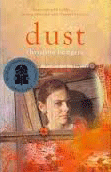
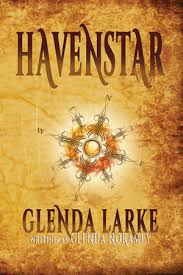
This is my fourth review as part of the 2013 Australian Women Writers Challenge — the first was Glenda Larke’s Havenstar; the second, Krissy Kneen’s Steeplechase; the third, Christine Bongers’ Dust — and completes my commitment to review four titles. There are, however, more on the shelf — let’s see how I go!
It’s not hard to see why Dust (Woolshed Press, 2009) was named a Children’s Book Council of Australia notable book, among its many accolades. It’s a simple, powerful coming-of-age story, the sort of thing that’s just the ticket for school libraries. Fairly subtle, too.
Chris Bongers grew up in Biloela and she taps that experience in this tale set in the countryside of her childhood. Like heroine Cecilia, Bongers had a mob of brothers to run amok with, too: how many chinese burns, corkies and horse bites did she trade? Droughts and flood and heaps of strine are, however, only the wonderfully drawn backdrop of this tale, set in the 1970s with a modern bookend.
Cecilia is on the cusp of moving from primary school to high, and there’s a steep learning curve to do with being yourself, of making choices, of caring for those on the fringes who have no one to care for them.
Working up ways to dodge the worst of penance in the confessional is just the start of it.
There’s the mysterious Kapernicky sisters, chalk and cheese and both just a little off; and the new girl, peaches-and-cream Hayley in her revelatory knee-high white boots; and Glenda with her ciggies and alluring coterie of no-gooders … and just what has got into Cecilia’s brother, Punk?
Bongers has the knack of flipping the switch from larrikin humour to pathos. Of painting her characters in human strokes, the good with the bad with the damn frustrating. Of letting the time go by, incident by incident, letting the allusions grow as the illusions slowly fade.
She perfectly captures that onset of maturity, young people trying to make sense of the world. Coming to realise that the dust of regret accumulates, seeking a way to keep the surfaces clean or at least keep the rug in its place; discovering the power of compassion.
Perth singer-songwriter Abbe May blasted onto my radar with 2011’s Design Desire, a rockin’ album, blistering and sexy. So blistering in places I’d quite forgotten its tender, electronic moments that have been further explored on Kiss My Apocalypse.
This album is insanely slinky, sexy, cool. DD‘s bluesy, rock guitars are eschewed for synths and beats: steamy, savvy, invasive… the title track and Karmageddon are the kinds of tunes that you find yourself humming hours after.
Throughout, with the amps down, May’s voice is allowed to roam through her impressive range. It’s pop meets electro meets attitude. There’s even an undertone of flamenco.
Outside the couple of atmospheric bites and minute-and-a-bit F**k/Love, each song carries its own weight on what is a fairly even-tempo collection.
There’s an inner city or inner suburban feel; a sense of melancholy, of waiting, of love on hold or disappointed; of frustration and defiance and a will to overcome. That we will not fall into the cracks in the pavement, we will not go quietly, we will not accept the betrayal and the inadequacies; we will demand respect.
Maybe the message of the album is that, when love lies bleeding, we will rise above. And if not, well, this is a damn fine album to go down to.
Other new music of 2013 on rotation:
Wild ‘n’ arty England four-piece Savages‘ debut, Silence Yourself. If Abbe May is seducing you into the end of the world, then these gals are tearing it down around your ears. There are clear roots to the 80s — Joy Division, Siouxsie Sioux, Bauhaus — but there’s a modern polish, aided in no small measure by the vocals of Jehnny Beth. Getting slammed shouldn’t feel this good, should it?
Yeah Yeah Yeahs‘ newish album Mosquito provides a pleasant mix of textures, none tastier than the title track. Opener ‘Sacrilege’ feels almost like a bridge from previous, electro outing It’s Blitz until the guitar buzz opens up on the way to a gospel conclusion, and the suggestion of Blitz 2 is left behind. ‘Subway’, backed by train-on-sleeper rhythm, shows they can tone it down, too. Eminently listenable, but then, Karen O is, ain’t she?
I helped kick-start Free Dominguez‘s Volcano and the Sea, based on the ear-grabbing awesomeness than is her band Kidneythieves. Alas, the poppy solo outing isn’t quite as grabby, sliding by innocuously and pleasantly enough with plenty of style, but failing to announce its presence. There’s a remix ep that features a cracking KMDFM version of ‘The Wolf’.
Likewise, Helalyn Flowers‘ new album, White Me In Black Me Out, sports a couple of wonderful tracks — the title song’s one of ’em — but too much of this new album from the ’80s-loving Italian electro-goths does too little.
Into that same territory of passing good but unexceptional are The Next Day from David Bowie — extra points for using the word ‘gormless’ in a song — and Depeche Mode, following up the meh of Sounds of the Universe with equally meh Delta Machine. Black Celebration feels like such a long time ago. Oh, crap, it was!
And finally, fresh out in cyberspace, is the debut album from Falling Echoes, being my mate Aaron R Walker of Wretched Villains fame and his mate Cristian Matheson (not to be confused with the writerly son of Richard Matheson, Christian with a h). Those familiar with the Villains’ foot-tapping gloom rock will appreciate this outing, though might miss Peter Green’s axe. The album, Counterclockwise, is a rhythm-led, simmering affair with touches of Cure-like joie de vivre. Ideal for walking home from the station on foggy nights.
Nicki Jaine: Her album Of Pigeons and Other Curiosities should please Jill Tracy fans with its gritty cabaret sound — ‘untitled’ is particularly suitable in these days of depressing headlines, filling my head with noirish imagery of sweaty bedroom sheets and barely turning fan and, on the other side of the dusty blinds, streets descending into bedlam.
Retro buy:
Dr John‘s 1968 debut, Gris Gris. Swamp blues comin’ at you, bone-shakin’ and bayou drippin’. Play it with the lights down low and go, baby, go.
Saw King Kong the musical playing at The Regent in Melbourne, and can’t say it did the business. Or perhaps it tried to do too much business.
The titular ginormous gorilla was awesome, worked by puppetry ninjas, with a fetching array of facial expressions. And the lighting, a triumph during the climactic air assault on Kong atop the Empire State Building. Almost drew a tear, too, except the big fella’s death scene was dragged out far past the point of caring.
There was one other scene of note, bodies falling upwards as Kong wreaked devastation on the Big Apple.
And that was one of the problematic scenes, too, bringing to mind the terror attacks of 9/11, the dubious metaphor amplified in quasi religious tones by a mysterious — in terms of, who are you and what are you doing in this story? — but well-played fortune teller.
Trying to retrofit modern allegory to the tale was as effective as combining Lady Gaga bondage dance numbers with 1930s swing. Add a suite of non-memorable songs — Ann Darrow’s lullaby the only one to really make an impression amid all the song-and-dance noise — and it all kind of left me swinging in the breeze, really.
But the gorilla was ace.
Tastier far: the lamb ribs at Ombra are amazing (the plonk’s not that cheap, but), and Father’s Office has a scrummy range of Southern-style dishes. Both highly recommended.
Brisbane writer Krissy Kneen has a deft touch with prose; her character’s voice in Steeplechase (Text, 2013) flows off the page, captivating and intriguing and thoroughly believable. And what a tale she tells, of her and her sister, her mother and Oma, all locked up in a history of mental illness where reality and truth are stretched to breaking point, not unlike a painter’s canvas stretched on a rack.
For Emily Reich is a painter of renown, having left her sister Bec — our narrator — in the shade.
Life for the sisters has been insular, to say the least, with their grandmother running the house, father gone, mother herself locked away inside a mental breakdown of sorts, a haunting presence that dominates the rural homestead. Stern Oma restores paintings for a living; she sequesters the girls, perhaps fearful of them falling prey to their mother’s sickness. For naught, as it happens.
Emily, having had her turn with illness, is in China, living large on her renown, while Bec, still very much in her shadow and more than a little fragile herself, ekes out a living as an art teacher and painter of less renown.
There’s that student Bec’s bonking — how wrong, but yet, so occasionally right — and there’s the imaginary boy who teased her and her sister so magnificently; the neighbour’s horse of childhood distractions, the games of steeplechase in the back yard, sisterly dynamics and a past disaster that hangs over them both.
I’ve read the word ‘claustrophobic’ used to describe the first section of this two-parter, and it’s a good choice, the past infusing the present, Bec locked between the two. And in her future, inducing yet further unease, that invitation from her sister to attend an exhibition in China — the second part, less claustrophobic but no less unsettling as Bec flounders in the foreign streets, trying to work through to the truth of the past and forge an understanding with her brilliant, troubled sister.
My only hesitation of the course was in the denouement: a little too much too soon for me, but I can’t argue that Bec earned her just rewards.
Identity, mental illness, art and, yes, horses — though equestrians might not find much to please them, here — form this delicious miasma, with the weather — sub-tropical Brisbane, I belatedly realised; and confronting, bird-less Beijing, Kneen drawing on her time there to invoke smells and sights fit to alienate our heroine — used superbly to enhance the mood.
Kneen debuted sensationally with her gorgeously rendered erotic memoir Affection and followed that with thoughtfully pornographic Triptych (which I have yet to read), both through Text; this, her first foray into less salacious fiction, confirms she’s a writer who deserves to go the distance.
I caught Lisa-Skye‘s Songs My Parents Taught Me at the ‘pop-up’ venue Tuxedo Cat in Melbourne last night — love this town and how it uses these spaces so creatively — and what an enjoyable hour* it was.
Songs My Parents Taught Me is a clever piece of memoir/biography, centred on the 1970s couple Maddog and Bunny. The night’s chat is a fond, second-hand reminiscence passed down by her parents, heavy on the ‘Wogs’ and drugs and booze and partying. The anecdotes serve as a springboard for Skye’s reflections on drugs, sexuality, parenthood … of growing up, however reluctantly and defiantly.
‘Some people are sexually attracted to fire,’ she says, summarising teenage proclivities for setting things on fire and masturbating.
And one can’t help wonder if that was a summary of Bunny and Maddog’s carefree life, both of them having passed away before Lisa-Skye had a chance to know them.
Lisa-Skye is so personable, her face so expressive, an hour in her velvet-draped pad passes quickly. Her show has some fetching touches: audience engagement, slide shows to help make connections and score some visual chuckles, several wonderfully constructed spoken word pieces set to the ticking of a metronome.
Southern Comfort lovers may be offended; others might never see a knitting needle again without thinking about a shark making love to a space rocket. (You have to be there.)
The conversation at Lisa-Skye’s place is engaging, at times confronting, a little loose and undoubtedly entertaining, with some food for thought – and glitter – thrown in. And the punchline – oh so very nicely done.
* Due to the unfortunate train timetable and the show going a little over time, I missed the last three minutes or so, but Lisa-Skye very kindly sent me the script for that final portion.
Lured by a shopping docket discount of 50 per cent off meals, last night we had our first dinner out since moving to Ballarat: at the bistro of the Blue Bell Hotel, probably the closest eatery to the Tor that doesn’t serve tucker in a cardboard box. (My god, you should’ve seen the length of the line-up at McDonald’s drive through down the corner …)
The Blue Bell’s bistro is on two levels further divided by a low wall: the lower section has television screens with captions and gambling, the other just a wall. The wall was preferable, though it was further from the bar, and mercifully further from the top 40 muzak. Ambience-wise, better than a roadhouse, but not exactly homely.
Still, we weren’t expecting fireplaces and shagpile, and the menu is a solid order-at-the-counter pub outing: Thursday nights are parma night and many of the tables were taken. There were three steaks on offer, plus a reef ‘n’ beef special, a variety of pastas, lamb shanks, salads, seniors and kids meals … they have the bases covered with pork belly and Greek lamb pizza adding interest.
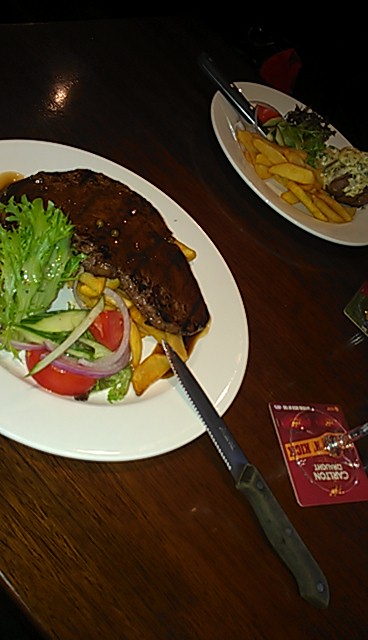
I went for a 400g rump steak with pepper sauce, Kirstyn tried the special with garlic sauce — both under $30 — and we were both well satisfied. Both cuts came cooked an accurate medium, with a handful of innocuous salad and a handful of tasty chips.
We washed it down with a glass of Oomoo shiraz ($8 a glass), but a bottle change mid-pour meant a surprising difference in taste and I didn’t go back for a second. Don’t know what happened to the normally dependable drop, there.
We forced ourselves to sample dessert from the display case: an, um, interesting take on black forest cake for me and a vanilla slice for her; not disappointing, just lacklustre, and quite surplus to requirements, really. I mentioned the 400g steak, right? The coffee, however, was pretty damn fine.
Add in friendly, efficient staff and the verdict was: the Blue Bell hits its target, and we’ll be back — I reckon the place would register high on the Dad scale with the cut of those steaks — but might give the dessert a miss and go straight for the coffee.
Extra points for off-street parking and an excellent website, complete with PDFs of the menu.
In this standalone fantasy, Glenda Larke shows the world building, characterisation and thematic grist that make her one of my favourite fantasy writers.
Larke has made Havenstar, originally published by Virgin Books in the UK in 1999 under the name of Glenda Noramly, available as an e-book, and the book will get the full treatment from Ticonderoga Publications in May.
Havenstar is notable for its imaginative setting: islands of stability set in an ever changing wilderness ruled by chaos, the result of a massive battle a thousand years ago that, meteorite-like, changed the face of the planet. Now the god of chaos, a cruel spirit indeed, rules the wastes, threatening to destroy those few outposts of order.
The islands are held together by strict social order overseen by a priesthood and their devotions to structure, but of course there is corruption and jealousy.
Larke isn’t much of one for patriarchy and blind adherence, and so her heroes are questioners and adventurers who look past the strictures for the truth between the lines. There is an almost Biblical undertone as the spirit of chaos offers temptations to those in the wilderness, for the price of a soul and a type of damnation: for some, the price is worth it; others are more ruthlessly afflicted and victimised.
The magic system is, typically for Larke, imaginative and logical, using a type of ley line as a key element, and showing the power of knowledge and even art (the trompleri maps here are perhaps an early template for the magical paintings used in the Watergivers series).
Mapmaker Keris finds herself on the road with a wonderfully eclectic mix of fellow travellers making the pilgrimage among the stabilities, and braving the dangers of chaos along the way.
It’s a superbly drawn world, complex but simply explained without recourse to massive info dumps — so enjoyable to learn about a world through the interactions of the characters rather than slabs of data.
Each chapter is headed by an excerpt from the holy writings, lending some sense of history — the teachings are relevant to the story, although elements of prophecy I probably could’ve done without given their absence of much mystery, though I have to admit, what’s a holy book without some kind of prophecy about the end of days or the better times ahead? Carrot and stick, carrot and stick … and a little tension, too.
The characters carry this story, whether Keris’s guilt over abandoning her family to pursue her own happiness, or her love interest’s tragic past with all the weight and darkness it brings, or the driven, blind visionary who has his own agenda.
One of the themes of the story is the debate between law and chaos, restraint and free rein, and both are presented in shades of grey.
The e-book has been given a light revisit by the author, and could’ve used another proofread, but it is a striking debut, well worth the downloading for lovers of intelligent and beautifully realised fantasy.
Glenda Larke, who has lived overseas for many years, is returning to her native Western Australia this year. She runs a workshop on world building on April 25 as part of Conflux in Canberra.

 John le Carre‘s spy novels were always a cut above for me; him and Frederick Forsyth ruled my thriller firmament in my teens, when the second-hand book stores were raided for the Colin Forbes, Len Deightons, Adam Halls, the Bond books, and soforth.