
Snapshot 2012: Simon Brown

australian speculative fiction snapshot 2012 logoSIMON Brown started writing fiction every day at the age of 14, which means he’s been a writer for more than 40 years. He’s had six novels published in Russia, which means his brag shelf has books he’s written that he can’t read. He currently lives in Thailand with his wife, who is an English teacher in Phuket, and his two school-age children.

PanMacmillan, under their Momentum imprint, have just released e-book versions of his previous fantasy trilogy, the Chronicles of Kydan. He’s working on three different books – a young adult/crossover horror, the first book in a new fantasy trilogy and a non-fiction book – because he can’t make up his mind which one to concentrate on.


You’ve been living overseas for the past few years. Grist for the writer’s mill or one huge distraction?
Living overseas is a great way to concentrate the mind on what you’ve left behind, at least initially. After four years in Thailand, I find that some of the things about living in a different country and a different culture are finally starting to get under my skin and become a part of me. It’s a nice feeling. But when I look up and towards the horizon, it’s always towards Australia. I think my time here in Thailand will start seeping into my work about the time I come home. That’s the way of things.


Momentum has re-released one of your series as e-books. What’s been happening to let readers know they’re available?
Mark Harding at Momentum Books has been great at getting the Chronicles of Kydan some attention. It was recently one of the books of the week on Google Play, for example, and the Momentum site has a piece by me on writing the trilogy. Gillian Polack has also kindly let me blog about the trilogy on her site. I just have to save up for an e-book reader now so I can download them myself. Imagine carrying hundreds of books in your pocket. Weird.


Can you tell us more about what’s inspired the latest projects?
The young adult/crossover horror novel, based on a short story I wrote called ‘Water Babies’ (published in Agog! Smashing Stories), is currently with a publisher, so until I get word back it’s difficult to say where it’s going.

The idea for the new fantasy trilogy I’m working on was inspired by reading about the importance of trade in ancient and medieval societies, something usually ignored in most fantasies. Since it’s just kicking off, I’m not sure how it’ll pan out at this point, but I’m enjoying booting ideas around.

The non-fiction book I hope to co-author with a good friend who is also a great writer is about the development of quantum theory. The book will concentrate on the Fifth Solvay Conference in 1927, which featured an amazing array of scientists who were also larger-than-life personalities.


What Australian works have you loved recently?
I’m ashamed to say that I’ve been so detached from the Australian scene over the past four years that I’ve read very little home-grown fiction. I did manage to read and enjoy the first book of Sean and Garth’s Troubletwisters and Scott Westerfeld‘s Leviathan (we’re allowed to poach Scott, aren’t we? (definitely: his snapshot his here — JN).


What have been some of the biggest changes in Australian speculative fiction (or the industry?) in the past two years since Aussiecon 4?
Difficult to assess from a distance, but surely the big development not just over the past two years but the past decade has been the increase in the number of Australian specfic writers and the quality of their work. I think Clarion South has a lot to do with this (and by implication Clarion South’s organisers), as well as the continued and it seems to me against-all-odds existence of short fiction markets such as Aurealis and Andromeda Spaceways Inflight Magazine.

The other big change has been the slow but inevitable move in Australia from ink to phosphor dot and LED, including e-books and online magazines. We’ll have to wait a year or 10 before properly assessing what effects this has had on writers and writing. If I’m still around, feel free to ask me again in 2022.

* * *

THIS interview was conducted as part of the 2012 Snapshot of Australian Speculative Fiction. We’re blogging interviews from 1-8 June and archiving them at Australian Speculative Fiction in Focus. You can read interviews at:
Snapshot 2012: Adam Browne

australian speculative fiction snapshot 2012 logoADAM Browne lives in Melbourne. He’s published 30 short stories, winning an Aurealis Award for best SF short story in 2002 and the Chronos in 2009. His first novel, Pyrotechnicon: Being the Further Adventures of Cyrano de Bergerac among the States and Empires of the Stars, by Himself (dec’d), is being released by coeur de lion in September this year — look for a launch at Canberra’s Conflux. Adam has also been working on the internal illustrations — one is available for sale as a print at Signed and Numbered, in Prahran. You can also see a few at his blog.


In ‘The End of Roentgen Rays’, the aptly concluding story of your Phantasmagoriana collection, reality unwinds as language collapses, a process begun with the loss of capital letters: is there a line to be drawn, currently perhaps, between the evolution and devolution of language, and should we privileged texters care as long as we can all understand each other’s tweets?
Yeah, that one’s less about the devolution than language than the idea that the world is made of language. Most of us can’t remember anything before we were two or three; it’s because language doesn’t colonise the mind until around then. Language is cloudware – it does a lot of our thinking for us – or, more than that, it does our perceiving for us.

I wrote the story as a lipogram, but was far too easy on myself: the only letter missing is X. In the end, all the letters unknot and fall apart, the story becoming a lipogram with the entire alphabet missing…

I was looking at the lipogrammatic novel A Void the other day, and suddenly realised it’s a double achievement – not only that it was written, but that it was translated from the French while also avoiding the letter E…

Your short stories often offer a blend of science, history and the fantastic: is there a particular advantage, say, in discussing certain themes, to this melding that more othordox narratives might not hold for you?
I didn’t start writing historical stuff until a friend, Barry Rome, sent an email with a beautiful little paragraph of what he’d like to see in SF; I can’t remember it very well, except that it was sumptuous, diseased – renaissancepunk – bewigged ancients with intelligent calipers, that sort of thing – transgenic peacocks… I wrote a story about Mozart as a hacker as a result. To be frank, I’ve long been driven by the need to impress. Historical science fiction offered opportunities along that line.

But I sometimes think that what we do is try on affectations to see which ones fit. This one fit me in a deep way. Historical SF dealt with my misgivings about fiction set in the future – the future was over, for me at least – and history provides atmosphere, which is so important in fantastical storytelling. The baroque period suits me best, as it suits my love of crammed, adjectival prose, and I think it feels rather like the present – the heedless headlong nature of it – the horror vacui – decadents dancing on the brink of the abyss.


In your forthcoming novel Pyrotechnicon, Cyrano de Bergerac takes us on space adventures. What made you choose Cyrano for this adventure?
Cyrano wrote two SF novels, Englished and republished as Other Worlds in the 1970s. I had the book for years without being all that interested, but then one day my eye just sort of lit on it – that’s all I remember – that moment I knew it was my novel. I was surprised someone hadn’t thought of it before: the third in the trilogy seemed an obvious project. I have to admit I didn’t start my research into the man himself until a year or so into the process. The most interesting detail for me was that Cyrano was gay – proudly, openly – his Trip to the Moon makes it obvious, for all that I assumed the affection between the male characters was just a French thing, or a 17th century thing. I began to wonder if Edmond Rostand, who wrote the eponymous play, was giving a sly nod to this when Cyrano’s love of Roxane is never consummated.

My Cyrano belongs more to Rostand than history. Manic, swashbuckling, epigrammatic, ingenious, madly inventive, a magnificent outsider. I got the same thrill from writing him as I do writing pirates – he’s at once real and fictional – a picture book character with heft, a commedia dell’arte character with depth. His energy and strength of character served to hold the novel together – he’s ridiculous, but he’s vulnerable and ferocious and engaging…

So to answer your question, I can’t really answer it. I don’t know why I started with him, but I think what I’ve said here goes to show why I stuck with him.

As for Pyrotechnicon: Being a True Account of the Further Adventures of Cyrano de Bergerac, by Himself (dec’d), I’m proud of it. I reckon it’s a goer. It’s a good sign when you read something and it feels like someone else wrote it. Like it’s come from on high, where all good art comes from. Maybe it’ll be for me as it was with Rostand, whose best work was also about Cyrano – he’s our muse, taking us to the peak of our art.


What Australian works have you loved recently?
Recently, I belatedly bought Anna Tambour’s Monterra’s Deliciosa & Other Tales. It’s wonderful, full of wonder. Two stories in particular, ‘Temptation of the Seven Scientists’ and ‘Monterra’s Deliciosa’, gave me a feeling I find hard to describe – an airiness in the frontal lobes, as if the central crevice were opening out. Literally mind expanding, I suppose. I relish her naturalist’s approach to the world, her witty, transparent, rich but economical prose.

After Paul Haines died, I re-read The Last Days of Kali Yuga, and enjoyed it as much as ever — he’s not a horror writer, despite that was how he defined himself; like all of the most worthwhile artists, his writing is its own genre, unique to him alone.

I went through my old David Ireland books this year too. The Flesh Eaters, A Woman of the Future. What a writer. How shameful that he’s been out of print for so long – though I saw recently that someone else felt that lack, and is having them reissued.

I beta-read Lee Battersby‘s novel The Corpse-Rat King too – and I’m realising now that all these authors are the same in that they’re all different – all unique. Like the others, Lee’s writing was ostensibly of a genre I normally avoid, but I persisted, and was glad of it – it’s a romp, it’s grotesque and inventive; it’s peculiarly Battersbyesque…

What have been some of the biggest changes in Australian speculative fiction in the past two years since Aussiecon 4?
The biggest change was Paul Haines’s death. Without being too sentimental or eulogistic, he’d be king of the scene by now; with his Penguin deal, his novelisation of the Wolf Creek prequel, all the rest of it, he’d have been a Proper Writer, object of awe at the conventions. I’d have been jealous of his success, but his largesse was such that he would have shared it around, would have been admonishing me and my more insular contemporaries to keep ourselves out there; he would been sending this or that opportunity our way and encouraging us with his enthusiasm — all that stuff. Ah, he was such a fun guy. I’ll always miss him.

* * *

THIS interview was conducted as part of the 2012 Snapshot of Australian Speculative Fiction. We’re blogging interviews from 1-8 June and archiving them at Australian Speculative Fiction in Focus. You can read interviews at:

Snapshot 2012: Garth Nix

australian speculative fiction snapshot 2012 logoGARTH Nix has been a full-time writer since 2001. He has worked as a literary agent, marketing consultant, book editor, book publicist, book sales representative, bookseller and as a part-time soldier in the Australian Army Reserve. Garth’s books include the award-winning fantasy novels Sabriel, Lirael and Abhorsen and the science fiction novels Shade’s Children and A Confusion of Princes. His fantasy novels for children include The Ragwitch; the six books of The Seventh Tower sequence; The Keys to the Kingdom series; and the Troubletwisters books (with Sean Williams).

More than five million copies of Garth’s books have been sold around the world. His books have appeared on the bestseller lists of The New York Times, Publishers Weekly, The Guardian and The Australian, and his work has been translated into 40 languages.

Garth also produced the IF Award-winning and ACTAA-nominated short animated film The Missing Key, directed by Jonathan Nix; is a silent partner in the literary agency Curtis Brown (Australia); and is a co-founder of the online games developer Creative Enclave.

He lives in a Sydney beach suburb with his wife and two children. Find him online at www.garthnix.com.


You and Sean Williams looked to be having fun with the whiteboard when it came to plotting out your Troubletwisters series. How did the two of you go about collaborating on that series?
The whiteboard video you can see on YouTube is a kind of condensed version of how it actually works. Basically, we got together at various times to work out the story in considerable detail, building up a chapter outline for the first book, and a backgrounder for the characters, setting and so on. Then I wrote the first chapter, Sean took it away and wrote the first draft of the rest of the book, mostly following the chapter outline but varying where he wanted to or thought it necessary. Then he flicked it back to me, and I revised it, sent it back again and he revised it, and so on for a couple of iterations. We also discussed any major changes as we went along. The end result is that when we look at any given page, neither of us can remember who wrote what, it is a true joint effort. We’ve repeated this basic process in the next two books, including the one that is just out now, Troubletwisters: The Monster.


A Confusion of Princes is based on a computer game and you’ve done a great job of absorbing the game conventions such as respawning into the narrative. What were the challenges of this adaptation, if that’s a fair description of the process?
It would be more accurate to say that the game, Imperial Galaxy, shares a background with the book. I actually had started writing the book first, then when Phil Wallach and I began work on the game, I suggested we use the background of the galactic empire, the three teks and so on, for the game. I had intended to finish the book earlier, but got distracted, so a kind of limited subset of the game came out in a beta version before the book was finished. You can play that game at www.imperialgalaxy.com, but essentially the game is stalled at the moment for lack of funds, and has been frozen for about two years now. We do still hope to return to it at some stage.


You’ve been branching out and drawing on your family’s various skills as well: a very well received short film, self-publishing a collection of Sir Hereward stories, the computer game and the novel, and goodness knows what else. What have been the biggest pleasures you’ve found from exploring these diverse creative worlds?
The film, The Missing Key (trailers at www.themissingkey.com), is very much my brother Jonathan Nix’s work. I co-produced it, but had little creative input, just the business management and so on typical of a producer. It has won a bunch of awards, and I am pleased to be an IF Award-winning and ACTAA-nominated producer, but I can’t take much of the credit.

I self-published Sir Hereward and Mister Fitz: Three Adventures as an experiment to test new digital waters. I like to keep up with and investigate publishing trends and changes were I can. I do like to be involved in various ventures and activities, and I like to use my business mind as well as my fiction-writing faculties.

What Australian works have you loved recently?
I was enthralled by Margo Lanagan‘s Sea Hearts and greatly enjoyed Dave Freer‘s Cuttlefish (not yet released), but in general I haven’t read much Australian (or in fact any) science fiction or fantasy. I’ve been mostly reading non-fiction, particularly history. I was kind of shocked at myself when I realised how little of the Aurealis shortlist I’d read at the awards ceremony last month, so I have picked up a bunch of books and stories to read when I get the chance.

What have been some of the biggest changes in Australian speculative fiction in the past two years since Aussiecon 4?
I’m not sure changes are obvious until much later, perhaps six, seven or even 10 years, when you can look back and point to things that have become significant or made an impact over time. That said, I think in general it is encouraging to see so many people involved in reading and writing speculative fiction, and to see more and more Australian authors getting a foothold in the USA and UK, and in translation.

* * *

THIS interview was conducted as part of the 2012 Snapshot of Australian Speculative Fiction. We’re blogging interviews from 1-8 June and archiving them at Australian Speculative Fiction in Focus. You can read interviews at:


Snapshot 2012: Andrew McGahan

australian speculative fiction snapshot 2012 logoANDREW McGahan is one of Australia’s finest and most varied writers. His first novel, Praise, won The Australian/Vogel Literary Award in 1992, and his third, Last Drinks, won a 2001 Ned Kelly award for crime writing. In 2004 his fourth novel, The White Earth, won the Miles Franklin Literary Award, the regional Commonwealth Writers’ Prize, the Age Fiction Book of the Year, and The Courier Mail Book of the Year. His most recent adult novel is Wonders of a Godless World which won the 2009 Aurealis award for science fiction. In 2011 Andrew released the first volume of his young-adult fantasy Ship Kings series, The Coming of the Whirlpool, currently short-listed in the CBCA awards and the Australian Book Industry awards and an Aurealis finalist. The second volume in the series, The Voyage of the Unquiet Ice, will be published in late 2012.

Andrew lives in Melbourne with his partner of many years, Liesje.


Some writers use pen names when they write across disparate genres, but you haven’t. What have been the pros and cons of sticking with the one brand?

I did toy with using a pen name for Ship Kings, and I might indeed have elected to employ one if my previous books had been in a single non-fantasy genre. But as I’ve already strayed a little across the genres with the earlier novels, I didn’t think anyone would be too bothered if I ventured into yet another field under my own name. As for the pros and cons of it -– I’m not sure about either. I’ve never given much thought to myself as a ‘brand’, or better to say, by the time I realised that I should think about it, my brand was already too muddled to save.


What have been some of the biggest pleasures and perils for an avowed landlubber building a nautical fantasy world?

The perils are obvious enough -– that, in my descriptions of sailing, I make a technical error so obvious and outrageous that it snaps the reader out of the story. To that end, I’ve done as much research as I can on the basics of sail, but at the same time I’ve avoided full-on immersion in it, nor have I signed up for duty on a tall ship. Too much reality could actually become self defeating. For of course the Ship Kings series is not set in our world, or upon our oceans -– indeed, the Ship Kings ocean has quite different physical properties — so real sailing is only relevant up to a point. Therefore my premise has been that even though I’ll never fool experienced sailors, if I can reasonably convince fellow landlubbers that I know what I’m talking about, then that’s good enough.

The pleasures are manifold. Precisely because I have so little experience of the sea, it has remained a great unknown for me where imagination can roam as it likes, which no doubt is why I’ve always particularly loved seafaring stories — especially the more fantastic tales of whirlpools and sea monsters and baffling disappearances. The Ship Kings series is a gleeful chance to revisit and enlarge upon all those boyhood adventures I remember reading. I couldn’t be having more fun.


You’ve won an Aurealis award and been short-listed for another, and have some far more presitigious award credits to your name. Without necessarily buying into the recent fracas in your old home state, what have these various levels of accolade meant for you personally and your writing career?

I’ve been very fortunate with awards over the years and I’m always amazed by (and grateful for) the passion for writing that it takes to set up and run such things. The Queensland awards are a case in point. As you know, they’re going ahead anyway in community form –- and the lack of prize money aside (and ignoring the wider politics of their axing, and the whole question of the role of governments in supporting literature) they’ll actually be better awards for it in some ways, because they’ll be a product of ground level enthusiasm, rather than an obligation of government policy.

But to win any award, of course, feels fantastic, for all the obvious reasons –- the validation of your work, the increased sales of the book in question, and not least the raw cash, should prize money be included. There’s no doubt that all of it together gives you confidence to push on with your career, when royalty statements alone might make you question if it’s worth while -– and the bigger the award the better. But strangely it’s some of the smaller awards I’ve won or been shortlisted for that have stuck in my mind the most, because I’ve been aware that they exist only because a tight group of organisers, judges and fans care enough to make them exist. There’s something rather humbling about that.


What Australian works have you loved recently?
Of late, Scot Gardner’s The Dead I Know –- very interesting indeed. And far too belatedly, sadly, I finally cottoned on to Paul Haines, with The Last Days of Kali Yuga collection. Cracking stuff.


What have been some of the biggest changes in Australian speculative fiction in the past two years?
I’m the last person to ask as I’m not very well read in any realm of Australian writing, speculative or otherwise, and I’ve struggled life-long with a deep-seated phobia for group activities such as conferences and literary festivals, so that I rarely meet or talk with other writers, or even readers. Which all means I’m pretty ignorant of trends in the local industry.

* * *

THIS interview was conducted as part of the 2012 Snapshot of Australian Speculative Fiction. We’re blogging interviews from 1-8 June and archiving them at Australian Speculative Fiction in Focus. You can read interviews at:

Snapshot 2012: Ian Irvine

australian speculative fiction snapshot 2012 logoIAN Irvine, a marine scientist who has developed some of Australia’s national guidelines for protection of the marine environment and continues to work in this field, has written 28 novels. These include the internationally bestselling Three Worlds fantasy sequence (The View from the Mirror, The Well of Echoes and Song of the Tears), which has sold over a million copies, a trilogy of thrillers set in a world undergoing catastrophic climate change, Human Rites, and 12 books for younger readers, the most recent being the humorous fantasy quartet, Grim and Grimmer.

Ian’s latest fantasy novel is Vengeance, Book 1 of The Tainted Realm trilogy. He’s currently doing the final edits of the second book, Rebellion, which will be published in Australia in October 2012, and the US and UK in early 2013.

Keep up with Ian at his website www.ian-irvine.com and on Facebook.

Your eco-thrillers have been recently re-released: how has the market for such stories changed since they were first published?
I don’t know that it has, actually. As far as I can tell, the market for eco-thrillers has never been a huge one. Even at times when the public had a high level of concern about environmental issues, and has been flocking to eco-disaster movies such as The Day After Tomorrow, I’m told that sales of eco-thriller books have generally been modest. I’m not sure why – perhaps it’s a bit close to home.


Your latest novel is called Vengeance. What topics have you found that fantasy can talk about more easily or more effectively than other genres, if any?
I’ve long been fascinated by the ways that seizing or maintaining political power can undermine the legitimacy of a realm – it happens all the time in history. For instance in Australia, the current Gillard government is constantly being white-anted because of the way its previous prime minister was overthrown. Malcolm Fraser’s government 30 years ago also suffered from the way the previous Whitlam government was deposed.

This issue formed the germ of the idea behind The Tainted Realm – a nation, scarred by a deep sense of national guilt about its own origins, that now faces a resurgent enemy it has no idea how to fight.


Your recent releases include a series for younger readers and now this new, epic fantasy. What are the different joys and challenges you’ve experienced in writing for these two audiences?
One of the best things about being a writer is the ‘next-book dream’ – that the story I’m about to write will be original or provocative or funny or life-changing, or non-stop, edge-of-the-seat suspenseful. Sometimes, in moments of authorial madness, I imagine that it can be all of the above. And everything in my life: every snippet of research, every odd idea jotted down or moment of inspiration can go into the pot, get a good stir, simmer for weeks or years, then miraculously and effortlessly flow into the story. Ha!

One of the worst aspects is grinding out the first draft. It usually starts well, and sometimes runs well for as much as eight or 10 chapters. Vengeance did. And I was lulled, poor fool that I am. Yes, I thought, this book is going to be a snap.
Then suddenly I was in the writer’s ‘death zone’ where every word came with an effort, every sentence sounded banal, every character was done to death, every situation boring and repetitive. Nothing worked; nothing felt inspired. What had gone wrong? Had I used all my ideas up and burned myself out as a writer? I started to think that I’ll never write anything worth reading again.

Nearly every novel has this stage, which generally occurs about a quarter of the way in, and sometimes lasts until half-way. Of all my books, the only ones I’ve not been stuck on were the last two books of my humorous adventure stories for younger readers, Grim and Grimmer. They were written to such short deadlines and with such wild and wacky enthusiasm that there wasn’t time to get into the death zone. It was the first time I’d ever completely let go as a writer, and they were the most fun I’ve had writing.

Vengeance, on the other hand, was one of the worst because I had so many interruptions from other deadlines – pre-existing commitments for the last Runcible Jones YA novel plus the four Grim and Grimmers. Writing is hard work at the best of times, but doubly hard when I’m forced to jump back and forth between different kinds of books.

Also, because really big books present a writing challenge that doesn’t occur with small ones – it’s difficult to keep the whole vast canvas in mind at once. The only way to write such books (for me, anyway) is in long, uninterrupted slabs of time, otherwise every interruption hurls me out of the characters’ heads and I have to laboriously write my way back in again. And no matter how well yesterday’s writing went, each new day presents the same challenge.


What Australian works have you loved recently?
I’m a big fan of Richard Harland’s steampunk world, as exemplified in his terrific World Shaker and Liberator. I’ve also enjoyed Stephen Irwin’s dark thriller The Dead Path, and Trent Jamieson’s excellent trilogy The Business of Death. Apart from that, I’ve bought lots of Aussie speculative fiction recently but it’s still on the ever-growing unread pile.

What have been some of the biggest changes in Australian speculative fiction in the past two years since Aussiecon 4?
Sorry, I don’t have the faintest idea. I’m only now emerging from the busiest time of my writing life, and I rarely read short stories, so any emerging trends in Aussie speculative fiction have passed me by.

However, looking at the publishing and bookselling side of things, we face challenges we haven’t seen in the past decade and a half, since Aussie SF publishing, sales and international success exploded in the mid-to-late ’90s. From now on, due to the high dollar, the demise of book chains and the explosion in e-books and self-publication, it’s going to be a lot harder to get published by a traditional print publisher than it has been at any time since 1995, and sales, for the most part, are liable to be smaller because we’re also competing with a million self-published e-book titles. They might only sell a handful of copies individually, but because there’s so many of them, they add up to a significant chunk of the market. So, tough times ahead, but fantastic opportunities as well.

* * *

THIS interview was conducted as part of the 2012 Snapshot of Australian Speculative Fiction. We’re blogging interviews from 1-8 June and archiving them at Australian Speculative Fiction in Focus. You can read interviews at:

Snapshot 2012: Traci Harding

australian speculative fiction snapshot 2012 logoTRACI Harding’s books blend the esoteric mysteries, time travel and quantum physics in adventurous romps through history, alternative dimensions, universes and states of consciousness. She has had 16 books published by HarperCollins Voyager (four trilogies and three stand alone novels). The first book of The Timekeepers trilogy, Dreaming of Zhou Gong, is due for release in February 2013, with another trilogy to follow. Her first book, The Ancient Future, has featured regularly on the Dymocks’ Top 101 Books. It also made the ABC’s lists of Most Loved Books of All Time and Favourite Australian Book, and has been reprinted more than 35 times. It and her stand-alone novel The Alchemist’s Key have been published in Complex Chinese, while The Mystique Trilogy has been published in Russian, Czech, Slavic and Romanian. The Alchemist’s Key has been optioned to Dragonlight Productions and is being developed as a feature film project.

Traci’s website is at traciharding.com.


You were able to arrange to have free short stories made available as part of promotion for your most recent novel. Did you find that readers appreciated this?
The readers loved this, and it certainly served to get the traffic flowing through my web pages and Facebook Fan pages. This was actually an idea I came up with while chatting to Kim Falconer and our editor at the Byron Bay Writers’ Festival last year – thanks girls – it was a great success! It was a hell of a promotion to get organised to happen over the Christmas break, but HarperCollins did an amazing job and the entire promotion flowed really smoothly.


What are some of the outstanding perils and pleasures of writing in historical periods other than the present that you’ve encountered?
The pleasure of writing ancient history is uncovering little know facts buried throughout time; the peril is not finding them LOL.

I have just had an extended stint in Ancient China, and although I felt really very at home there, I have found a gentleman in Hong Kong who has kindly agreed to proof read the MS for me and he has already pointed out several amusing mistakes – when I mess with other cultures I like to get it right, if I can.


Is there a genre you’re dying to write in other than your SF/fantasy realm? Perhaps another collection of supernatural stories?
I wouldn’t mind having a crack at non-fiction, actually. I have shares in a company Gamma Power who have recently rediscovered Tesla’s free energy and are doing all sorts of amazing things with it. They are calling it ambient energy and I would very much like to write about that rediscovery in the not too distant future.


What Australian works have you loved recently?
So many good Aussie authors, but here are those I’ve enjoyed lately: my fav Aussie author is Kim Wilkins aka Kimberley Freeman, Belinda Alexandra, Grant Hyde, Christopher Ride, Kate Morton, Nathan Burrage and Jessica Shirvington. There is so many really great Australian authors out there; I wish I had more time to read them all!


What are some of the biggest changes in Australian speculative fiction in the past two years (since Aussiecon 4)?
The most obvious change that I am aware of is that e-books have sent hardback book sales plummeting – we’re seeing the collapse of the big book chains, and its a much tougher market now for new authors. But, on the upside, I see the independent book stores doing better and they’ll keep local authors alive and thriving, and e-books can reach a bigger a market. Yet with so many different delivery formats and troublesome data transfers, one wonders how long it will be before people discover that you cannot beat having the book in your hand.

* * *

THIS interview was conducted as part of the 2012 Snapshot of Australian Speculative Fiction. We’re blogging interviews from 1-8 June and archiving them at Australian Speculative Fiction in Focus. You can read interviews at:

Snapshot 2012: Australia’s speculative fiction scene

australian speculative fiction snapshot 2012 logo
The Aussie Spec Fic Snapshot has taken place three times over the past eight years. In 2005, Ben Peek spent a frantic week interviewing 43 people in the Australian spec fic scene, and since then, it’s grown every time, now taking a team of interviewers working together to accomplish! In the lead up to Continuum 8 in Melbourne, I will join Alisa Krasnostein, Kathryn Linge, David McDonald, Helen Merrick, Ian Mond, Alex Pierce, Tansy Rayner Roberts, Tehani Wessely and Sean Wright in blogging interviews conducted over the past couple of weeks. To read the interviews hot off the press, check these blogs below daily from today to 7 June 2012.

As we celebrate the breadth and depth of the Australian spec fic scene, 2012 Snapshot is also a bittersweet time and we take the opportunity to remember two well-loved members of the community who sadly passed away in the past year; Paul Haines and Sara Douglass.

You can find the past three Snapshots at the following links: 2005, 2007 and 2010.

A Confusion of Princes: YA space opera is on target

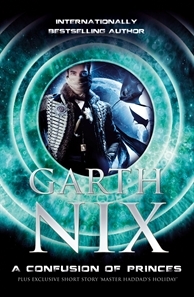
a confusion of princes by garth nixGarth Nix has unveiled his A Confusion of Princes, and it’s a great read starting with that fetching title. One of the most interesting elements is how he’s taken its computer game origins and incorporated them into the world building — in particular, the respawning, made familiar to viewers of the remade Battlestar Galactica.

  • My full review is at ASiF, but in short: most excellent fun with a serious message at its heart.
  • Aurealis Awards: catching up with the tribe

    We are home from Sydney, having feted our peers in the speculative fiction community at last night’s Aurealis Awards. Once again, organisers SpecFaction NSW put on a smooth show with plenty of time to mingle at Rydges North Sydney before and after, with a gettogether at the nearby gorgeous awards venue The Independent theatre as well.

    I recognised writers and publishers from all states and the ACT in the crowd that pretty much filled the theatre with a veritable who’s who, which once again demonstrated the generosity and openness of the community.

    The audience saw a virtual passing of the torch from HarperVoyager stalwart editor Stephanie Smith to the new top ed in the hot seat, the much respected Deonie Fiford.

    The late Sara Douglass and Paul Haines were in our thoughts, and it was wonderful to see Haines’s rivetting story ‘The Past is a Bridge Best Left Burnt’ score a win. His widows, Jules, sent a lovely acceptance message read by Cat Sparks which addressed the importance of writing to Paul and the value he placed on the spec fic community.

    Sean the Bookonaut provides a storified rundown of the awards

    Scott Westerfeld, Kim Westwood and — by iPhone, via Alan Baxter — Robert N Stephenson provided some of the other memorable speeches, and Kate Forsyth was the most delightful host one could ask for.

    I think it was a tie between Sean Williams and Marty Young for having the shirt most people wanted to own… but that might just have been at our breakfast table. Robert Hood should be in the running for a Ditmar next year for ‘best use of a cow in a science fiction slideshow’.

    I believe the awards will be held in Sydney for a third year next year — bring it on!

    Pictures of the night by Cat Sparks

    AUREALIS AWARD WINNERS FOR WORKS PUBLISHED IN 2011

    Children’s fiction told primarily through words: City of Lies by Lian Tanner (Allen & Unwin)
    Children’s fiction told primarily through pictures: Sounds Spooky by Christopher Cheng (author) and Sarah Davis (illustrator) (Random House Australia)
    Young Adult Short Story: ‘Nation of the Night’ by Sue Isle (Nightsiders, Twelfth Planet Press)
    Young Adult Novel: Only Ever Always by Penni Russon (Allen & Unwin)
    Illustrated Book/Graphic Novel: TIE Hidden by Mirranda Burton (author and illustrator) (Black Pepper)
    The Deep: Here be Dragons by Tom Taylor (author) and James Brouwer (illustrator) (Gestalt Publishing)
    Collection: Bluegrass Symphony by Lisa L Hannett (Ticonderoga Publications)
    Anthology: Ghosts by Gaslight edited by Jack Dann and Nick Gevers (HarperVoyager)
    Horror Short Story: TIE ‘The Past is a Bridge Best Left Burnt’ by Paul Haines (The Last Days of Kali Yuga, Brimstone Press)
    ‘The Short Go: a Future in Eight Seconds’ by Lisa L Hannett (Bluegrass Symphony, Ticonderoga Publications)
    Horror Novel: No winner or shortlist.
    Fantasy Short Story: ‘Fruit of the Pipal Tree’ by Thoraiya Dyer (After the Rain, FableCroft Publishing)
    Fantasy Novel: Ember and Ash by Pamela Freeman (Hachette)
    Science Fiction Short Story: ‘Rains of la Strange’ by Robert N Stephenson (Anywhere but Earth, Coeur de Lion)
    Science Fiction Novel: The Courier’s New Bicycle by Kim Westwood (HarperCollins)
    Peter McNamara Convenors’ Award: Galactic Suburbia podcast –- Alisa Krasnostein, Alex Pierce, Tansy Rayner Roberts, Andrew Finch (producer)
    Kris Hembury Encouragement Award: Emily Craven of Adelaide

    The Hunger Games: a tasty exercise in bread and circuses

    hunger games poster with jennifer lawrenceWe saw the Hunger Games movie on Friday night in a packed theatre heavy on the teen girl demographic, some still in school uniform. It had the hallmarks of a dreadful event — I’m still haunted by the twittering of prats in the back row during the Exorcist redux — but it turned out okay. Those gaps, those giggles, the occasional interjection from a boof in the front row, all added to the ambience. I’m not usually one for interactive theatre like this, but given the arena styling of the Hunger Games, it made sense.

    Premise: a boy and a girl between 12 and 18 are taken by ballot from each of 12 districts, to fight to the death in a controlled landscape arena for the entertainment of the masses. There’s a propaganda element to it, this being the fallout from a rebellion about 50 years ago. This arena is a forest, with controlled bushfires, lots of mobile and embedded cameras, a PA system for ‘Big Brother’ style announcements, and a roof which functions as both bulletin board and artificial atmosphere.

    The movie scored points for not trying to explain everything to do with the back story, but simply hint; the clues were enough to allow suspension of disbelief. Wisely, it took its time getting to the showdown so we weren’t treated to a mere game of cat and mouse. The casting and the performances were spot on. Jennifer Lawrence brings the perfect level of expression to the relatively complex hero of Katniss. The love interest — real or clever survival tactic? — was also deft. Special effects and setting were well done. And the brutality of children fighting 18-year-olds: very nicely handled indeed, neither overdone nor glossed over. It was no coincidence that Roman architecture featured in the cityscapes of the Capitol where the games are held.

    The movie didn’t blow me away but it didn’t bore me witless either and I’m keen to read the books to get the full benefit of the world-building and, frankly, see what all the fuss is about. But I’m not dying to know what happens next, which is curious from a part one of a trilogy. I’m not sure the movie had the time to make all the connections it perhaps needed to, in terms of the games’ impact outside the arena, for instance. In truth, and I know the focus is a little different, I’d rather watch Salute of the Jugger again. Maybe it’s the Rutger factor …

    It was interesting that afterwards in the loo the young boys were discussing the poor tactics that had got half the tributes killed in the first encounter. I wonder if they noticed, or cared, that the heroine didn’t wear PVC and have exposed cleavage? That it was the less-martial lad using emotion and attraction as survival tactics?

    The Running Man and Series 7 are two other movies to have explored the idea of death matches for entertainment, but Hunger Games is riding the books’ fervour; it’s opening weekend has been massive. The YA component makes it confronting and offers a point of difference.

    Meanwhile, Hollywood is already looking for its next big thing: the ‘mommy porn’ of Fifty Shades of Grey is being plugged as a forerunner of a new wave of erotica. Can’t wait to see what the action figures for that one will look like, but I’m guessing they’ll be fully articulated.