
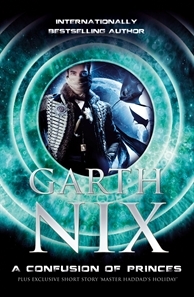
 Garth Nix has unveiled his A Confusion of Princes, and it’s a great read starting with that fetching title. One of the most interesting elements is how he’s taken its computer game origins and incorporated them into the world building — in particular, the respawning, made familiar to viewers of the remade Battlestar Galactica.
Salvage giveaway at Goodreads
Dark Shadows shines a light on writing tips
We saw Dark Shadows last night. Oh my goodness. Michelle Pfeiffer was wonderful, the settings and particularly the porcelain/egg shell witch stuff were delightful, but over all: a train wreck. Still, in an effort to get my money’s worth, I came away with some notes, assembled quickly here (there are spoilers, but I don’t see how anything can spoil the movie more than watching it).
1. Pick you story.
Dark Shadows ran as a daily serial for how long? So lots of material to sift through. <I tried to watch the 1990s remake recently: it hasn’t travelled well.> What to include? How about not everything? Save the werewolf girl for later, or at least foreshadow her inner hairiness, for instance. No, when presented with so many story ideas, best to pick just one, and add a subplot or two, but make sure you have that narrative drive from beginning to end. So it might be a love story or a love gone wrong/revenge story; it might be a family drama; it might be a vampire trying to deal with society 200 years later; it might be how a vampire helps a boy and his dead mother find a happy ending. It’s probably not all of those things at once.
2. Pick your tone.
So many ways to approach such material… a once wealthy family brought under by a scheming, vengeful witch, and then along comes a vampire from the past to help put things right. Is this a comedy? A kitsch retro bit of fun pie? Is it a horror story, a melodrama, a thriller? Pick one, leaven it with another, and work it, baby. But don’t bounce between them willy nilly, and for pity’s sake don’t suck your few slightly funny gags dry. Alice Cooper’s a girl’s name. Oh my. A family that has the big balls. Oh dear.
3. Characterisation is key.
It’s about the people, innit. So you have a cool cast of characters, each with their own thang, and then you give a glimpse of each and forget about them. Instant or reincarnated love? Two people in one house who believe in ghosts? Two hundreds years of obsessive love? Hm, somewhere along the line, they need to meet. But most of all, perhaps, that hero needs to be heroic, not a cad; or if he is a cad, he needs to realise it. But our vampire hero treats the help wrong and, on this occasion, he picked the wrong gal to use and discard, and hell hath no fury, right? What exquisite blackmail it is to have to make love to the pretty witch — tell me again why she still loves the cad? As Depp’s Barnabas admits, he’s not a gentleman.
4. Story that works for a greater whole.
So you kill the psychologist and you catch the bad dad thieving and there will be ramifications. Won’t there? You kill a bunch of folks and there will be ramifications … won’t there? History repeats with the torch-wielding mob baying for your blood and — they go home when told to. No, when the hero suffers a setback, it has to have an impact. The worst thing happens and it means something, damnit; it doesn’t get swept under the carpet.
5. Make sure your theme is up to date.
So this is probably being overly harsh, but damn.. Dark Shadows seems to have embodied those far simpler times when those with money could get away with anything. Murder is fine as long as the family’s fortunes and social standing is upheld. The staff should know their place and even the most accomplished, self-made witch with 200 years of achievement under her cauldron just wants to be loved.
A case study of how to do it: after we got home, we had a palate-cleansing viewing of The Addams Family movie. Now that’s kooky.
‘Salvage’ cover unveiled!

My novella Salvage, a seaside Gothic, is available for pre-order in paperback from Twelfth Planet Press for $15 plus postage.
The novel was primarily written on, and is set on a fictional version of, Bribie Island, over a three-year stretch of writing retreats.
About Salvage:
“Seeking to salvage their foundering marriage, Melanie and Richard retreat to an isolated beach house on a remote Queensland island.
“Intrigued by a chance encounter with a stranger, Melanie begins to drift away from her husband and towards Helena, only to discover that Helena has her own demons, ageless and steeped in blood.
“As Richard’s world and Helena’s collide, Melanie must choose which future she wants, before the dark tide pulls her under … forever.”
Aurealis Awards: catching up with the tribe
We are home from Sydney, having feted our peers in the speculative fiction community at last night’s Aurealis Awards. Once again, organisers SpecFaction NSW put on a smooth show with plenty of time to mingle at Rydges North Sydney before and after, with a gettogether at the nearby gorgeous awards venue The Independent theatre as well.
I recognised writers and publishers from all states and the ACT in the crowd that pretty much filled the theatre with a veritable who’s who, which once again demonstrated the generosity and openness of the community.
The audience saw a virtual passing of the torch from HarperVoyager stalwart editor Stephanie Smith to the new top ed in the hot seat, the much respected Deonie Fiford.
The late Sara Douglass and Paul Haines were in our thoughts, and it was wonderful to see Haines’s rivetting story ‘The Past is a Bridge Best Left Burnt’ score a win. His widows, Jules, sent a lovely acceptance message read by Cat Sparks which addressed the importance of writing to Paul and the value he placed on the spec fic community.
Sean the Bookonaut provides a storified rundown of the awards
Scott Westerfeld, Kim Westwood and — by iPhone, via Alan Baxter — Robert N Stephenson provided some of the other memorable speeches, and Kate Forsyth was the most delightful host one could ask for.
I think it was a tie between Sean Williams and Marty Young for having the shirt most people wanted to own… but that might just have been at our breakfast table. Robert Hood should be in the running for a Ditmar next year for ‘best use of a cow in a science fiction slideshow’.
I believe the awards will be held in Sydney for a third year next year — bring it on!
AUREALIS AWARD WINNERS FOR WORKS PUBLISHED IN 2011
Children’s fiction told primarily through words: City of Lies by Lian Tanner (Allen & Unwin)
Children’s fiction told primarily through pictures: Sounds Spooky by Christopher Cheng (author) and Sarah Davis (illustrator) (Random House Australia)
Young Adult Short Story: ‘Nation of the Night’ by Sue Isle (Nightsiders, Twelfth Planet Press)
Young Adult Novel: Only Ever Always by Penni Russon (Allen & Unwin)
Illustrated Book/Graphic Novel: TIE Hidden by Mirranda Burton (author and illustrator) (Black Pepper)
The Deep: Here be Dragons by Tom Taylor (author) and James Brouwer (illustrator) (Gestalt Publishing)
Collection: Bluegrass Symphony by Lisa L Hannett (Ticonderoga Publications)
Anthology: Ghosts by Gaslight edited by Jack Dann and Nick Gevers (HarperVoyager)
Horror Short Story: TIE ‘The Past is a Bridge Best Left Burnt’ by Paul Haines (The Last Days of Kali Yuga, Brimstone Press)
‘The Short Go: a Future in Eight Seconds’ by Lisa L Hannett (Bluegrass Symphony, Ticonderoga Publications)
Horror Novel: No winner or shortlist.
Fantasy Short Story: ‘Fruit of the Pipal Tree’ by Thoraiya Dyer (After the Rain, FableCroft Publishing)
Fantasy Novel: Ember and Ash by Pamela Freeman (Hachette)
Science Fiction Short Story: ‘Rains of la Strange’ by Robert N Stephenson (Anywhere but Earth, Coeur de Lion)
Science Fiction Novel: The Courier’s New Bicycle by Kim Westwood (HarperCollins)
Peter McNamara Convenors’ Award: Galactic Suburbia podcast –- Alisa Krasnostein, Alex Pierce, Tansy Rayner Roberts, Andrew Finch (producer)
Kris Hembury Encouragement Award: Emily Craven of Adelaide
Flocking to Grants Picnic Ground, the Dandenongs

Grants Picnic Ground, the Dandenongs
To start the week on a high, here’s a picture from a recent drive to Grants Picnic Ground near Kallista in the Dandenongs. The picnic ground offers a couple of walking tracks. I chose it with my father in mind, because one track is specifically built for people with limited mobility — it’s about 300m of flat track through the ferns and ash trees if I remember the sign rightly.
A bonus is the cafe serving coffee and scones, and across the road, the bird-feeding area where you can buy seed for the cockatoos, galahs and other parrots who flock to the tucker. The national parks in the Dandenongs are a spectacular getaway close to the eastern outskirts of the city, and sometimes you really need that breath of fresh air, eh?


The Australian ‘right’ club strikes again
 Another day, another nose at the Australian newspaper stuck up the arse of Queensland’s new autocrat, Campbell Newman. Those boys are really enjoying Newman’s slaying of the literary dragon, in his cancellation of the Queensland Premier’s Literary Awards.
This time (in yesterday’s Weekend Australian) it’s Ross Fitzgerald sinking the boot, lambasting writing festivals — or at least a selection of them — for not paying attention to the nation’s up-and-comers; for not selling enough books; for making those garretted writers get out and talk about their work to the faintly curious, non-buying masses.
There are good points he makes about how writers are perceived to have to operate to make a buck. Some enjoy meeting readers, some do not; some like rubbing shoulders with their peers, others do not. Are festivals a cost-effective way to invest in a country’s literary industry? But he’s taken the Newman approach to a problem: if it’s not working, or perceived to be working, don’t fix it; axe it. That’ll learn’em!
If the Australian‘s editor, Chris Mitchell, is right, none of it matters anyway for the young, emerging writers: if they’re ‘good’ enough, those young guns will find their market. Ta-dah!
Fitzgerald wails about a ‘sloppy’ schedule at the Sydney Writers Festival that means he can’t see two people he’d like to — unfortunate, but, you know, diddums. I think he’s right, though, to question the audience the marquee festivals target — he could’ve also mentioned the prices most marquee festivals charge for admission that must impact on the money people are willing to spend on books, for instance, and indeed how many panels and events they can attend.
He questions the validity of foreign writers on the program, but that’s more problematic. Should no one here be interested in how others perceive the world — one of the reasons people read, one would think; those who don’t read selectively to have their world view reinforced, at least. Bob Katter’s book should sell well up Queensland way, for both reasons.
Fitzerald decries the Sydney festival giving Katter and Kevin Rudd a platform — we’ve heard enough from them surely, he suggests. Thing is, maybe we haven’t. Maybe the people who buy their books are looking for something behind the media veneer and pointed headlines. Maybe these pollies have just the same right for consideration to have their written opinions heard and discussed as any other scribe. Maybe.
Fitzgerald doesn’t talk about the Emerging Writers Festival, or the National Young Writers Festival. Genre events don’t get a look in. As Fitzgerald notes, being on a festival program is one of few ways a writer might hope to attract some mainstream media attention, but even then, good luck with that: unless you are someone like Katter, or Rudd, or maybe an award winner, say, a Vogel award winner.
Fitzgerald doesn’t note that the marquee festivals spread their net widely, relying on the headliners to draw an audience that, one hopes, will stay for a taste of the up-and-comers also on the program — a program that, again, hopefully, will work to provide them with that hard-to-get exposure. Exposure by osmosis, not just in front of an audience but in the green room, too.
A recent lit fest I attended was Adelaide Writers Week: I came away with a bag of books and knowledge of two Aussie debut novelists I’d never heard of before; one has just been shortlisted for the Miles Franklin award. A connection has been made. The festival panels were free; grazing was encouraged. Schmoozing was enabled. The signing queues were long. One book I wanted to get had sold out.
Fitzgerald and others decry the rewards given to established writers who, apparently, don’t deserve them, having already made their mark and achieved, presumably, some kind of self-sufficiency, and call for greater focus on the emerging writers — hear hear! — but yet fail to acknowledge that Newman’s applauded stroke has taken out two valuable, career-starting awards for emerging Queensland writers. And surely a university professor like Fitzgerald would have some opinion on Newman scratching the nation’s only prize for science writing. Nah.
Few have talked about the way in which Newman raced to kill off the awards, leaving Queensland the only state without such a program. A unilateral decision that left his Arts minster blowing in the wind like a dag on a sheep’s arse, her standing in tatters before she’d even been sworn in.
Unhappy with last year’s awards decisions, looking to save a buck, Newman’s answer was to scratch the whole thing. Not cut back on the cash, or maybe roll some awards together, which given the economic times most folks would’ve understood. Just kill’em off, taking with them the emerging writers manuscript prize and the David Unaipon award: two rare opportunities for starting writers (not necessarily young ones, mind!) to get a leg up.
How important is an award, really? Well, yesterday at the Williamstown Literary Festival, a panelist speaking to a packed room on ‘the path to publication’ told how she had been shortlisted — shortlisted, not won — for the Vogel award. The award is, ironically, supported by the Australian: yes, the paper celebrates the death of two such awards while sponsoring another, age-restricted one — the word you’re looking for is hypocrisy. Anyway, this writer was shortlisted for the Vogel and it was, combined with her CV of short stories and articles, sufficient springboard to establish a fledgling career in the literary industry.
Anyhow, the Queensland Literary Awards, set up by the writing community to replace the government’s, has extended its submission deadline until May 20. University of Queensland Press has continued its support of the emerging writers and Unaipon prize. A leg up for those with the ‘right’ stuff.
Dracula on the airwaves
 Brisbane community radio 4ZZZ’s Book Club show is celebrating Dracula tomorrow night (3 May) at 7 o’clock. As part of the program, host Amy and I had a wee chat about Stoker’s magnificent creation and the impact the novel has had since. Fangstastic fun! This cover illo from a 1916 edition of the book illustrates one of the scenes we talked about. *shiver* The show is available on the net, too.
UPDATE: You can listen to the interview portion of the show here.
The timing was cool, because I’d just finished listening, albeit in a distracted fashion, to the novel read by Christopher Lee. Overall, an entertaining and atmospheric reading, enhanced by background music, with Lee investing himself in the telling. All those first-person narratives certainly come to the fore, and his link to the cinematic Dracula just adds to the glee.
Pre-order Epilogue – tales of hope after the apocalypse
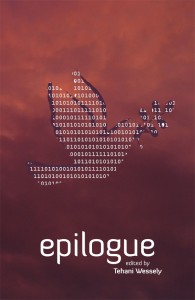 FableCroft has opened pre-orders on Epilogue, an anthology of stories about finding hope in the aftermath of the apocalypse. It’s exciting to read that the anthology is to be launched at Continuum in June, where Twelfth Planet Press should also be letting my Australian Gothic Salvage loose on the public as well.
Another title being launched at Continuum is Bread and Circuses (also available for pre-order), an anthology by the inimitable Felicity Dowker. Nom nom nom!
There are some old hands and new chums in the table of contents of Epilogue, which should make for some interesting and perhaps atypical reading for stories in this setting. Epilogue costs $20 including postage.
Also worth pointing out is that FableCroft has put After the Rain on special for $15 inc postage; it includes my cyberpunk yarn ‘Wet Work’.
And here’s a clue to one of the themes of my ‘Epilogue’ story, ‘Mornington Ride’:
Ditmar shortlists announced
The shortlists for the Ditmar awards, fan nominated and fan voted, have been announced. Interesting to note that, outside of the novel realm, small press dominate almost exclusively, and that fan publications has four podcasts to one paper newsletter; the Atheling, too, is heavy on the blogs. Hilarious and also exemplary is that Robin Penn’s ‘Ballad of the Unrequited Ditmar’ is in there, summarising pointedly yet with tongue in cheek a stoush in the community about, wonderfully, the Ditmars. The novels show a wide spread of genres and the novellas are particularly strong, showing perhaps a resurgence in the form. With e-publishing’s growth, I’d expect that to continue. The winners will be announced at Continuum 8 in Melbourne in June. Here’s the shortlist:
Best Novel
(HarperCollins)
Best Novella or Novelette
of Kali Yuga (Brimstone Press)
Ishtar (Gilgamesh Press)
Love and Romanpunk (Twelfth Planet Press)
Best Short Story
More Scary Kisses (Ticonderoga Publications)
Cravings (Tor)
Planet Press)
Best Collected Work
(Brimstone Press)
Press)
Planet Press)
Krasnostein (Twelfth Planet Press)
Best Artwork
Fantastically Rich and Strange Stories (Candlewick Press)
Best Fan Writer
Speculative Fiction in Focus! and Not If You Were The Last Short Story
On Earth
Speculative Fiction in Focus!, Not If You Were The Last Short Story On
Earth, and Randomly Yours, Alex
series in Adventures of a Bookonaut
Fanzines is Now”, and SF Commentary 81 & 82
Best Fan Artist
Time, SF Commentary and Scratchpad
including “The Dalek Game”
Best Fan Publication in Any Medium
Pierce
Best New Talent
William Atheling Jr Award for Criticism or Review
Year’s Best Australian Fantasy and Horror 2010 (Ticonderoga Publications)
Best of Science Fiction: A Review of Speculative Literature (Borgo Press)
New Who” series, in A Conversational Life
in Randomly Yours, Alex
Norrell by Susanna Clarke”, in Metamagician and the Hellfire Club