Salvage nominated in the Ditmar Awards

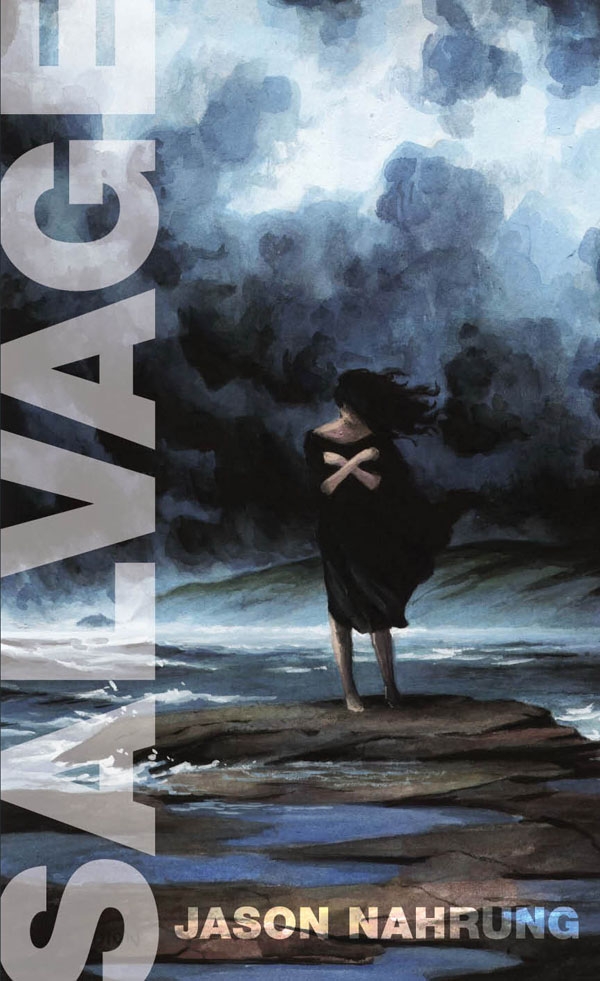
Salvage by Jason NahrungVery pleased to see Salvage among the six nominations for best novel of 2012 in the Ditmar Awards. The awards are popularly nominated and voted upon, so perhaps can be seen more as a measure of awareness within fandom, which makes the listing very cool.
Salvage and Blood and Dust are both finalists for best horror novel in the Aurealis Awards, and Blood and Dust is up for best novel in the Australian Shadows, so the Ditmar nom balances the books nicely!

There was a little confusion with Salvage, due its word count being precariously balanced on the cut-off 40,000-word mark between novella and novel. My fault, really: I should’ve got a final-version count from the publisher rather than going off an earlier version. We’re talking a difference of one or two sentences, but enough to tip it over into novel territory.

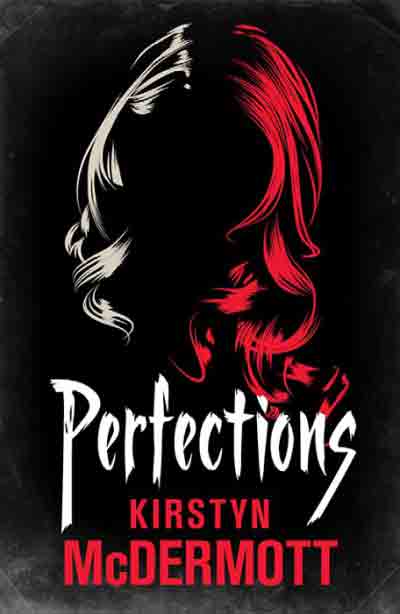
Also up for the Ditmar is a star-studded field, including Kirstyn’s Perfections — also a finalist in Aurealis and Shadows.

The awards will be announced at Conflux in Canberra in April. (Edit: I originally said the awards would be presented at Continuum in June; sorry Conflux!)

Once again, the Ditmars show the stature of podcasts and the internet in the realm of fan publications, and strong fields elsewhere. Here’s the full list:

Ditmar Finalists 2012

Best Novel

  • Sea Hearts, Margo Lanagan (Allen & Unwin)
  • Bitter Greens, Kate Forsyth (Random House Australia)
  • Suited (The Veiled Worlds 2), Jo Anderton (Angry Robot)
  • Salvage, Jason Nahrung (Twelfth Planet Press)
  • Perfections, Kirstyn McDermott (Xoum)
  • The Corpse-Rat King, Lee Battersby (Angry Robot)
  • Best Novella or Novelette

  • ‘Flight 404’, Simon Petrie, in Flight 404/The Hunt for Red Leicester (Peggy Bright Books)
  • ‘Significant Dust’, Margo Lanagan, in Cracklescape (Twelfth Planet Press)
  • ‘Sky’, Kaaron Warren, in Through Splintered Walls (Twelfth Planet Press)


    Best Short Story

  • ‘Sanaa’s Army’, Joanne Anderton, in Bloodstones (Ticonderoga Publications)
  • ‘The Wisdom of Ants’, Thoraiya Dyer, in Clarkesworld 75
  • ‘The Bone Chime Song’, Joanne Anderton, in Light Touch Paper Stand Clear (Peggy Bright Books)
  • ‘Oracle’s Tower’, Faith Mudge, in To Spin a Darker Stair (FableCroft Publishing)


    Best Collected Work

  • Cracklescape by Margo Lanagan, edited by Alisa Krasnostein (Twelfth Planet Press)
  • Epilogue, edited by Tehani Wessely (FableCroft Publishing)
  • Through Splintered Walls by Kaaron Warren, edited by Alisa Krasnostein (Twelfth Planet Press)
  • Light Touch Paper Stand Clear, edited by Edwina Harvey and Simon Petrie (Peggy Bright Books)
  • Midnight and Moonshine by Lisa L. Hannett and Angela Slatter, edited by Russell B. Farr (Ticonderoga Publications)
  • The Year’s Best Australian Fantasy and Horror 2011, edited by Liz Grzyb and Talie Helene (Ticonderoga Publications)


    Best Artwork

  • Cover art, Nick Stathopoulos, for Andromeda Spaceways Inflight Magazine 56 (ASIM Collective)
  • Cover art, Kathleen Jennings, for Midnight and Moonshine (Ticonderoga Publications)
  • Illustrations, Adam Browne, for Pyrotechnicon (Coeur de Lion Publishing)
  • Cover art and illustrations, Kathleen Jennings, for To Spin a Darker Stair (FableCroft Publishing)
  • Cover art, Les Petersen, for Light Touch Paper Stand Clear (Peggy Bright Books)

    Best Fan Writer

  • Alex Pierce, for body of work including reviews in Australian Speculative Fiction in Focus
  • Tansy Rayner Roberts, for body of work including reviews in Not If You Were The Last Short Story On Earth
  • Grant Watson, for body of work including the ‘Who50’ series in The Angriest
  • Sean Wright, for body of work including reviews in Adventures of a Bookonaut


    Best Fan Artist

  • Kathleen Jennings, for body of work including The Dalek Game and The Tamsyn Webb Sketchbook


    Best Fan Publication in Any Medium

  • The Writer and the Critic, Kirstyn McDermott and Ian Mond
  • Galactic Suburbia, Alisa Krasnostein, Tansy Rayner Roberts, and Alex Pierce
  • Antipodean SF, Ion Newcombe
  • The Coode Street Podcast, Jonathan Strahan and Gary K. Wolfe
  • Snapshot 2012, Alisa Krasnostein, Kathryn Linge, David McDonald, Helen Merrick, Ian Mond, Jason Nahrung et. al.
  • Australian Speculative Fiction in Focus, Alisa Krasnostein, Tehani Wessely, et. al.
  • Galactic Chat, Alisa Krasnostein, Tansy Rayner Roberts, and Sean Wright

  • Best New Talent

  • David McDonald
  • Faith Mudge
  • Steve Cameron
  • Stacey Larner
  • William Atheling Jr Award for Criticism or Review

  • Alisa Krasnostein, Kathryn Linge, David McDonald, and Tehani Wessely, for review of Mira Grant’s Newsflesh, in ASIF
  • Tansy Rayner Roberts, for ‘Historically Authentic Sexism in Fantasy. Let’s Unpack That.’, in tor.com
  • David McDonald, Tansy Rayner Roberts, and Tehani Wessely, for the ‘New Who in Conversation’ series
  • Liz Grzyb and Talie Helene, for ‘The Year in Review’, in The Year’s Best Australian Fantasy and Horror 2011
  • Rjurik Davidson, for ‘An Illusion in the Game for Survival’, a review of Reamde by Neal Stephenson, in The Age
  • Double trouble: Blood and Dust an Australian Shadows finalist

    In the same week that the Aurealis Awards listed Blood and Dust and Kirstyn’s Perfections as finalists for best horror novel of 2012, lightning has struck twice: both books were announced last night as finalists for the Australian Shadows best horror novel.

    This time, the pair is keeping company with Lee Battersby‘s Corpse Rat King.

    That short-list of three is overshadowed by the short fiction award finalists — eight of ’em! That’s a long short-list! I blame Kaaron Warren, who has not only three of the four yarns in her Through Splintered Walls collection listed there, but the fourth in long fiction (kind of a middle ground between short and novel) AND the collection itself. Pretty awesome, huh?

    Here’s the full list, with winners to be announced on April 12.

    Australian Shadows 2012 finalists

    NOVEL

  • Lee Battersby, The Corpse Rat King (Angry Robot)
  • Kirstyn McDermott, Perfections (Xoum)
  • Jason Nahrung, Blood and Dust (Xoum)


    LONG FICTION

  • Daniel I Russell, Critique (Dark Continents)
  • Robert Hood, Escena de un Asesinato (Exotic Gothic 4, PS Publishing)
  • Kaaron Warren, Sky (Through Splintered Walls, Twelfth Planet Press)


    SHORT FICTION

  • Felicity Dowker, To Wish on a Clockwork Heart (Bread and Circuses, Ticonderoga Publications)
  • Jason Fischer, Pigroot Flat (Midnight Echo 8, AHWA)
  • Martin Livings, Birthday Suit (Living with the Dead, Dark Prints Press)
  • Andrew J McKiernan, They Don’t Know that We Know What They Know (Midnight Echo 8, AHWA)
  • Kaaron Warren, Creek (Through Splintered Walls, Twelfth Planet Press)
  • Kaaron Warren, Mountain (Through Splintered Walls, Twelfth Planet Press)
  • Kaaron Warren, Road (Through Splintered Walls, Twelfth Planet Press)
  • Marty Young, A Monstrous Touch (Dangers Untold, Alliteration Ink)


    COLLECTION

  • Felicity Dowker, Bread and Circuses (Ticonderoga)
  • Martin Livings, Living With the Dead (Dark Prints Press)
  • Kaaron Warren, Through Splintered Walls (Twelfth Planet Press)


    EDITED PUBLICATION

  • Cthulu Unbound 3, eds David Conyers and Brian M Sammons (Permuted Press)
  • Surviving the End, ed Craig Bezant (Dark Prints Press)
  • The Year’s Best Australian Fantasy & Horror 2011, eds. Liz Grzyb and Talie Helene (Ticonderoga Publications)


  • New year, new home, new books!

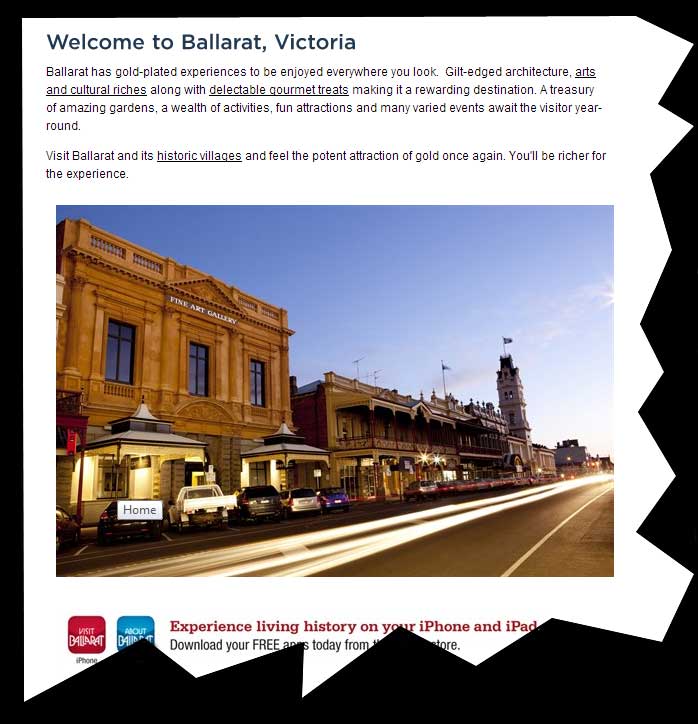
    website clipping of ballarat

    When I’ve told people we’re moving to Ballarat, there are two comments that usually follow: ‘Why?’ and, ‘It’s cold, y’know. Like, freezing.’

    To the latter, the simple answer is, y’know, coats. But the former is a bit more long winded, to do with property prices in Melbourne, and how Ballarat is as close as we could get to spitting distance of the big smoke, and how it’s got a uni and a writers’ centre and a literature festival (hey, it’s Victoria: what town doesn’t have a literature festival? or a market…), and so on. I liken it to being on the Sunshine Coast and working in Brissie, without the coast. Or the ranges, for that matter. Okay, so it’s got a train and it’s got two lanes of divided road with a respectable stretch of 110kmh in between, and it takes about same amount of time, traffic (an hour and a bit) and rail gods (90 minutes and a bit) allowing.

    Ballarat’s a tidy town, brimming with neat cottages and such, and history oozing out its mine shafts. No river to speak of, but lots of culverts, and a very fine lake with swans. I’m told it has a very good Irish pub, obviously that friend’s first memory of a previous visit, and a very fine bakery, too — my friends have broad tastes, clearly. Plus — OMG — an absinthe bar!

    Kirstyn and I are looking forward to exploring the place, and the surrounds — for instance, the Pyrenees wine district, which I’m told does a very drinkable shiraz, which is what I want in a wine region. Oh yes. AND we’ve spotted a cafe with a view of the cemetery from the al freso dining area — w00t!

    By the end of February, we’ll be Ballaratians. Some might pronounce the former Ballah-ratt-e-ans, but I’m thinking of going for Bal-ah-ray-shuns. I guess Rats could also come up. B-Rat is just far too street. I’m stopping now.

    So, a new address, our own patch of suburban dirt with a line already dotted out for a future chook pen, I believe. Excitements!

    To go with the new house, new books (though the books came first, to be honest), one apiece: my outback vampire road-trippin’ blood-lettin’ romp, Blood and Dust, and Kirstyn’s dark tale of family secrets, an amazing game of make believe and how what you wish for can be a tad detrimental, Perfections. Both are available now in digital formats (all of ’em) thanks to the small but passionate team at Xoum.

    There will be some kind of ceremony to mark the arrival of these two yarns into the wilds, but it’s been delayed by the move. One thing to be said for e-books — no packing!

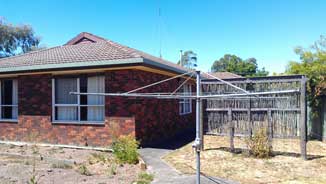
    house with Hills hoist

    A Hills hoist of our own


    Blood and Dust on the Christmas tree

    blood and dust by jason nahrung

    You can’t get much more Christmassy than outback vampires spreading mayhem in a Monaro, can you? That’s what publisher Xoum thought, too, and they’re spreading some Blood and Dust at tinsel time, just to keep it real.

    Read an extract from Blood and Dust

    Blood and Dust is now available digitally, at Amazon, iBooks … all over the place.

    Also out: Kirstyn’s Perfections, at the Xoum website and Amazon(and all the rest)!

    And of course, Salvage is still available in paperback ($17.50 inc postage) and for Kindle.

    Blood and Dust on the digital horizon aka Kevin the vampire lives!

    blood and dust by jason nahrung

    This is the cover for Blood and Dust, my outback vampire novel coming soonish to digital shelves everywhere thanks to Aussie publisher Xoum. I quite like it! (Honestly, the art dept has fkn nailed it, yeah?)

    The cat has kind of slipped out of the bag on this one, but it’s nice to be able to share the horror joy. The story’s more than 10 years and four major iterations in the making, and for those who know — this is the story of Kevin, the vampire. And yes, the Monaro is still there …

    You might have also noticed recently another lurvly book cover hitting the interwebs:

    perfections by kirstyn mcdermott

    Why yes, I have read an unedited version of this novel by Kirstyn McDermott, and yes, it is very good. Coming soonish, too!

    Brisbane launch for Salvage, and other Queensland events

    Salvage by Jason NahrungI’m very pleased to announce that Salvage will be enjoying a few days in the sun in Queensland.

    On Friday August 10, Kim Wilkins will be launching the book at Avid Reader in West End. It’s a free event, there will be wine: 6pm for 6.30pm, we get kicked out at 8pm. RSVP to Avid by emailing events AT avidreader.com.au or drop me a line and I’ll pass it on.


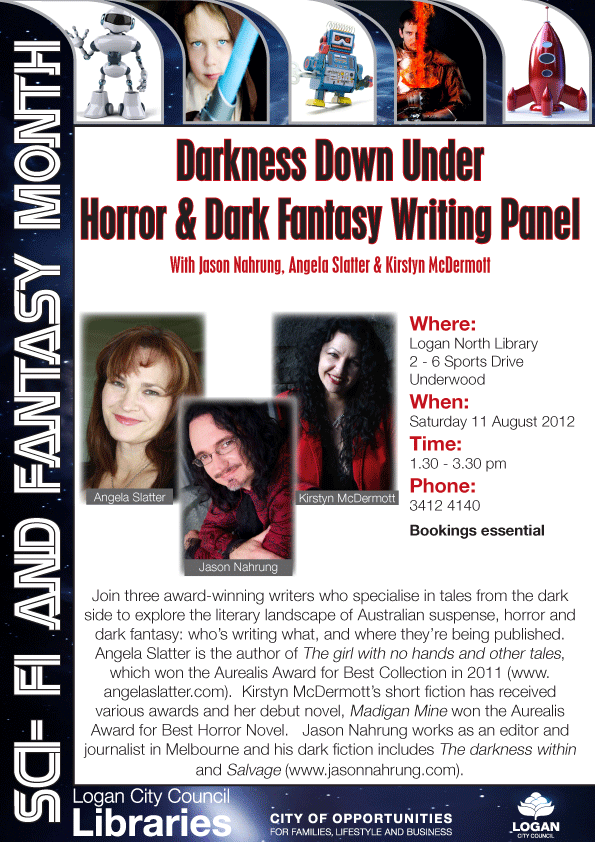
    On Saturday August 11, I’ll be on a panel at Logan North Library‘s Science Fiction and Fantasy Month with the inimitable Angela Slatter and Kirstyn McDermott, discussing all things dark and spooky: a snapshot of Australia’s dark fantasy and horror scene with plenty of market advice. The panel is 1.30-3.30pm so there’s plenty of time for questions and a chat. It’s free, but rsvp to the library on 3412 4140.


    And a heads up for folks on the Sunshine Coast: on Monday August 13, Caloundra Library is kindly having me in to present a talk about Salvage, landscape and Australian vampires, and I’ll backing up on Tuesday August 14 to do the same at Noosa. At this stage, it’s looking like 10am at Caloundra and 4pm at Noosa, but those times are to be locked in: let me know if you’re interested and I can keep you updated, or check with the libraries closer to the date.

    I’m particularly happy to be able to take Salvage to the coast, given that the book was written on Bribie Island and is so anchored in its setting — one not perhaps expected of a vampire story, even one that’s a little left of centre. Salvage will be available at all events, or can be found at select bookshops — ask your local! — or at the publisher’s website for $15 + postage, or direct from me if you’d like a signed copy.

    In Victoria, I know that Notions Unlimited has three signed copies. 🙂

    Writerly round-up: a new book, an award, a farewell

    It’s the afternoon after the four days that came before, and what a grand four days Continuum 8 offered. Held at Rydges in Carlton, where the bartenders were, as usual, outgunned by demand, the convention pulled together writers, publishers, readers and knitters (!) from around the country for the celebration of all things fantastical.

    Twelfth Planet Press launched new titles by Kaaron Warren — a printing error has meant a recall for those who have already snaffled the enticing collection — and Margo Lanagan (officially hitting the shelves in August) and my novella Salvage (yay!). Keep an ear out for a podcast recorded at the beautifully laid out Embiggen Books(timber shelves! ladders! SECRET DOOR!) about the Twelve Planets series of collections. [update: the podcast is now available here]

    Twelve Planets podcast

    Twelve Planets podcast at Embiggen Books

    There were panels on vampires, e-books, Australian writing and many other things; launches; parties; costumes; crafts; dinners on Lygon St; the nearest Japanese restaurant would’ve seen a pleasing surge in income. And there were awards, with Paul Haines and Sara Douglass both receiving posthumous accolades. A further highlight of the Ditmars was the squeaking octopii, given out as stand-ins when the actual awards failed to arrive in time.

    Also awarded were the Chronos awards, recognising achievements by Victorian writers, artists and fans, and how pleasing it was to receive one for ‘best fan writer’. A lovely acknowledgement of my new address! And Kirstyn and co-host Ian Mond landed Ditmar and Chronos awards for their podcast, The Writer and the Critic. The awards lists are below.

    Convention pictures by Cat Sparks*

    More pix from yours truly

    So amidst the catching up, the memorials and general frivolity, a bittersweet announcement has been made: my wonderful boss, Kate Eltham, is leaving the Queensland Writers Centre to take the reins at next year’s Brisbane Writers Festival. Kate is a dynamic woman and talented writer who has made the QWC such an active organisation, reaching out across the state and the nation and overseas through various programs all aimed at not just keeping writers of all ilks in the loop but helping them to be part of the loops. It’ll be interesting to see what new ideas she brings to the BWF. This is great news for Kate and a real shift of gears, but I confess that I will sure miss her. Good luck with it, mate!

    Kirstyn McDermott, Ian Mond host Continuum awards ceremony

    Kirstyn and Ian host the awards ceremony

    Ditmar Award winners:

    Peter McNamara Award: Bill Congreve

    A. Bertram Chandler Award:Richard Harland

    Norma K Hemming Award, TIE: Anita (AA) Bell for Hindsight; Sara Douglass for The Devil’s Diadem

    And a new award, the Infinity:Merv Binns

    Best Novel

    • WINNER: The Courier’s New Bicycle, Kim Westwood (HarperCollins)
    • Debris (The Veiled Worlds 1), Jo Anderton (Angry Robot)
    • Burn Bright, Marianne de Pierres (Random House Australia)
    • The Shattered City (Creature Court 2), Tansy Rayner Roberts (HarperCollins)
    • Mistification, Kaaron Warren (Angry Robot)

    Best Novella or Novelette

    • WINNER: ‘The Past is a Bridge Best Left Burnt’, Paul Haines (The Last Days of Kali Yuga)
    • ‘And the Dead Shall Outnumber the Living’, Deborah Biancotti (Ishtar)
    • ‘Above’, Stephanie Campisi (Above/Below)
    • ‘Below’, Ben Peek (Above/Below)
    • ‘Julia Agrippina’s Secret Family Bestiary’, Tansy Rayner Roberts (Love and Romanpunk)
    • ‘The Sleeping and the Dead’, Cat Sparks (Ishtar)

    Best Short Story

    • WINNER: ‘The Patrician’, Tansy Rayner Roberts (Love and Romanpunk)
    • ‘Bad Power’, Deborah Biancotti (Bad Power)
    • ‘Breaking the Ice’, Thoraiya Dyer (Cosmos 37)
    • ‘The Last Gig of Jimmy Rucker’, Martin Livings & Talie Helene (More Scary Kisses)
    • ‘Alchemy’, Lucy Sussex (Thief of Lives)
    • ‘All You Can Do Is Breathe’, Kaaron Warren (Blood and Other Cravings)

    Best Collected Work

    • WINNER: The Last Days of Kali Yuga, Paul Haines (Brimstone)
    • Bad Power, Deborah Biancotti (Twelfth Planet)
    • Nightsiders, Sue Isle (Twelfth Planet)
    • Ishtar, Amanda Pillar & KV Taylor, eds. (Gilgamesh)
    • Love and Romanpunk, Tansy Rayner Roberts (Twelfth Planet)

    Best Artwork

    • WINNER: ‘Finishing School’, Kathleen Jennings, in Steampunk!: An Anthology of Fantastically Rich and Strange Stories (Candlewick)
    • Cover art for The Freedom Maze (Small Beer), Kathleen Jennings

    Best Fan Writer

    • WINNER: Robin Pen, for The Ballad of the Unrequited Ditmar’
    • Bruce Gillespie, for body of work including The Golden Age of Fanzines is Now’, and SF Commentary 81 & 82
    • Alexandra Pierce, for body of work including reviews at Australian Speculative Fiction in Focus, Not If You Were The Last Short Story On Earth, and Randomly Yours, Alex
    • Tansy Rayner Roberts, for body of work including reviews at Australian Speculative Fiction in Focus, and Not If You Were The Last Short Story On Earth
    • Sean Wright, for body of work including ‘Authors and Social Media’ series in Adventures of a Bookonaut

    Best Fan Artist

    • WINNER: Kathleen Jennings, for work in Errantry, including ‘The Dalek Game’
    • Rebecca Ing, for work in Scape
    • Dick Jenssen, for body of work including work in IRS, Steam Engine Time, SF Commentary, and Scratchpad
    • Lisa Rye, for Steampunk Portal series
    • Rhianna Williams, for work in Nullas Anxietas Convention Program Book

    Best Fan Publication in Any Medium

    • WINNER: The Writer and the Critic podcast, Kirstyn McDermott & Ian Mond
    • SF Commentary, Bruce Gillespie, ed.
    • Galactic Chat podcast, Alisa Krasnostein, Tansy Rayner Roberts & Sean Wright
    • Galactic Suburbia podcast, Alisa Krasnostein, Tansy Rayer Roberts, & Alex Pierce
    • The Coode Street podcast, Gary K. Wolfe & Jonathan Strahan

    Best New Talent

    • WINNER: Joanne Anderton
    • Alan Baxter
    • Steve Cameron

    William Atheling Jr. Award for Criticism or Review

    • WINNER: Alexandra Pierce & Tehani Wessely, for reviews of The Vorkosigan Saga, in Randomly Yours, Alex
    • Russell Blackford, for ‘Currently reading: Jonathan Strange and Mr. Norrell by Susanna Clarke’, in Metamagician and the Hellfire Club
    • Damien Broderick & Van Ikin, for editing Warriors of the Tao: The Best of Science Fiction: A Review of Speculative Literature
    • Liz Grzyb & Talie Helene, for ‘2010: The Year in Review’, in The Year’s Best Australian Fantasy and Horror 2010
    • David McDonald, Tansy Rayner Roberts & Tehani Wessely, for ‘Reviewing New Who’ series, in A Conversational Life


    Chronos Awards

    Best Long Fiction: The Last Days of Kali Yuga, Paul Haines (Brimstone Press)


    Best Short Fiction: ‘The Past is a Bridge Best Left Burnt’, Paul Haines (in The Last Days of Kali Yuga)


    Best Fan Writer: Jason Nahrung


    Best Fan Artist: Rachel Holkner


    Best Fan Written Work: ‘Tiptree, and a collection of her short stories’, Alexandra Pierce (in Randomly Yours, Alex)

    Best Fan Artwork: Blue Locks, Rebecca Ing (Scape 2)

    Best Fan Publication: The Writer and the Critic, Kirstyn McDermott and Ian Mond

    Best Achievement: Conquilt, Rachel Holkner and Jeanette Holkner (Continuum 7)


    * It’s possible there might be a photo of me with a bottle of wine and a glass: I was pouring for other people. Honest.

    Snapshot 2012: Alison Goodman

    australian speculative fiction snapshot 2012 logoALISON Goodman has been writing and being published for almost 24 years. She began to get published in her second year of university – mainly feature articles and short stories – and her first novel came out in 1998: Singing the Dogstar Blues, a young adult science fiction thriller. It won the Aurealis Award for Best YA novel and was an ALA Best YA book. That was followed by her crime thriller, Killing the Rabbit, published originally in the USA, and which is now about to be re-released in print in Australia and as an e-book under the new title, A New Kind of Death.

    Her latest two books are the fantasy duology Eon and Eona, which were New York Time Bestsellers and have been published in more than 18 countries and 10 languages. Eon (under its initial Australian title The Two Pearls of Wisdom) won the 2008 Aurealis Award for Best Fantasy Novel and was also an ALA Best YA book and a James Tiptree Jr Honour Book.

    This year, Alison has been contracted to write a new historical/supernatural series with publishers in the USA, Canada and Australia. The first book is due out in 2014.

    Keep in touch with developments at www.alisongoodman.com.au and her Facebook page.

  • Alison is guest of honour at Continuum, starting TOMORROW NIGHT at Rydges on Swanston in Melbourne.
  • YA SF, crime, Chinese-influenced fantasy … have you picked stories to best address certain themes, or are you just having a grand old time in all the diversity genre has to offer?
    I suspect a bit of both. In terms of genre, I go where the story takes me. When I have the initial idea for a book or series, I take note of where it seems to fit in the genre market and think about the conventions of that genre. If some of them work for me, I’ll use them (either with or against the expectations). However, I don’t feel obliged to stick faithfully to the conventions or, indeed, to one genre. I do like to meld genres, which can bring a whole bucket load of problems with it but is a lot of fun to write.

    In terms of themes within a novel, I usually find that I may start with an idea of a thematic line – developed from the plot and character – but find that other, stronger themes emerge as I write. Having said that, the thematic starting point is not usually the driving force for me in my writing process – I am more engaged by character and plot and these supply the passion that propel me. So, I don’t feel that I pick stories to write by the appeal of their themes. Still, it is not really possible to separate out those three elements – plot, character, and theme. They are so deeply entwined in the development of my fiction that at least some of each needs to be in place before I start writing.

    Romantic plotlines, of varying degrees, operate under some level of mostly social pressure duress in your books, and happy endings are not guaranteed. In what ways is love, whether unrequited, doomed or conquering all, important to your storytelling?
    I think it is more that desire is important to my storytelling, rather than love. That often includes the desire for love, but I think that is secondary to the desire for the ultimate goal of the main character, be it power as in the Eon duology or truth in A New Kind of Death (Clan Destine Press). Love is not the main goal of my characters, but it is almost always part of their motivation. How characters go about loving or seeking love is a fundamental building block of my characterisation. It is not the driving force of the main plot-line – that is the domain of romance fiction – but it is one of the elements that adds depth and universality to the characters, and provides sub-plots that support and add duress to the events in the main plot.

    You’re in the midst of a research trip to Europe for your new series. Has anything you’ve unearthed been wonderfully surprising, the kind of thing where you just HAVE to use it in the books?
    Yes, I came across a porcelain women’s urinal shaped like a lady’s slipper. In time of necessity in a crowded royal drawing room, it was slipped under one’s huge hooped court dress and clutched between the thighs! That is definitely going into my novel. However, I’m always wary of bunging in a bit of research because I like it. For me, research has to be at the service of the story and the fastest way to become a bore is to write pages of research detail and go off-story.

    I recently read an article by James Wood in the on-line New Yorker about Hilary Mantel’s Thomas Cromwell novels, but it is also about writing good historical fiction. Wood writes that:

    ‘..what gives fiction its vitality is not the accurate detail but the animate one … novelists are creators, not coroners, of the human case’.

    That really hit a chord with me. When I am researching, I look for those shining details that are going to give the flavour and energy of the time without weighing down my story…such as a urinal for women that is shaped like a shoe.

    What Australian works have you loved recently?
    This is where I shift uncomfortably and confess that I haven’t read much fiction lately because it has been all about researching my new series. My stack of fiction To-Be-Reads is huge, but I have just finished Garth Nix’s new book A Confusion of Princes which was magnificently inventive with a great, wry narrator and a lot of satisfying action. I’m also reading an advance copy of Kirstyn McDermott’s new novel Perfections, which is heart-achingly gorgeous. Mostly, though, I have been reading primary and secondary source research books, which sounds dry but is actually a lot of fun. And, as it happens, one of the most valuable research books I’ve come across so far has been by an Australian – Jennifer Kloester – who has written an excellent guide to the Regency era in Georgette Heyer’s Regency World.

    What have been some of the biggest changes in Australian speculative fiction in the past two years since Aussiecon 4?
    I think some of the biggest changes in Australian speculative fiction are the same changes that have been hitting all of publishing. What immediately comes to mind is the rise of the e-book and the crisis of the bookshop. The gathering force of the e-book is offering some great opportunities for authors – more control over backlists and a greater cut of the royalties – but as with all these new modes, it also brings challenges that often leave many behind. The demise of so many of our bookshops breaks my heart, and I sincerely hope that Australia does not follow in the footsteps of Britain and starts closing libraries too.

    Another change that I think has particularly affected the speculative fiction market is the ‘phenomenon book’ such as Harry Potter, Twilight and The Hunger Games series. They can all be gathered under the banner of the speculative genre and, I think, have opened up new audiences to our work, and in fact, to the idea of reading for pleasure.

    * THE END *

    THIS is my final interview conducted as part of the 2012 Snapshot of Australian Speculative Fiction. We’re blogging interviews from 1-8 June and archiving them at Australian Speculative Fiction in Focus: the list of interviewees is here. You can also read the interviews at:

    Snapshot 2012: Rjurik Davidson

    australian speculative fiction snapshot 2012 logoRJURIK Davidson is a freelance writer and associate editor of Overland magazine. Rjurik has written short stories, essays, reviews and screenplays. PS Publishing published his collection, The Library of Forgotten Books, in 2010. His novel, Unwrapped Sky, will be published by Tor in 2012. He writes reviews of speculative fiction for the Age newspaper, film reviews for several magazines and has a regular column in Overland. Rjurik’s screenplay The Uncertainty Principle (co-written with Ben Chessell) is currently under development with German company Lailaps Films. He has been short-listed for and won a number of awards. He can be found at www.rjurikdavidson.blogspot.com and has a blog on the Overland website called Against Reality.

    You have a collection and, in the pipeline, novels set in your world of minotaurs and sirens: how have you approached such mythic creatures in your fiction?
    As a child I read the Greek myths and, around the age of six, my imagination was captured by the ruins of Ancient Rome. There’s always been something transcendent about myth, which is why they still resonate with us. But in my stories, I wanted to approach the mythology — minotaurs, sirens, cyclops and gorgons — with a modern sensibility. That is, I wanted to keep the sense of myth and the mythic, but place it within an industrial world. The minotaur myth, for example, is sometimes said to be about technology: Theseus finds his way through the minotaur’s labyrinth with a ball of string. In a sense, ‘The Passing of the Minotaurs’ <read the short story at SciFi.com> — which is an extract from an early section of Unwrapped Sky — is a rewriting of this myth in an industrial capitalist world. The minotaurs are undone by modernity — by the power of commodification, if you like, in a similar way to many old and beautiful things in our world (old buildings or old forests, for example).

    This fantasy world, and the city of Caeli-Amur, might be thought of as city a bit like Rome or Turin in the 1920s. In Caeli-Amur, there’s industrialism, a rising working class, a strange bureaucratic capitalism, but there’s also the remnants of an older less developed society, and even further back the ruined remnants of a more advanced society. So the mythology all takes place in a world where there’s a great deal of of change. There’s social turbulence. No one quite knows where it’s all headed. It is a world where ‘all that is solid melts into air, all that is holy is profaned’ as Marx once described it. What could be more profane than the death of a minotaur and the use of its body parts as commodities?


    Have the short stories been a way of exploring the world in preparation for the longer works, or were the novels always the end goal?
    I love short stories. In many ways, they’re more interesting than novels. You can be more experimental and you can be more adventurous in content. Quite often, the things which become famous at novel-length are first done in short story form (think of Gibson, for example). The stories gain a certain notoriety and this encourages the writer to develop those sorts of stories at longer length. One of the reasons is that novels have a slightly longer shelf-life, and there’s a little more money in them. That’s the way it happened with me, anyway. People liked Caeli-Amur and the stories set there, so I thought, right, time to write a novel set there. Still, I’ll always write short stories, just as I’ll always write essays and scripts and other things.


    You are an editor on a literary magazine and you’re a Ditmar winner for best new talent: what’s your take on the literature/genre divide?
    Oh, I have several responses, all pretty contradictory. My first response is that the division is false. Writers like Atwood, Ishiguru, Houllebecq and Winterson are clearly writing SF. On the other hand, there are plenty of SF writers writing very ‘literary’ science fiction: Gene Wolfe or M John Harrison, for example. Partly the division is invented by the marketing departments of publishing companies, partly there’s an inherited prejudice against SF in the ‘mainstream’ (which I find ignorant and repulsive), but there’s also quite often a self-reinforced ghettoisation from the SF community also.

    I find it all pretty frustrating because there are all sorts of deleterious effects of the division. SF writers are unfairly ignored and ‘literary’ writers writing SF too-often claimed as ‘original’ when they’re really borrowing tropes that have been around for decades. At Overland we try to be inclusive: we’ve had special SF editions, publish SF stories and articles, but I do feel fairly sad that the SF community pretty much ignores us — something reflected not only in terms of our submissions but reflected in things like awards, links to our online articles and so on.

    Another passed-down quirk of the division between the literary and SF worlds is the over-emphasis on plot-driven narrative in genre. Genre writers, readers and editors probably do want more ‘action’ than the literary world (which could often do with more action!). I’m not sure that’s healthy. Having said that, the SF community is a really welcoming and in the end, in terms of fiction, that’s where I happily exist.


    What Australian works have you loved recently?
    There’s a bunch of really great Australian SF writers. In fact, I’m amazed by the talent in Australian SF. I’ve loved stories by James Bradley, Lisa Hannett, Angela Slatter. But you know, I’m constantly surprised by the number of new writers coming though. And then there are other wonderful writers who have been around a while: Kirstyn McDermott, Margo Lanagan, Deborah Biancotti, Trent Jamieson and so on. I might say that the loss of Paul Haines leaves a massive hole in the SF scene.


    What have been some of the biggest changes in Australian speculative fiction in the past two years since Aussiecon 4?
    I’m not sure I could answer that. I’ve been a bit lost in novel-writing. But things seem to be coming along okay. The Aurealis Awards I went to last year were vibrant and professional, and the writers coming through, as I mentioned before, are talented. The end of Clarion South is a pretty big blow, I think, and there’s the ongoing ‘digital’ revolution (Aurealis is now mostly in e-book format).

    The challenges here are going to be the challenges the whole publishing industry is facing. No one can be sure quite where we’ll end up, but it seems likely that there will be less money around, and fewer readers (the statistics show that the average reader age is increasing). None of this is great for writers or publishers and we can expect that as an money-making industry, publishing might be on its last legs.

    At Overland we’ve been debating this for some time (on the website, in public forums and in the magazine’s pages) and some of us think that the solution may be to return to a more, for want of a better term, ‘social-democratic’ system, where the government funds an independent publishing house (or houses?) in the way it funds something like the ABC.

    In this sense, the challenges of publishing are similar to those of quality Australian TV drama, which can’t compete with international TV without stepping out of the system of commercialism. SF steps out of these bounds with labour-of-love small presses (which are wonderful), but they’re not a way for anyone to earn a basic living.

    * * *

    THIS interview was conducted as part of the 2012 Snapshot of Australian Speculative Fiction. We’re blogging interviews from 1-8 June and archiving them at Australian Speculative Fiction in Focus. You can read interviews at: