Wishlist Aussie books: Peacemaker, Lascar’s Dagger, Path of Night

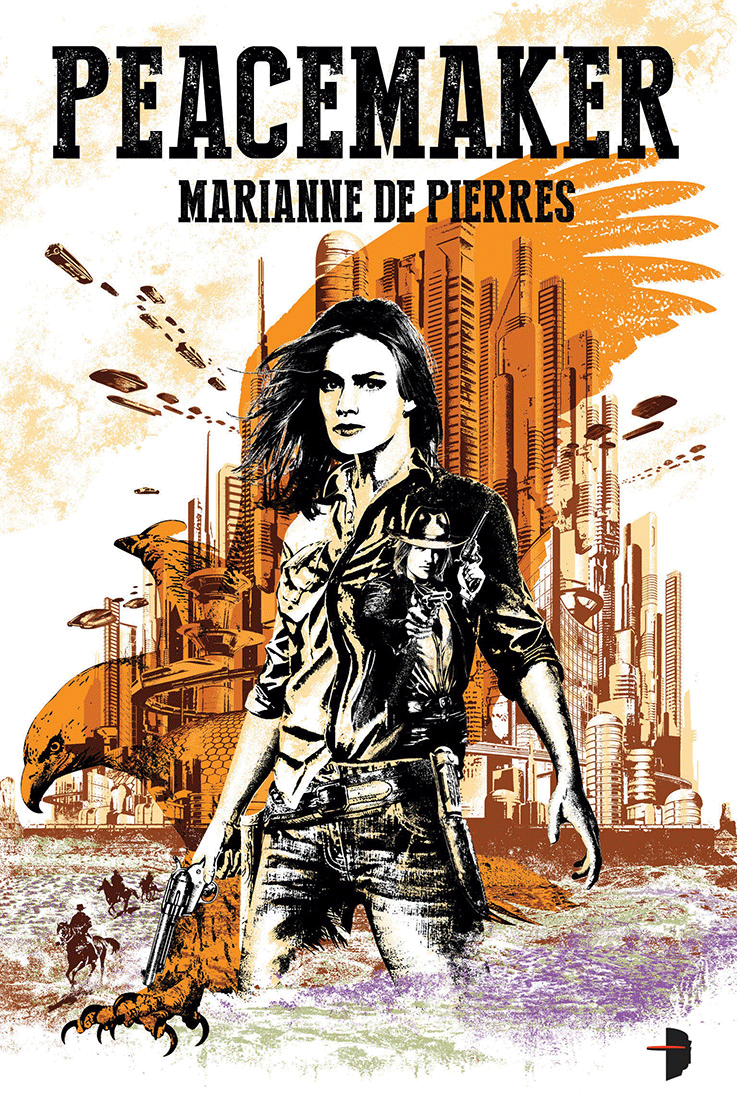
peacemaker by marianne de pierres


I read the short story *years* ago, and then there was a comic, and now there’s the novel: Peacemaker is on its way in May next year through Angry Robot books. It’s about a ranger protecting our last wilderness area, but of course there is some corporate shenanigans going on. One to keep an eye out for!


lascars dagger by glenda larke

Another one to check out is Glenda Larke’s The Lascar’s Dagger, coming from Orbit in March. I love Larke’s worldbuilding and storytelling, so this new fantasy series can’t come soon enough. Probably my favourite Larke book, The Aware, has been re-released by FableCroft, who has also recently released Path of Night, by Dirk Flinthart. I’ve enjoyed Flinthart’s short stories for yonks — they are succinct and emotive — so his first novel-length work should be a hoot: says Dirk, ‘It’s got guns and motorbikes, vampires and cops, sax and violins and a buttload of conspiracies, plot twists and action as well as a distinctly Australian setting and sense of humour.’
path of night by dirk flinthart


Focus 2012 now on sale

focus 2012 coverFableCroft has announced their highlights anthology of 2012 short fiction is now available — ‘Mornington Ride’ is rubbing shoulders with brilliant company. Check out this contributor list! With illustrations and cover by Kathleen Jennings!
Joanne Anderton – ‘Sanaa’s Army’
Thoraiya Dyer – ‘The Wisdom of Ants’
Robert Hood – ‘Escena de un Asesinato’
Margo Lanagan – ‘Significant Dust’
Martin Livings – ‘Birthday Suit’
Kaaron Warren – ‘Sky’
You can read about it, and order it in the digital format of your choice, at the website.

Trucksong — haz music!

trucksong by andrew macraeFriend Andrew Macrae launched his novel Trucksong last night — an excellent, crowded launch with psychedelic David Lynchian underpinnings — and in the spirit of multimedia shenanigans, has a soundtrack to go with it! The book is a postapocalyptic tale of a fella in the Australian wilderness looking for a kidnapped woman with an INTELLIGENT TRUCK for an ally. Mad Max on cyberpunk steroidsd or what? The soundtrack sounds like just the thing for a Nullarbor road trip. Here’s hoping Andy gets plenty of mileage from Trucksong!

Honourable mentions by Ellen Datlow

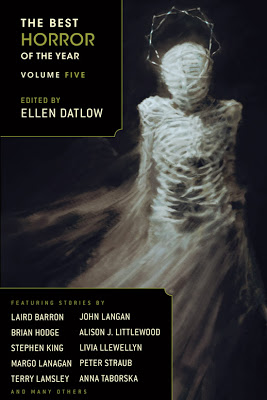
best horror of the year volume 5 edited by ellen datlowEditor extraordinaire Ellen Datlow has released the LOOOOONG list — and it’s true to label, appearing in two pieces (Alexandra to Johnstone, Jones to Yolen) on her blog — to go with the short list of honourable mentions of short stories from 2012, anchored by her Best Horror of the Year Volume 5. The short list appears in the book; the long list doesn’t. Despite the collapse and sale of publisher Night Shade, the book’s listed as available on Amazon.

So why am I mentioning this? Because Datlow has seen fit to list three of my yarns in the long list — ‘The Kiss’ from Tales from the Bell Club, ‘Last Boat to Eden’ from Surviving the End, and ‘Breaking the Wire’, from Aurealis #47 — and ‘Eden’ made it through to the short list.

There is a whole posse of Aussie talent in the lists, and stories by Margo Lanagan and Terry Dowling made it into the collection.

To get a pat on the back from anyone is always a warm and fuzzy moment; to get it from someone with Datlow’s pedigree, and knowing just how widely she reads to compile these lists, well, that’s very nice indeed.

It’s especially cool to see ‘The Kiss’ get a mention: writing in the voice of a turn-of-the-last century Austrian suffragette was quite fun, and one of the first yarns I’ve written involving historical figures. If you go to the link above, you can read the little sucker in the ‘look inside’ feature!

Ticonderoga’s recommended reading list: we have squee!

years best fantasy and horror 2012Just a wee note to say, yay, ‘Mornington Ride’ from Epilogue and ‘Breaking the Wire’ from Aurealis #47 have been included in the recommended reading list from Ticonderoga Publications’ forthcoming Year’s Best Australian Fantasy and Horror 2012. ‘Last Boat to Eden’, from Surviving the End, is included in the volume (I blogged the full contents of this packed volume here). My ego aside, it’s a good place to start if you’re looking to take the pulse of short Aussie dark fiction. The book is available for pre-order.

The Burial: uncovering some natural talent

the burial by courtney collinsThe Burial is the debut novel from Courtney Collins, and it has been received well enough – short listings for the Stella Prize and the NSW Premier’s Literary Awards, a long-listing for the Dobbie – to earn her a place in Australia’s literary delegation to the UK.

The voice is a large part of its appeal, one suspects. Narrated by a dead baby who’s been buried in the earth, it might not surprise that a large part of the story concerns relationships with the earth: a part-Aboriginal stockman cum tracker, a city-trained policeman with his own destructive obsessions, and the heroine of the piece: outlaw Jessie Hickman.

Jessie is based on a real person, one who had a vague legendary status in the area of NSW where Collins grew up. Few details of her life were available, but there were police records and a mug shot.

Jessie was a circus rider, a wild child, a horse thief.

Her life in 1920s Australia, as imagined by Collins and recounted by Jessie’s dead child, is one of displacement and discomfort, of trying to find one’s place. For Jessie, that happiest place seems to be on horseback.

Backgrounding the tale is life in the rural back blocks, still a frontier post-World War I, with broken soldier settlers eking out their livings in the wild country, the law mistrusted by all, and women – those hardy few – getting the rough end of the stick.

It a place where Jessie is indentured to Fitz, whose brutal hold on Jessie sets up the core of the story: a protracted pursuit that gathers pace as the tracker and the copper get their act together, drawn together by their mutual history with Jessie, who wants only to be free — even if she isn’t entirely certain what that freedom might entail.

australian women writers review challenge logoThe story of Jessie’s flight into the high country is interspersed with flashbacks of her journey to these straits, and insights into why these two men pursue with such persistence.

But it is the bush that is the major backdrop and a key character, shaping these lives on the edge of civilisation, offering both threat and succour.

Collins’s prose has a cadence, with drawn-out sentences clopping along with conjunctions to offer a folkloric, lyrical atmosphere. The sense of the tale being narrated in an otherworldly fashion is enhanced by the use of italics for dialogue, rather that punctuation marks. The story could have afforded to lose a few extraneous scenes, but overall it draws the reader on as pursuers and pursued head to their inevitable resolution.

There is, however, no historical conclusion to The Burial; with the focus on the environment and adapting to it, its conclusion possibly owes a debt to Picnic at Hanging Rock and that fascination with civilisation vs nature, that throwing off of social binds and embracing the environment. Certainly, The Burial is a worthy companion to that section of Australian literature that examines our place in this environment. I wonder what the Poms will make of it.

A most Delicate Truth from John le Carre

delicate truth by john le carreJohn le Carre‘s spy novels were always a cut above for me; him and Frederick Forsyth ruled my thriller firmament in my teens, when the second-hand book stores were raided for the Colin Forbes, Len Deightons, Adam Halls, the Bond books, and soforth.

It was le Carre’s mood that won me, the sheer honesty of his tales in which grey was the colour de rigeur and the good guys, if you could find them, were never guaranteed of victory. As with the Cold War, everyone was playing for a draw.

In A Delicate Truth, his latest, he examines matters of conscience and political expediency, as a former British diplomat and a serving public servant find an incident on Gibraltar has not so much a delicate truth but a damned inconvenient one for Her Maj’s government. Against the backdrop of terrorism and rendition, mercenaries and dirty tricks, it’s a fraught tale of men unable to sleep easily with guilt and the ways in which the system seeks to silence them.

The characters are stoic, suitably reserved, in their dealings, and the dialogue is brilliantly esoteric, with echoes of phrases used to at times Yes Minister levels of cutting effect within the overall atmosphere of growing malevolence. Le Carre knows when to be sparse and when to use his astute descriptions of setting, a wonderful example of crafted world building.

While the end note was superb, the actual climax felt a little convenient, just a touch, but in no way undermined the story or the carefully presented character arcs that brought it about.

It’s been a long time since I devoured The Spy Who Came in from the Cold and Tinker Tailor Soldier Spy — the Tomas Alfredson movie was beautifully realised — but A Delicate Truth takes me right back to the joy of those masterpieces. Le Carre is as foxy as he ever was.

Black Spring by Alison Croggon: revisiting Heathcliff for a spell

black spring by alison croggonAlison Croggon, whose fantasy novel The Gift (first of the Pellinor series) floated my boat way on release in 2002, has done a fine job of cutting to the chase in Black Spring (Walker Books, 2012), which makes no bones about its strong foundation in Emily Brontë’s Wuthering Heights.

Croggon takes the structure — a narrator arrives, meets some of the players and receives the story in a monologue from someone in the know — the mood and the cornerstones of the plot about thwarted desire, class and revenge, but does some elegant re-imagining.

UPDATE, VIDEO: Alison Croggon talks Wuthering Heights, Emily Brontë and Black Spring at the Wheeler Centre

The moors are out; instead, it’s a highland plateau — just as isolated, just as windswept — with a touch of the fantastic.

Narrator Hammel, a writer, begins in an almost New Weird setting of hedonistic city, where the literati have their own guild and a certain social sway. It might bring to mind the shenanigans of the Romantics wine bar crowd. Hammel retires to the north, a rented manor in sight of the Black Mountains. The plateau is a land of mystery, a kind of Transylvania meets Sicily, with changeable weather and a certain harshness, just right for this dark tale. It’s a land of small villages, of priests vying with magicians for the fear of the populace if not their hearts, of rampant superstition … and the vendetta, a way in which the king’s coffers are enriched and the male population is culled.


It might be a fantastical setting but for the incongruous presence of the Catholic church, uncomfortable in a land where magicians really can burn people from the inside out, send curses and engage in psychic combat, making this more of an alternative realm.

Hammel meets the Heathcliff analogue, Damek; has a suitably wonderful paranormal experience in line with Lockwood’s dream of Cathy in the Brontë version; and then is told the tragic story of Damek’s obsession with Lina, the daughter of the local lord both blessed and cursed with royal and witch blood.

Perhaps the most notable departure from Brontë’s text is in the ending — this isn’t called Black Spring for nothing!

The characters are all suitably flawed, each unable to prevent the inevitable tragedies that drag them all down.

Croggon uses suitably prose of the era with all her poetic might, delivering a satisfying if — as I recall the original — slow-paced recounting of love and revenge.

  • This is my fourth review as part of the 2013 Australian Women Writers Challenge — the first was Glenda Larke’s Havenstar; the second, Krissy Kneen’s Steeplechase; the third, Christine Bongers’ Dust — and completes my commitment to review four titles. There are, however, more on the shelf — let’s see how I go!
  • Dust, by Christine Bongers: easy to take a shine to

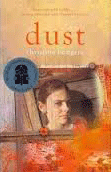
    dust by christine bongersIt’s not hard to see why Dust (Woolshed Press, 2009) was named a Children’s Book Council of Australia notable book, among its many accolades. It’s a simple, powerful coming-of-age story, the sort of thing that’s just the ticket for school libraries. Fairly subtle, too.

    Chris Bongers grew up in Biloela and she taps that experience in this tale set in the countryside of her childhood. Like heroine Cecilia, Bongers had a mob of brothers to run amok with, too: how many chinese burns, corkies and horse bites did she trade? Droughts and flood and heaps of strine are, however, only the wonderfully drawn backdrop of this tale, set in the 1970s with a modern bookend.

    Cecilia is on the cusp of moving from primary school to high, and there’s a steep learning curve to do with being yourself, of making choices, of caring for those on the fringes who have no one to care for them.

    Working up ways to dodge the worst of penance in the confessional is just the start of it.

    There’s the mysterious Kapernicky sisters, chalk and cheese and both just a little off; and the new girl, peaches-and-cream Hayley in her revelatory knee-high white boots; and Glenda with her ciggies and alluring coterie of no-gooders … and just what has got into Cecilia’s brother, Punk?

    australian women writers review challenge logoBongers has the knack of flipping the switch from larrikin humour to pathos. Of painting her characters in human strokes, the good with the bad with the damn frustrating. Of letting the time go by, incident by incident, letting the allusions grow as the illusions slowly fade.

    She perfectly captures that onset of maturity, young people trying to make sense of the world. Coming to realise that the dust of regret accumulates, seeking a way to keep the surfaces clean or at least keep the rug in its place; discovering the power of compassion.

  • This is my third review as part of the 2013 Australian Women Writers Challenge. The first was Glenda Larke’s Havenstar; the second, Krissy Kneen’s Steeplechase.
  • Steeplechase, by Krissy Kneen — that’s quite a ride

    steeplechase by krissy kneenBrisbane writer Krissy Kneen has a deft touch with prose; her character’s voice in Steeplechase (Text, 2013) flows off the page, captivating and intriguing and thoroughly believable. And what a tale she tells, of her and her sister, her mother and Oma, all locked up in a history of mental illness where reality and truth are stretched to breaking point, not unlike a painter’s canvas stretched on a rack.

    For Emily Reich is a painter of renown, having left her sister Bec — our narrator — in the shade.

    Life for the sisters has been insular, to say the least, with their grandmother running the house, father gone, mother herself locked away inside a mental breakdown of sorts, a haunting presence that dominates the rural homestead. Stern Oma restores paintings for a living; she sequesters the girls, perhaps fearful of them falling prey to their mother’s sickness. For naught, as it happens.

    Emily, having had her turn with illness, is in China, living large on her renown, while Bec, still very much in her shadow and more than a little fragile herself, ekes out a living as an art teacher and painter of less renown.

    There’s that student Bec’s bonking — how wrong, but yet, so occasionally right — and there’s the imaginary boy who teased her and her sister so magnificently; the neighbour’s horse of childhood distractions, the games of steeplechase in the back yard, sisterly dynamics and a past disaster that hangs over them both.

    I’ve read the word ‘claustrophobic’ used to describe the first section of this two-parter, and it’s a good choice, the past infusing the present, Bec locked between the two. And in her future, inducing yet further unease, that invitation from her sister to attend an exhibition in China — the second part, less claustrophobic but no less unsettling as Bec flounders in the foreign streets, trying to work through to the truth of the past and forge an understanding with her brilliant, troubled sister.

    My only hesitation of the course was in the denouement: a little too much too soon for me, but I can’t argue that Bec earned her just rewards.

    Identity, mental illness, art and, yes, horses — though equestrians might not find much to please them, here — form this delicious miasma, with the weather — sub-tropical Brisbane, I belatedly realised; and confronting, bird-less Beijing, Kneen drawing on her time there to invoke smells and sights fit to alienate our heroine — used superbly to enhance the mood.

    Kneen debuted sensationally with her gorgeously rendered erotic memoir Affection and followed that with thoughtfully pornographic Triptych (which I have yet to read), both through Text; this, her first foray into less salacious fiction, confirms she’s a writer who deserves to go the distance.

  • This is my second review as part of the 2013 Australian Women Writers Challenge. The first was Glenda Larke’s Havenstar.