Brisbane launch for Salvage, and other Queensland events

Salvage by Jason NahrungI’m very pleased to announce that Salvage will be enjoying a few days in the sun in Queensland.

On Friday August 10, Kim Wilkins will be launching the book at Avid Reader in West End. It’s a free event, there will be wine: 6pm for 6.30pm, we get kicked out at 8pm. RSVP to Avid by emailing events AT avidreader.com.au or drop me a line and I’ll pass it on.


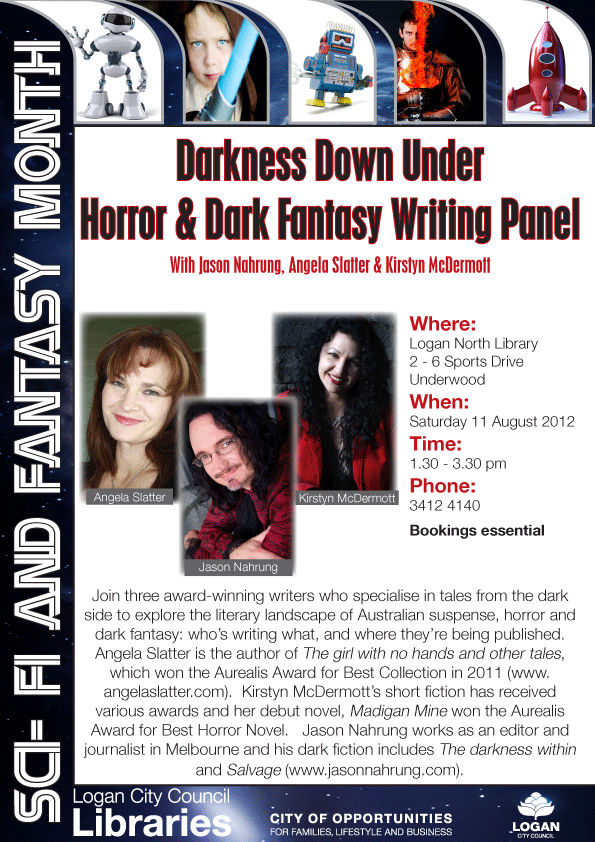
On Saturday August 11, I’ll be on a panel at Logan North Library‘s Science Fiction and Fantasy Month with the inimitable Angela Slatter and Kirstyn McDermott, discussing all things dark and spooky: a snapshot of Australia’s dark fantasy and horror scene with plenty of market advice. The panel is 1.30-3.30pm so there’s plenty of time for questions and a chat. It’s free, but rsvp to the library on 3412 4140.


And a heads up for folks on the Sunshine Coast: on Monday August 13, Caloundra Library is kindly having me in to present a talk about Salvage, landscape and Australian vampires, and I’ll backing up on Tuesday August 14 to do the same at Noosa. At this stage, it’s looking like 10am at Caloundra and 4pm at Noosa, but those times are to be locked in: let me know if you’re interested and I can keep you updated, or check with the libraries closer to the date.

I’m particularly happy to be able to take Salvage to the coast, given that the book was written on Bribie Island and is so anchored in its setting — one not perhaps expected of a vampire story, even one that’s a little left of centre. Salvage will be available at all events, or can be found at select bookshops — ask your local! — or at the publisher’s website for $15 + postage, or direct from me if you’d like a signed copy.

In Victoria, I know that Notions Unlimited has three signed copies. 🙂

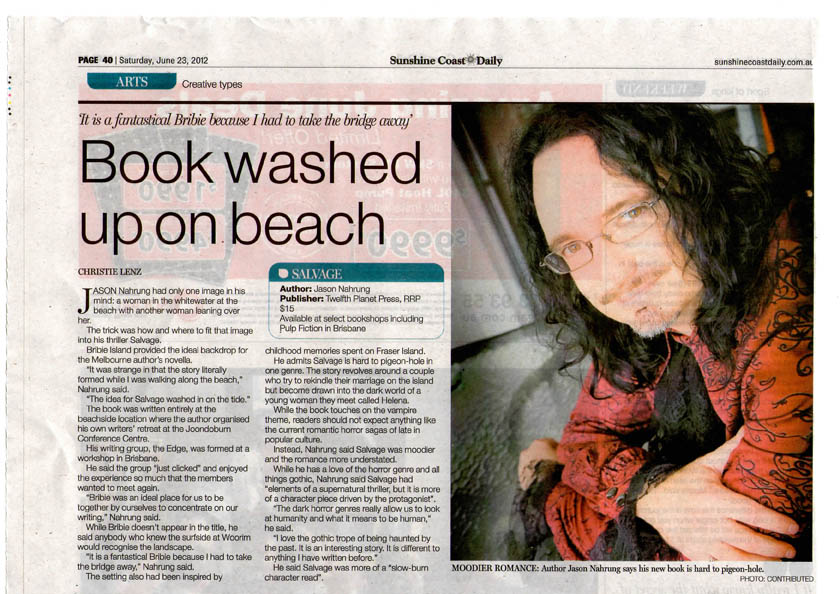
Salvage in the Sunshine Coast Daily

Queensland newspaper The Sunshine Coast Daily has today published an article about Salvage, which is most gratifying. Here it is:


salvage article in sunshine coast daily

The author pic is by Kim Thomsen of Thomsen’s Photographic Gallery, Maryborough.

  • Salvage is available direct from the publisher and truly awesome book shops. Watch this space for details of the Queensland launch in August!
  • Anna Funder on her Miles Franklin win and the power of fiction

    Anna Funder’s acceptance speech, delivered by video, on winning the Miles Franklin award for All That I Am has received a lot of coverage of varying degrees, thanks in part to her sideswipe at Queensland Premier Campbell Newman’s cancellation of the state’s literary awards. She says,

    Prizes like this one are important to writers, but they are not necessary: we would keep writing without them, as writers do in many countries where they are banned. But prizes are very important to the nation. They show that free speech is alive and unbeholden to government, or to media barons. And they provide signposts as to quality when it can be hard, in a bewildering topography of culture—high and low, in print and on-screen and in the fractured online world—to sort the enlightening and soul-feeding from the 50 Shades of momentarily gratifying.

    Hear, hear.

    You can read the full transcript here.

    Meanwhile, Newman continues his bull-in-a-china-shop approach to Queensland’s social fabric, trying it appease the religious fanatics and arch neanderthals typified by Bob Katter’s turn-back-the-clock party while holding some thread of decency. The changes to the same-sex marriage laws and surrogacy laws he’s enacted are ludicrous and insulting and worthy of derison, the semantic game being played highlighting Funder’s point about the importance of literacy in a free-thinking society. A ‘registered relationship’ has overtones of vileness; the ACL need to understand their definition of marriage is neither exclusive nor universal, nor even accurate, nor even logical. A vocal minority should not be dictating government policy that has absolutely no impact on their quality of life. Newman has been praised for standing up to vocal minorities in the past; what a shame he didn’t have the fortitude to do the same here.

    Neither logic nor compassion seem to have much of a home in Queensland these days. Maybe those wielding the stupid stick need to read more, and read more widely. As Funder says,

    This fusing of mind and soul with strangers is what fiction, the art form that is most personal, most interior permits us. Fiction helps us understand what it might be like to be another. It makes us understand that we are different. And also, that we are the same.

    Meanwhile, the non-government supported Queensland Literary Awards have secured some funding from CAL and UQP and will be held on September 5.

    Seaside cupcakes for Salvage

    cupcakes for SalvageMy seaside Gothic Salvage was launched in a combined party held by the publisher, Twelfth Planet Press, at Continuum earlier in June, and as part of the celebration, Terri took it upon herself to make cupcakes for certain of the press’s titles: I think 13 all up. Terri lives in Perth. The convention was in Melbourne. She spent the best part of 12 hours in a hotel room decorating some 400 cupcakes. That’s not including the ones she left behind…

    The madcap but ultimately delicious exercise is detailed at her blog, at which she details how to decorate a cupcake, or indeed a shortbread, with a beach theme fitting of a seaside Gothic. Coconut is the key!

    AWWNYRC#8: Debris by Joanne Anderton

    This is the eighth book I’m reading as part of my list of 10 for the Australian Women Writers 2012 National Year of Reading Challenge.

    Debris

    by Jo Anderton

    Angry Robot, 2011, ISBN: 978 0 85766 154 8

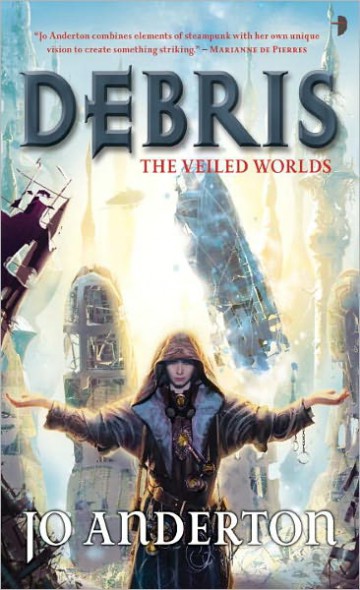
    debris by joanne andertonDEBRIS, by Joanne Anderton, was initially published in the UK in 2010, but I’ve read the US edition that followed a year later. So, that clarification out of the way, it’s a pretty fine debut novel from the Sydneysider.

    The world is fascinating: one where the haves build things, power things, move things by manipulating matter in the form of pions, while the have nots are left with far more mundane methods of constructing and lighting their world. As with any economy, there is ‘waste’ matter: in the case of pions, there is debris — random matter that can interrupt the systems of pions and cause lights to go out, water not to heat, even buildings to become unstable. As there are highly regarded wielders of pions, there are scorned debris collectors — akin to nightsoil collectors.

    This first person account is that of Tanyana, a highly skilled and talented architect, whose career takes a plunge for the worse when an outside force destroys her crowning glory, leaving her broken in body and unable to manipulate pions.

    What begins as a study of a person who no longer finds themselves in the upper echelons of society, shunned by her peers and unable even to pay her rent, changes emphasis to a mystery as Tanyana discovers she’s also a gifted wielder of debris, set on a course to uncover a great social secret and a threat to the world.

    australian women writers challenge 2012The first volume of a series, Debris is a highly enjoyable tale in which Tanyana’s view of the social strata is rebuilt through her own experience with the under classes. Tanyana is convincingly drawn and likeable and her society is well described. The pion technology, melding with a Dickensian norm, is innovative and rather fetching, especially as the ‘silver’ in Tanyana’s body reacts to external threats with all the yummy visuals of Witchblade.

    The second half lags a little as the conspiracy elements of the story overtake the more social aspects and the narrative drive falls a little short — my compulsion to get to the climax wasn’t great, but I was enjoying the world exploration and the unveiling mystery; I enjoy stories where the perception of history is at odds with the reality. A little vagueness in the description, the interruption of action scenes with dialogue and introspection, also served to slow the story in these crucial latter stages. While Tanyana’s arc here is satisfyingly self-contained, the underlying big-picture narrative hasn’t left me hungry to know what happens next.

    Debris is a rewarding read, steeped in shadow and intrigue, and Anderton, through this and her highly regarded short fiction, has clearly pegged herself as an Aussie writer on the rise.

    Read more about Joanne at her 2012 Snapshot

    Previous Challenge reviews:


    Writerly round-up: a new book, an award, a farewell

    It’s the afternoon after the four days that came before, and what a grand four days Continuum 8 offered. Held at Rydges in Carlton, where the bartenders were, as usual, outgunned by demand, the convention pulled together writers, publishers, readers and knitters (!) from around the country for the celebration of all things fantastical.

    Twelfth Planet Press launched new titles by Kaaron Warren — a printing error has meant a recall for those who have already snaffled the enticing collection — and Margo Lanagan (officially hitting the shelves in August) and my novella Salvage (yay!). Keep an ear out for a podcast recorded at the beautifully laid out Embiggen Books(timber shelves! ladders! SECRET DOOR!) about the Twelve Planets series of collections. [update: the podcast is now available here]

    Twelve Planets podcast

    Twelve Planets podcast at Embiggen Books

    There were panels on vampires, e-books, Australian writing and many other things; launches; parties; costumes; crafts; dinners on Lygon St; the nearest Japanese restaurant would’ve seen a pleasing surge in income. And there were awards, with Paul Haines and Sara Douglass both receiving posthumous accolades. A further highlight of the Ditmars was the squeaking octopii, given out as stand-ins when the actual awards failed to arrive in time.

    Also awarded were the Chronos awards, recognising achievements by Victorian writers, artists and fans, and how pleasing it was to receive one for ‘best fan writer’. A lovely acknowledgement of my new address! And Kirstyn and co-host Ian Mond landed Ditmar and Chronos awards for their podcast, The Writer and the Critic. The awards lists are below.

    Convention pictures by Cat Sparks*

    More pix from yours truly

    So amidst the catching up, the memorials and general frivolity, a bittersweet announcement has been made: my wonderful boss, Kate Eltham, is leaving the Queensland Writers Centre to take the reins at next year’s Brisbane Writers Festival. Kate is a dynamic woman and talented writer who has made the QWC such an active organisation, reaching out across the state and the nation and overseas through various programs all aimed at not just keeping writers of all ilks in the loop but helping them to be part of the loops. It’ll be interesting to see what new ideas she brings to the BWF. This is great news for Kate and a real shift of gears, but I confess that I will sure miss her. Good luck with it, mate!

    Kirstyn McDermott, Ian Mond host Continuum awards ceremony

    Kirstyn and Ian host the awards ceremony

    Ditmar Award winners:

    Peter McNamara Award: Bill Congreve

    A. Bertram Chandler Award:Richard Harland

    Norma K Hemming Award, TIE: Anita (AA) Bell for Hindsight; Sara Douglass for The Devil’s Diadem

    And a new award, the Infinity:Merv Binns

    Best Novel

    • WINNER: The Courier’s New Bicycle, Kim Westwood (HarperCollins)
    • Debris (The Veiled Worlds 1), Jo Anderton (Angry Robot)
    • Burn Bright, Marianne de Pierres (Random House Australia)
    • The Shattered City (Creature Court 2), Tansy Rayner Roberts (HarperCollins)
    • Mistification, Kaaron Warren (Angry Robot)

    Best Novella or Novelette

    • WINNER: ‘The Past is a Bridge Best Left Burnt’, Paul Haines (The Last Days of Kali Yuga)
    • ‘And the Dead Shall Outnumber the Living’, Deborah Biancotti (Ishtar)
    • ‘Above’, Stephanie Campisi (Above/Below)
    • ‘Below’, Ben Peek (Above/Below)
    • ‘Julia Agrippina’s Secret Family Bestiary’, Tansy Rayner Roberts (Love and Romanpunk)
    • ‘The Sleeping and the Dead’, Cat Sparks (Ishtar)

    Best Short Story

    • WINNER: ‘The Patrician’, Tansy Rayner Roberts (Love and Romanpunk)
    • ‘Bad Power’, Deborah Biancotti (Bad Power)
    • ‘Breaking the Ice’, Thoraiya Dyer (Cosmos 37)
    • ‘The Last Gig of Jimmy Rucker’, Martin Livings & Talie Helene (More Scary Kisses)
    • ‘Alchemy’, Lucy Sussex (Thief of Lives)
    • ‘All You Can Do Is Breathe’, Kaaron Warren (Blood and Other Cravings)

    Best Collected Work

    • WINNER: The Last Days of Kali Yuga, Paul Haines (Brimstone)
    • Bad Power, Deborah Biancotti (Twelfth Planet)
    • Nightsiders, Sue Isle (Twelfth Planet)
    • Ishtar, Amanda Pillar & KV Taylor, eds. (Gilgamesh)
    • Love and Romanpunk, Tansy Rayner Roberts (Twelfth Planet)

    Best Artwork

    • WINNER: ‘Finishing School’, Kathleen Jennings, in Steampunk!: An Anthology of Fantastically Rich and Strange Stories (Candlewick)
    • Cover art for The Freedom Maze (Small Beer), Kathleen Jennings

    Best Fan Writer

    • WINNER: Robin Pen, for The Ballad of the Unrequited Ditmar’
    • Bruce Gillespie, for body of work including The Golden Age of Fanzines is Now’, and SF Commentary 81 & 82
    • Alexandra Pierce, for body of work including reviews at Australian Speculative Fiction in Focus, Not If You Were The Last Short Story On Earth, and Randomly Yours, Alex
    • Tansy Rayner Roberts, for body of work including reviews at Australian Speculative Fiction in Focus, and Not If You Were The Last Short Story On Earth
    • Sean Wright, for body of work including ‘Authors and Social Media’ series in Adventures of a Bookonaut

    Best Fan Artist

    • WINNER: Kathleen Jennings, for work in Errantry, including ‘The Dalek Game’
    • Rebecca Ing, for work in Scape
    • Dick Jenssen, for body of work including work in IRS, Steam Engine Time, SF Commentary, and Scratchpad
    • Lisa Rye, for Steampunk Portal series
    • Rhianna Williams, for work in Nullas Anxietas Convention Program Book

    Best Fan Publication in Any Medium

    • WINNER: The Writer and the Critic podcast, Kirstyn McDermott & Ian Mond
    • SF Commentary, Bruce Gillespie, ed.
    • Galactic Chat podcast, Alisa Krasnostein, Tansy Rayner Roberts & Sean Wright
    • Galactic Suburbia podcast, Alisa Krasnostein, Tansy Rayer Roberts, & Alex Pierce
    • The Coode Street podcast, Gary K. Wolfe & Jonathan Strahan

    Best New Talent

    • WINNER: Joanne Anderton
    • Alan Baxter
    • Steve Cameron

    William Atheling Jr. Award for Criticism or Review

    • WINNER: Alexandra Pierce & Tehani Wessely, for reviews of The Vorkosigan Saga, in Randomly Yours, Alex
    • Russell Blackford, for ‘Currently reading: Jonathan Strange and Mr. Norrell by Susanna Clarke’, in Metamagician and the Hellfire Club
    • Damien Broderick & Van Ikin, for editing Warriors of the Tao: The Best of Science Fiction: A Review of Speculative Literature
    • Liz Grzyb & Talie Helene, for ‘2010: The Year in Review’, in The Year’s Best Australian Fantasy and Horror 2010
    • David McDonald, Tansy Rayner Roberts & Tehani Wessely, for ‘Reviewing New Who’ series, in A Conversational Life


    Chronos Awards

    Best Long Fiction: The Last Days of Kali Yuga, Paul Haines (Brimstone Press)


    Best Short Fiction: ‘The Past is a Bridge Best Left Burnt’, Paul Haines (in The Last Days of Kali Yuga)


    Best Fan Writer: Jason Nahrung


    Best Fan Artist: Rachel Holkner


    Best Fan Written Work: ‘Tiptree, and a collection of her short stories’, Alexandra Pierce (in Randomly Yours, Alex)

    Best Fan Artwork: Blue Locks, Rebecca Ing (Scape 2)

    Best Fan Publication: The Writer and the Critic, Kirstyn McDermott and Ian Mond

    Best Achievement: Conquilt, Rachel Holkner and Jeanette Holkner (Continuum 7)


    * It’s possible there might be a photo of me with a bottle of wine and a glass: I was pouring for other people. Honest.

    Snapshot 2012: Alison Goodman

    australian speculative fiction snapshot 2012 logoALISON Goodman has been writing and being published for almost 24 years. She began to get published in her second year of university – mainly feature articles and short stories – and her first novel came out in 1998: Singing the Dogstar Blues, a young adult science fiction thriller. It won the Aurealis Award for Best YA novel and was an ALA Best YA book. That was followed by her crime thriller, Killing the Rabbit, published originally in the USA, and which is now about to be re-released in print in Australia and as an e-book under the new title, A New Kind of Death.

    Her latest two books are the fantasy duology Eon and Eona, which were New York Time Bestsellers and have been published in more than 18 countries and 10 languages. Eon (under its initial Australian title The Two Pearls of Wisdom) won the 2008 Aurealis Award for Best Fantasy Novel and was also an ALA Best YA book and a James Tiptree Jr Honour Book.

    This year, Alison has been contracted to write a new historical/supernatural series with publishers in the USA, Canada and Australia. The first book is due out in 2014.

    Keep in touch with developments at www.alisongoodman.com.au and her Facebook page.

  • Alison is guest of honour at Continuum, starting TOMORROW NIGHT at Rydges on Swanston in Melbourne.
  • YA SF, crime, Chinese-influenced fantasy … have you picked stories to best address certain themes, or are you just having a grand old time in all the diversity genre has to offer?
    I suspect a bit of both. In terms of genre, I go where the story takes me. When I have the initial idea for a book or series, I take note of where it seems to fit in the genre market and think about the conventions of that genre. If some of them work for me, I’ll use them (either with or against the expectations). However, I don’t feel obliged to stick faithfully to the conventions or, indeed, to one genre. I do like to meld genres, which can bring a whole bucket load of problems with it but is a lot of fun to write.

    In terms of themes within a novel, I usually find that I may start with an idea of a thematic line – developed from the plot and character – but find that other, stronger themes emerge as I write. Having said that, the thematic starting point is not usually the driving force for me in my writing process – I am more engaged by character and plot and these supply the passion that propel me. So, I don’t feel that I pick stories to write by the appeal of their themes. Still, it is not really possible to separate out those three elements – plot, character, and theme. They are so deeply entwined in the development of my fiction that at least some of each needs to be in place before I start writing.

    Romantic plotlines, of varying degrees, operate under some level of mostly social pressure duress in your books, and happy endings are not guaranteed. In what ways is love, whether unrequited, doomed or conquering all, important to your storytelling?
    I think it is more that desire is important to my storytelling, rather than love. That often includes the desire for love, but I think that is secondary to the desire for the ultimate goal of the main character, be it power as in the Eon duology or truth in A New Kind of Death (Clan Destine Press). Love is not the main goal of my characters, but it is almost always part of their motivation. How characters go about loving or seeking love is a fundamental building block of my characterisation. It is not the driving force of the main plot-line – that is the domain of romance fiction – but it is one of the elements that adds depth and universality to the characters, and provides sub-plots that support and add duress to the events in the main plot.

    You’re in the midst of a research trip to Europe for your new series. Has anything you’ve unearthed been wonderfully surprising, the kind of thing where you just HAVE to use it in the books?
    Yes, I came across a porcelain women’s urinal shaped like a lady’s slipper. In time of necessity in a crowded royal drawing room, it was slipped under one’s huge hooped court dress and clutched between the thighs! That is definitely going into my novel. However, I’m always wary of bunging in a bit of research because I like it. For me, research has to be at the service of the story and the fastest way to become a bore is to write pages of research detail and go off-story.

    I recently read an article by James Wood in the on-line New Yorker about Hilary Mantel’s Thomas Cromwell novels, but it is also about writing good historical fiction. Wood writes that:

    ‘..what gives fiction its vitality is not the accurate detail but the animate one … novelists are creators, not coroners, of the human case’.

    That really hit a chord with me. When I am researching, I look for those shining details that are going to give the flavour and energy of the time without weighing down my story…such as a urinal for women that is shaped like a shoe.

    What Australian works have you loved recently?
    This is where I shift uncomfortably and confess that I haven’t read much fiction lately because it has been all about researching my new series. My stack of fiction To-Be-Reads is huge, but I have just finished Garth Nix’s new book A Confusion of Princes which was magnificently inventive with a great, wry narrator and a lot of satisfying action. I’m also reading an advance copy of Kirstyn McDermott’s new novel Perfections, which is heart-achingly gorgeous. Mostly, though, I have been reading primary and secondary source research books, which sounds dry but is actually a lot of fun. And, as it happens, one of the most valuable research books I’ve come across so far has been by an Australian – Jennifer Kloester – who has written an excellent guide to the Regency era in Georgette Heyer’s Regency World.

    What have been some of the biggest changes in Australian speculative fiction in the past two years since Aussiecon 4?
    I think some of the biggest changes in Australian speculative fiction are the same changes that have been hitting all of publishing. What immediately comes to mind is the rise of the e-book and the crisis of the bookshop. The gathering force of the e-book is offering some great opportunities for authors – more control over backlists and a greater cut of the royalties – but as with all these new modes, it also brings challenges that often leave many behind. The demise of so many of our bookshops breaks my heart, and I sincerely hope that Australia does not follow in the footsteps of Britain and starts closing libraries too.

    Another change that I think has particularly affected the speculative fiction market is the ‘phenomenon book’ such as Harry Potter, Twilight and The Hunger Games series. They can all be gathered under the banner of the speculative genre and, I think, have opened up new audiences to our work, and in fact, to the idea of reading for pleasure.

    * THE END *

    THIS is my final interview conducted as part of the 2012 Snapshot of Australian Speculative Fiction. We’re blogging interviews from 1-8 June and archiving them at Australian Speculative Fiction in Focus: the list of interviewees is here. You can also read the interviews at:

    Salvage launches — tomorrow night!

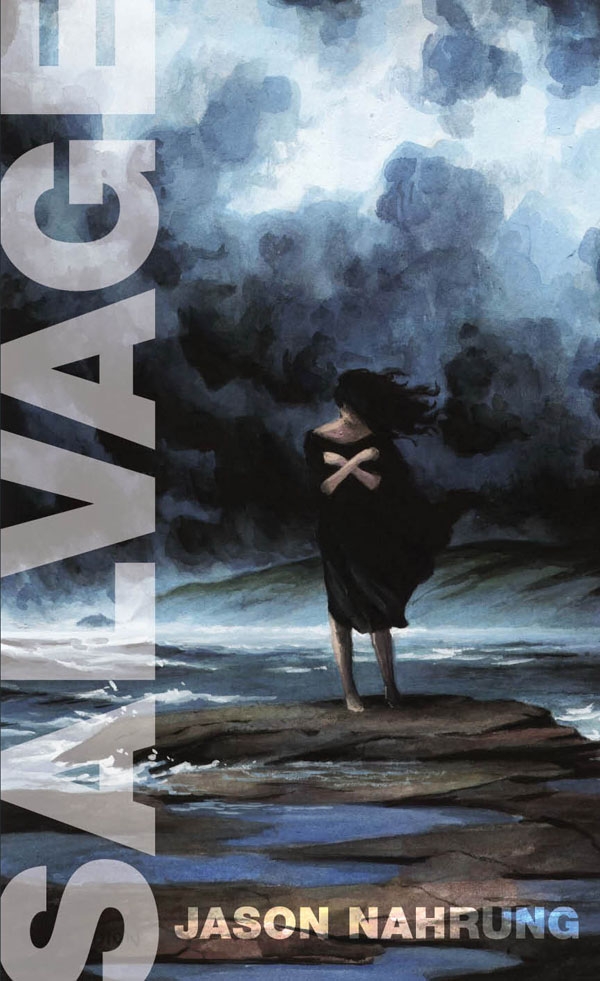
    salvage by jason nahrungA gentle reminder — well, more of a whoop, really — that Salvage is about to be launch. A bottle of red cracked across the bow and sent out into the stormy waters of the marketplace for your — I hope — reading pleasure.

    Tomorrow night’s launch at Continuum 8 in Melbourne is part of the Twelfth Planet Hour: a party to celebrate not just Salvage but the latest titles in the rather awesome Twelve Planets range of collections by Australian women writers: Kaaron Warren’s Through Splintered Walls and Margo Lanagan’s Cracklescape. You can schmooze with some of the other TPP authors, too. If that wasn’t enough there’s cupcakes, a juggler and a surprise announcement from the press … oo-err! The party kicks off  at 7pm; entry to the convention is by gold coin donation today.

    Can’t make it to the party, nor the convention but still want some seaside love-on-the-rocks with added vampire? Order Salvage at www.twelfthplanetpress.com, and/or enter the Goodreads giveaway for a chance to win a copy.

    At Continuum, I’ll be:

    • Launching fellow TPP author Narrelle M Harris’s sequel to The Opposite of Life, Walking Shadows, published by Clan Destine Press, at 6 o’clock tomorrow night
    • Discussing Backyard Speculation — Australian settings in fantastic fiction — on Saturday 10-11am
    • Reading, probably from Salvage, on Saturday 2-3pm alongside Cheryse Durrant, Alison Goodman and Margo Lanagan
    • Discussing e-books: what are they worth? on Sunday 11am-noon
    • Chatting with guest of honour Alison Goodman on Sunday noon-1pm
    • Discussing Vampires: From Horror to Heart-throb on Monday 10-11am
    • Discussing the Awards Debacle on Monday from 2-3pm.

    It’s gonna be a grand weekend!

    Snapshot 2012: Janeen Webb

    australian speculative fiction snapshot 2012 logoJANEEN Webb is a multiple award-winning author, editor and critic who has written or edited 10 books and more than a hundred essays and stories. She is a recipient of the World Fantasy Award, the Aurealis Award, the Peter MacNamara SF Lifetime Achievement Award, and is a three-time winner of the Ditmar Award. She is internationally recognised for her critical work in speculative fiction and has contributed to most of the standard reference texts in the field. She holds a PhD in Literature from the University of Newcastle, and lives on a small farm overlooking the sea near Wilson’s Promontory.

    You’re cancer battle meant you weren’t able to co-edit 2008’s Dreaming Again (the follow-up to 1998’s milestone Dreaming Down Under) as planned, but you’ve since, wonderfully, announced that you’re back. How have you been making up for that lost time in your writing? Back to your Sinbad series, perhaps?
    In all honesty, I should say that I still have, and probably always will have health issues – remission isn’t cure – and I just have to accept that. And although it sounds trite to say that writing is a great form of therapy, like so many axiomatic statements, it happens to be true: writing is a kind of zen space where the world can be as one would wish it to be, and I can try to make up for lost time. And I’m happy to say that yes, there is a third Sinbad YA novel in progress, working title Flying to Babylon. I am also writing an Arthurian fantasy, Perfect Knight, and an alternate Australian history novel.


    Back in ’98 you co-wrote an academic study, Aliens & Savages, on racism/bias in Australian SF: have you been able to keep track to provide an idea of how the current situation compares?
    I think this is one of those times when fiction is ahead of politics. We currently see a xenophobic political focus playing the politics of fear in a way that would not have been out of place in the 19th century. It seems our leaders have not yet learned kindness to strangers. Recently published fiction is more generous and understanding in its explorations of issues concerning both indigenous and immigrant peoples: it was good to see Kim Scott win the Miles Franklin Award with his historical novel of culture clash, That Deadman Dance.


    You’re known for your academic work in the realm of speculative fiction as well as your fiction. How do you find the two streams rest side by side — do they feed each other or are they slightly uncomfy bedfellows?
    It took me a long time to learn that the research techniques for both academic work and fiction are the same thing, seen from different angles: that I can use the same skill base but apply the results in a different fashion. The best fiction has a solid research base underneath it, and a background in the academic world does no harm at all in honing those technical skills.

    I recently used material from Aliens & Savages as the basis for my story ‘Manifest Destiny’ (in Gillian Polack’s Baggage anthology, reprinted in Liz Grzyb and Talie Helene’s 2010 Years Best Australian Fantasy & Horror from Ticonderoga), and am revisiting more of that work for my alternate history novel, so in that sense the two areas do complement each other very well.

    The downside of being a critic is my constant awareness of the scope the field, of the best that is produced, of the sheer volume of work that’s out there: sometimes it’s hard to stifle that internal critical voice in order to write at all!

    What Australian works have you loved lately?
    My favourite new work is Kim Westwood‘s The Courier’s New Bicycle, which recently won the Aurealis Award for science fiction novel. Kim has thought deeply about the issues of gender and has some very original ideas embedded in a compelling story: she is a genuinely fascinating new voice in the field.


    What have been some of the biggest changes in Australian speculative fiction in the past two years since Aussiecon 4?
    I think it’s really too soon to tell: a lot of things are still in the pipeline.

    One thing I will note is the rapid expansion of Creative Writing PhDs in the field. With so many of our best writers venturing into this sphere, SF has reached critical mass in this area. This unexpected incursion into academia will have an enormous impact in future years: I like the idea that SF is finally colonising the mainstream.

    * * *

    THIS interview was conducted as part of the 2012 Snapshot of Australian Speculative Fiction. We’re blogging interviews from 1-8 June and archiving them at Australian Speculative Fiction in Focus. You can read interviews at:

    Snapshot 2012: Scott Robinson

    australian speculative fiction snapshot 2012 logo
    QUEENSLAND writer Scott Robinson grew up reading and writing science fiction and fantasy — he was writing ‘novels’ when he was 10 years old. “It was never short stories, strangely enough,” he says, “but at 13 was sure I was going to make my living as a poet when I had poems published in Quadrant. Twenty-five years later, and I’ve barely made a couple of weeks’ worth of wages from any sort of writing at all.”

    Last year, he made one of his books available for free as an e-book and has since self-published four on Amazon — the first three books of Tribes of the Hakahei (The Space Between, Singing Other World and When the Times Comes), as well as a stand alone crystal-punk fantasy call The Brightest Light. The final book in the Hakahei series, A Different Kind of Heaven, is pending.

    Scott lives with his pregnant wife and two children. His website is www.scottjrobinson.com.


    What have been the joys and sorrows of the self-publishing route?
    Joys: my books is out there in the world for people to read. I’ve had some great feedback from readers and really can’t get enough. The sorrows: not as many people are reading them as I would like.

    Marketing has always been a problem for self-published authors, but these days I have to be compete against the good stuff out there as well as fighting the negative image created by the ‘writers’ who decided to knock up a book over the weekend and make their fortune. At least in the old days, the wife or husband or other keeper of the funds was something of a gatekeeper. Now, it takes no time or money as all to publish a book. Apparently, for some, it doesn’t take any effort, either. So, I just keep hoping for some word of mouth to kick in (The Brightest Light got a great review on Amazon the other day) while I work on the next book.

    Some varmint tried to purloin your free book through Amazon. How did you handle that and has it affected the way you look at e-publishing?
    My first port of call in that instance was an email to Amazon. I received an auto reply saying someone would contact me in three working days. When that didn’t happen ,I sent another email. Eventually, after a week or two, I initiated a live chat with Amazon customer service (or someone like that) and spoke to them. The book was taken down a couple of days later.

    I don’t think it changed my view on self-publishing. I actually brought forward my move to Kindle because of that. Piracy is something that could happen to everyone and it may have been a bit of a compliment that someone went to the effort (though not a lot — the conversion was terrible) to steal my work.

    You like to mix ‘n’ match your genres: has this worked for you or against you when shopping around the stories?
    Against me, of course. 🙂 The writing and the stories and everything else are great — it’s just that the editors can’t fit them into an easily marketable niche. It sounds nice and I’ll keep telling myself that.

    What Australian works have you loved recently?
    I actually haven’t read a lot of anything recently. I’ve been working on novels pretty solidly for about six months — getting ‘completed’ one’s ready for Amazon and finishing off No 4 in the Tribes of the Hakahei series. Unfortunately for me, I do my writing and reading in the same head space so they can interfere with each other quite dramatically.

    The last one I read was probably Business of Death by Trent Jamieson. It’s not really my kind of story, but I flew through it anyway (by my standards) and could definitely see the quality.

    Some of my favourite Aussie stuff from years ago would be Souls in the Great Machine and sequels by Sean McMullen. Or the Parish Plessis books by Marianne de Pierres. I also enjoy most of the stuff by Sean Williams.

    I have also been trying to get around to The Sentients of Orion series and King Rolen’s Kin <by Rowena Cory Daniells> for a while. And recent releases Roil (by Jamieson) and Debris (by Joanne Anderton). Just not enough hours in the day

    I can’t wait to make use of my Kindle and try to support some indie writers, hopefully some of who will be Australian. It’s always great to discover someone new and if nobody else knows them, it’s even better.

    What have been some of the biggest changes in Australian speculative fiction in the past two years since Aussiecon 4?
    Because of my slow reading (slow even when I’m not writing) and the fact that I don’t attend cons (or Vision Writers) any more (lack of money and two young kids to look after and feed), I probably don’t really follow Australian spec fic as something separate to spec fic in general. I just read what I read without thought to where it came from. But the changes here are probably the same as everywhere else and stem from the ease of self-publishing e-books. Or publishing them even if they aren’t yours. I think it’s a great thing but will be even better when the world comes up with a way to weed out the ‘first draft, I don’t need an editor’ type writers because they make it much harder for those of us who do care.

    * * *

    THIS interview was conducted as part of the 2012 Snapshot of Australian Speculative Fiction. We’re blogging interviews from 1-8 June and archiving them at Australian Speculative Fiction in Focus. You can read interviews at: