Queensland newspaper The Sunshine Coast Daily has today published an article about Salvage, which is most gratifying. Here it is:
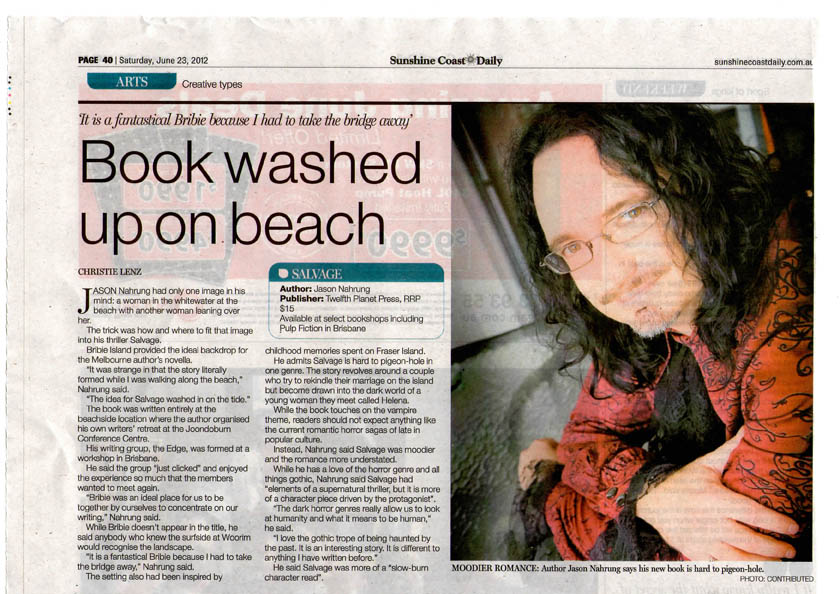
The author pic is by Kim Thomsen of Thomsen’s Photographic Gallery, Maryborough.

Queensland newspaper The Sunshine Coast Daily has today published an article about Salvage, which is most gratifying. Here it is:
The author pic is by Kim Thomsen of Thomsen’s Photographic Gallery, Maryborough.
 My seaside Gothic Salvage was launched in a combined party held by the publisher, Twelfth Planet Press, at Continuum earlier in June, and as part of the celebration, Terri took it upon herself to make cupcakes for certain of the press’s titles: I think 13 all up. Terri lives in Perth. The convention was in Melbourne. She spent the best part of 12 hours in a hotel room decorating some 400 cupcakes. That’s not including the ones she left behind…
The madcap but ultimately delicious exercise is detailed at her blog, at which she details how to decorate a cupcake, or indeed a shortbread, with a beach theme fitting of a seaside Gothic. Coconut is the key!
This is the eighth book I’m reading as part of my list of 10 for the Australian Women Writers 2012 National Year of Reading Challenge.
by Jo Anderton
Angry Robot, 2011, ISBN: 978 0 85766 154 8
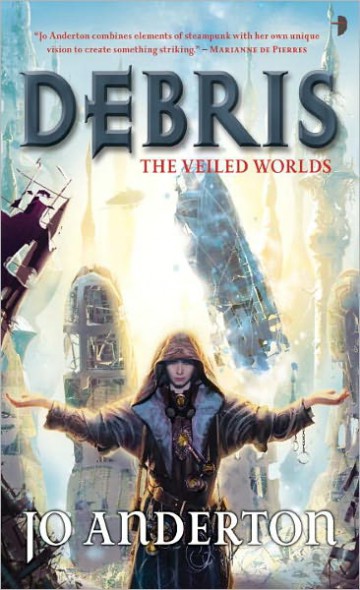 DEBRIS, by Joanne Anderton, was initially published in the UK in 2010, but I’ve read the US edition that followed a year later. So, that clarification out of the way, it’s a pretty fine debut novel from the Sydneysider.
The world is fascinating: one where the haves build things, power things, move things by manipulating matter in the form of pions, while the have nots are left with far more mundane methods of constructing and lighting their world. As with any economy, there is ‘waste’ matter: in the case of pions, there is debris — random matter that can interrupt the systems of pions and cause lights to go out, water not to heat, even buildings to become unstable. As there are highly regarded wielders of pions, there are scorned debris collectors — akin to nightsoil collectors.
This first person account is that of Tanyana, a highly skilled and talented architect, whose career takes a plunge for the worse when an outside force destroys her crowning glory, leaving her broken in body and unable to manipulate pions.
What begins as a study of a person who no longer finds themselves in the upper echelons of society, shunned by her peers and unable even to pay her rent, changes emphasis to a mystery as Tanyana discovers she’s also a gifted wielder of debris, set on a course to uncover a great social secret and a threat to the world.
 The first volume of a series, Debris is a highly enjoyable tale in which Tanyana’s view of the social strata is rebuilt through her own experience with the under classes. Tanyana is convincingly drawn and likeable and her society is well described. The pion technology, melding with a Dickensian norm, is innovative and rather fetching, especially as the ‘silver’ in Tanyana’s body reacts to external threats with all the yummy visuals of Witchblade.
The second half lags a little as the conspiracy elements of the story overtake the more social aspects and the narrative drive falls a little short — my compulsion to get to the climax wasn’t great, but I was enjoying the world exploration and the unveiling mystery; I enjoy stories where the perception of history is at odds with the reality. A little vagueness in the description, the interruption of action scenes with dialogue and introspection, also served to slow the story in these crucial latter stages. While Tanyana’s arc here is satisfyingly self-contained, the underlying big-picture narrative hasn’t left me hungry to know what happens next.
Debris is a rewarding read, steeped in shadow and intrigue, and Anderton, through this and her highly regarded short fiction, has clearly pegged herself as an Aussie writer on the rise.
Read more about Joanne at her 2012 Snapshot
Last night, there was steak, seafood and Macbeth. It’s a winning combination, even if the play wasn’t quite as noms as the dinner.
Il Primo Posto is at Melbourne’s Southbank. It’s a welcoming space, unlike many of the corporate aquariums that line the river walk, given warmth and character by its mural wall, wooden shelves and dashing burgundy feature wall. The staff are efficient and friendly, and the food — the food is spot on in size, quality and price.
We got to the Arts Centre with the bell — not just the theatre bell calling us to our seats, but the Bell Shakespeare Company, performing my favourite work by the Bard, Macbeth.
The stage was set with turf and grass, suitably crunchy for adding to suspenseful creeping scenes, and a key feature was a reflective ceiling — it had a more dramatic effect farther back, I think, based on what I saw at intermission. Lighting was superb.
Among the highlights: Lady Macbeth, played by Kate Mulvany, and the beautifully balanced and passionate relationship with Macbeth; the sensation of spirit possession in the cleverly singular witch, Lizzie Schebesta; Macduff’s emotional speech on reception of news of his family’s death; the way in which dead Banquo exits the stage as the dinner scene is set up around him; the sex/violence dynamic between Macbeth and the witch. Great fake blood, too!
Some of the things that didn’t work quite so well for me: the truncated, even jumpy, second half, especially the absence of the scene explaining how it is that the woods can march; slow motion while actors deliver soliloquies; the confusion about whether the witch is still the witch when playing minor characters. Why keep Macduff’s family’s death scene but deny Lady Macbeth her post-dinner ramble?
One striking aspect of the play was the unexpected humour. There was an ironic, even Ocker, vein that elicited laughs in places one wouldn’t normally expect, while the one character often played for laughs — the gatekeeper — presented in part as quite dour. Lady Macbeth suffers a bout of hiccups, highly effective at beginning and end, but a tad disruptive in the midst of a heavy emotional monologue. And Macbeth himself, looking impish with a constant crouch and hunch and arms akimbo, at times more Rumpelstiltskin than tortured king, giving air to that jarring Aussie twang once in a while. The costumery was understated Australian, too, with the men’s uniforms of jeans and work shirts topped occasionally by formal blue military coats, and woollen jumpers to the fore.
This is another version that seems to put more weight on the role of the witch/es not just as oracles of fate but manipulators or even victims of it. I’m not convinced that reframing is required, given the sheer power of the tale about self-fulfilling prophecy.
It was a bold, even challenging production, and overall I enjoyed it, not just for what it did so very well — some wonderful scenes will linger for a long time indeed — but for what it dared to do. And kudos for programming Fever Ray for the departure song: a perfect beat to leave on after such a striking final moment.
 A gentle reminder — well, more of a whoop, really — that Salvage is about to be launch. A bottle of red cracked across the bow and sent out into the stormy waters of the marketplace for your — I hope — reading pleasure.
Tomorrow night’s launch at Continuum 8 in Melbourne is part of the Twelfth Planet Hour: a party to celebrate not just Salvage but the latest titles in the rather awesome Twelve Planets range of collections by Australian women writers: Kaaron Warren’s Through Splintered Walls and Margo Lanagan’s Cracklescape. You can schmooze with some of the other TPP authors, too. If that wasn’t enough there’s cupcakes, a juggler and a surprise announcement from the press … oo-err! The party kicks off at 7pm; entry to the convention is by gold coin donation today.
Can’t make it to the party, nor the convention but still want some seaside love-on-the-rocks with added vampire? Order Salvage at www.twelfthplanetpress.com, and/or enter the Goodreads giveaway for a chance to win a copy.
At Continuum, I’ll be:
It’s gonna be a grand weekend!
What are the pleasures and perils of compiling the horror component of the Ticonderoga Year’s Best Fantasy and Horror? TALIE HELENE is a musician and writer, from Melbourne. She has poetry published in journals including Voiceworks, Avant and Inkshed, and Mary Manning’s About Poetry (Oxford University Press), and a co-authored short story (with Martin Livings) ‘The Last Gig of Jimmy Rucker’ in More Scary Kisses (edited by Liz Grzyb). Talie is horror editor for the anthology The Year’s Best Australian Fantasy and Horror (Ticonderoga Publications), and was news editor for the Australian Horror Writers’ Association for four years (2006-2010), for which she received a Ditmar nomination. She is a member of the SuperNova writers’ group. Talie has a background in music journalism – especially extreme genres – and has performed with many artists including The Tenth Stage, Wendy Rule, Sean Bowley, Saba Persian Orchestra, Maroondah Symphony, and Eden. She is currently developing a new audio arts anthology titled The Unquiet Grave. You can find out more at www.taliehelene.com.
One of the guiding principals I have is that the stories need to go to different emotional places, because horror is about hitting raw nerves. If you hit the same nerve too many times, you desensitise and the stories become emotionally monochrome. Horror is unique in that the genre is defined by emotion, rather than trope or context – you can have a completely supernatural story that is horror, and a totally realistic story that is also horror. So trying to keep the mix fresh and blow the readers away in different ways, keep the emotional impact – that is pure fun. Editing a Year’s Best is a bit like being a DJ. The works are already published and polished, so the job is to find that mix of hits and undiscovered gems and make the overall experience entertaining and powerful and surprising. It’s a kick!
Working with Liz and Russell at Ticonderoga is totally a pleasure. I was a dark horse choice for this editing job, and having them believe in my instincts is very humbling. They are also really understanding, and they’ve been very supportive throughout. Having a purpose that isn’t focused on my own headspace has probably been a saving grace for me. Just getting to associate with such fine writers is a buzz and an honour; meeting some of ‘my authors’ and having these instantly engaging conversations about narrative that I would never otherwise have is a delight.
The perils. Well, there should be perils in compiling horror, right?
I think probably the biggest peril is balancing literary horror and visceral horror; horror goes to places that connect with visceral responses, and it goes to places of deep trauma and danger and anger, and sex and death are so very tangled together. If the emotion overwhelms the form it can be incomprehensible, and if the form overwhelms the emotion you get cliche. The quality that lifts both aspects up is authenticity. I’m just one person, so I have to trust my own instincts as to which stories do which of those things excellently. Just entering that territory is perilous, because when people disagree they will disagree vehemently. Conversely, if I didn’t stick to my guns about my choices, I have no business editing horror.
I worship what I would call literary horror – writing that engages with top-shelf word craft and narrative constructs in the service of hitting those raw nerves. In the Capital L Literature world the idea of ‘literary horror’ is regarded as an oxymoron. The reality of any genre is you have to read through a truckload of mediocrity to find the amazing work. Go to a Capital L Literary spoken word night. You will have to endure an avalanche of bullshit to experience a few dazzling talents. But I think it’s harder for people to go the other way – from the literary world, to the horror world – because horror stories do contain exploded intestines! The bad ones have exploded intestines! The brilliant ones have exploded intestines! It takes a committed reader to learn to separate being repulsed by bad gory writing, and enthralled by brilliant gory writing – which is also repulsive! But repulsive in the service of some larger meaning.
Really great horror stories aren’t just about horror – there is always something else that makes you empathise. That’s the reason Stephen King writes so much about love and different kinds of relationships. If you write about death, you write about life. I think horror is the deepest genre because it speaks from that precipice of our mortality. But I’m not allowed to harpoon people who don’t share that view!
While I prize literary horror, I also feel very connected with visceral horror. There would be something really wrong if the horror selection in Year’s Best didn’t include some stories where things that are supposed to be inside people are splashed all over the page – maybe that is blood, or a terrible secret, or unbearable knowledge. I think there are people who read horror and appraise the shock value over the literary merit – that reader is going to roll their eyes at terror in sunlight stories or existential horror. For me, blood and the numinous are equally powerful. By making a broad selection, I’m demanding the reader be open to all of that.
Is that condescending? I don’t mean to be condescending to consider that a peril. My gut tells me horror writers feel that they put great demands on readers too, and that is one of the issues of commercialism (or lack of) for horror.
There is an amorphous danger zone of gender politics in the speculative fiction community in Australia, and in horror more than any other genre. It is in part due to a disparity in theorised feminism, because writers range from all walks of life – can I say thank fuck? That is something I can appreciate from both sides, because I’m not a theorised feminist myself. (I don’t have a degree, and while I do read feminist musicology with interest, I’m truant on Feminism 101.) I think the sticking point is that horror is often violent, and historically violence precedes from the patriarchy, so there has been confusion in separating confronting language from gendered language.
As horror editor of the Year’s Best, I’ve had to remain silent on feminist issues I might have otherwise been very vocal about, because I have conflict of interest – and I support people in their artistic practice who have completely contradictory views, including views that I don’t agree with. It doesn’t mean I’m not participating in the discourse, because I will recognise writers who are disrupting and interrogating those issues in their work, and that becomes an influence in my editorial process. I want the anthology to be a powder keg of awesome! My philosophy is stolen from an old 3RRR Radio Station ID: ‘Diversity in the face of adversity’.
A more personal peril is discovering if I don’t include a writer’s stories, I can hurt the feelings of a friend – and maybe give them the erroneous impression that they had ‘a bad year’. While the words ‘best’ and ‘horror’ are the stars by which I navigate in story selection, there are also other pressures on the selection process – and not every fine story on the shortlist makes it through. It does not always mean those stories aren’t as good – or that I am prejudiced against a certain flavour of horror and won’t ever include it. This is the arts. It is subjective. It has to be subjective. And the DJ part of the editorial process serves a mix, not just an evaluation.
The final peril is for me as an emerging writer. Donning the hat of gatekeeper threatens to crush my view of my own writing with 10,000 tonnes of neurosis. (And that’s what SuperNova is for?)
You’ve got a Ditmar-nominated short ghost story co-written with Martin Livings: is this a sign that we might be seeing more Talie Helene stories out in the wild soon, and is the supernatural likely to play a role in new material?
If by soon you mean ever, then the answer is ‘eventually’. It’s a sign! The stories I have in progress have supernatural elements, although that wasn’t a conscious choice. You can’t really marinate your brain in horror fiction without soaking up the supernatural – and it kind of crunches down to writing emotion. I was already into it, but how tumultuous and marginalised my life has been in the past few years has probably pushed me deeper into it. You can write emotion through the supernatural that might not translate if you tried to deliver it Capital L Literary style. I don’t want to jinx the writing by turning this into a publicity blurb for unpublished work. I need to submit an ‘unavailable form’ to my retail job for SuperNova Sundays, and be humble or shameless with bringing drafts to the table.
You’re known for being a musician and a writer, and ‘The Last Gig of Jimmy Rucker’ combines the two: in what ways do those two creative pursuits influence each other in your practice?
Your question makes it sound nice, Jason. My stock answer is ‘they are the two halves of my heart’ – but right now, fox-holed in a robotic random day job, wearing a plastic smile and folding knickers in a department store – music and writing feel like combatants! They both fight for time and energy I barely have, and one is always stealing time from the other, so of course the other claws in as an influence. Anything beyond writing, that a writer spends time immersed in – history, physics, maths, or philosophy – that is going to influence them. That goes both for social engagement – dialogue colour and character – and for soaking up information that ignites ideas. Whatever boards you tread – the squeaky boards there are your story. Especially if the dark stuff sings to you.
So that kind of influence… I’d like to think my diction and structural sense of drama are influenced by music. I’m definitely influenced by the more personal ways people use music, and that is always a place of story – to grieve, to love, to evoke memory, to escape, to heal, to endure, to mark time, to hide from or find themselves, as a mask, as a drug, as an excuse, as redemption, as Dutch courage, a mating cry, a war cry, a goodbye…
There is something really spooky about singing a Dorian mode with a bunch of other music students. It is intended as an aural drill, but sometimes it hits you that you are inside an ancient structure – and it gives you shivers.
What Australian works have you loved recently?
I’ll tell you about some things I didn’t anthologise. I had post-it notes plastered all over them – one saying ‘HELLYEAH!’ and one with a sad face and ‘NOT HORROR’.
Two stories from Cat Sparks – ‘The Alabaster Child‘ and ‘Beautiful‘ – were both completely immersive science fiction with a distinct visual style. Cat is one of the best visual stylists in Australia, which is not surprising given her involvement in design and photography. She studies colour and light all the time. Thoraiya Dyer‘s ‘Fruit Of The Peepal Tree‘ was the most delicately painted and subtly paced story I read from 2011, and I’m so glad it won the Aurealis in the Fantasy Short Story category, because I was shattered I couldn’t use it for Year’s Best. Even touching on dark themes of loss, environmental degradation, and female infanticide – it didn’t riff the emotion of a horror story, but it was an exquisite story.
The Rage Against The Night anthology Shane Jiraiya Cummings edited as a fundraiser – while under-the-radar locally, that was an impressive collection. The excerpts I’ve seen from Rocky Wood and Greg Chapman’s Witch Hunts: A Graphic History of the Burning Times (with Lisa Morton) look kickarse.
What have been some of the biggest changes in Australian speculative fiction in the past two years since Aussiecon 4?
Given that I have an Atheling nomination for a 2010 Year in Review essay (co-authored with Liz Grzyb), and I’m gap-filling the 2011 review essay right now – it is absurd, but I don’t feel that qualified to answer this question, because I only really follow the horror. I’m kind of new as a writer and an outsider in the Australian speculative fiction enclave – and I’m tremendously self-involved. The PR Bitch answer would be to say Ticonderoga Publications launched a Year’s Best Australian Fantasy & Horror series, right? The size of the two boxes of Year’s Best reading – 2010 and 2011 – 2010 weighs in as a year of bigger output, but the marketing impetus of a Worldcon makes that almost a given.
Australian spec fic had an international profile boost with all those international practitioners visiting Melbourne. While I’d never dream of suggesting it was the reason Alisa Krasnostein and Twelfth Planet Press scored a World Fantasy Award, I think the wave of Aussiecon4 helped an already deserving and enterprising nominee – and this is a good and natural development, and I’m cheering that success on.
The bowing out of Brimstone Press certainly changed the playing field for local horror writers. Bummer. The AHWA seems to have lost cohesion, but I can see a rallying point emerging with Marty Young executive editing Midnight Echo.
The unfortunate melee that Robin Pen hilariously sketched as ‘Ballad of the Unrequited Ditmar‘ seemed to cause a lot of hurt – factions seem delineated, which I think is a pity because in a scene this small we all move forward together. (Who knew I was such a hippy?)
I think the true biggest change – to paraphrase the words of Bren MacDibble – there is a Paul Haines shaped hole in the world. For the broad generation of Paul’s contemporaries, the wave of writers around him, that loss is going to be felt for a long time. Art doesn’t evolve in a slow creep, it leaps forward with bold thinkers and original voices, and then other practitioners play catch-up. I’m not saying he is the only trailblazer in Australia, but that ego Paul always talked about having – to my mind was just that awareness. He was a leap forward kind of artist. He was special. He knew it. The curtailing of that brave talent is the biggest change I’ve seen, and the saddest.
THIS interview was conducted as part of the 2012 Snapshot of Australian Speculative Fiction. We’re blogging interviews from 1-8 June and archiving them at Australian Speculative Fiction in Focus. You can read interviews at:
KYLA Ward is a Sydney-based creative who works in many modes. Her latest release is The Land of Bad Dreams, a collection of dark and fantastic poetry. Her novel Prismatic (co-authored as Edwina Grey) won an Aurealis Award for Best Horror. Her short fiction has appeared in Ticonderoga Online, Shadowed Realms, Borderlands, Gothic.net and in the Macabre anthology, amongst others. The next Cursebreaker story, ‘The Jikininki and the Japanese Jurist’, will shortly appear in The New Hero anthology from Stone Skin Press, who will also print her very first Mythos tale, ‘Who Looks Back?’ in Shotguns vs Cthulhu.
Her work on RPGs including Buffy the Vampire Slayer saw her appear as a guest at the inaugural Gencon Australia. She has had feature articles in magazines ranging from Dragon to Art Monthly Australia. Her short film, ‘Bad Reception’, screened at the Third International Vampire Film Festival and she is a member of the Theatre of Blood repertory company, which has also produced her work. In addition, she programmed the horror stream for the 2010 Worldcon. A practising occultist, she likes raptors, swordplay and the Hellfire Club. To see some very strange things, see her website at www.tabula-rasa.info.
Your first solo book is a collection of poetry — did you see that coming in your projections of a writing career, given how hard it is to get poetry published, let alone (one would think) macabre poetry?
No, it was a complete surprise! I attended the secondary launch of Leigh Blackmore’s Spores From Sharnoth at the Don Banks cottage and performed a few pieces in the open mic section. Danny Lovecraft of P’rea Press heard me and the entire idea was his. The faith was his and a serious part of the work. Poetry is a hard sell these days and I can’t pretend the book has been an overwhelming financial success, even though we recently made it onto Amazon. But I hope that the good reviews in Publishers Weekly amongst others, the Rhysling nominations and making the Stoker preliminary ballot go some way towards repaying him.
You write for the theatre and for role playing games as well as poetry: in what ways do these pursuits influence your fiction practice?
Undoubtedly it does. As a matter of fact, one of the things turned up by the process of editing The Land of Bad Dreams was that, all unknowing, I write poems specifically to be spoken aloud. Danny would point out errors in the metre and such that I couldn’t see, until we realised I was counting the points where I drew breath as syllables! Some pieces such as ‘Day Cars’ we ended up leaving in this weird hybrid form. But as I have said elsewhere: when I have an idea, it’s generally specific to a form. A script idea is a script, a poetry idea is a poem, a novel idea is a psychosis. It is extremely rare that I would translate one to another.
I think this is one reason poetry continues to be written, long after the days when people would fight each other at bookstores to secure the latest instalment of Byron’s ‘Don Juan’. Some ideas can only be expressed in poetry, and any attempt to do so tends towards poetry, whether this is acknowledged or not. Thus ‘prose poems’, dramatic monologues and a significant amount of flash fiction.
What advice do you have for writers who get the chills when it comes to reading their work out loud to an audience?
No, no, no: it’s the audience who are supposed to get the chills!
Being able to read your work in public is a great resource for a writer. They are the most difficult aspect of a work for the general public to ignore, or pirate. Readings can make a launch or signing into an event. Readings can be filmed and placed on YouTube. Plus, nothing displays the artistry of a piece, the flow of sentences and the aptness of words, like performance — assuming that the performer doesn’t freeze up and treat gripping prose like it’s a list of ingredients on a cereal box. The life is all there on the page, you simply have to release it out. Practice is the key: first getting used to the sound of your own voice and then learning how to control it. In my case, I can’t pretend that lengthy drama training didn’t help.
What Australian works have you loved recently?
Ben Peek’s ‘Below’ and Stephanie Campisi’s ‘Above’ <in Above/Below>. Clever, unusual and effective.
What have been some of the biggest changes in Australian speculative fiction in the past two years since Aussiecon 4?
Those associated with a slow recovery from near-total exhaustion? Or was that just me? E-books seems to have taken off in a big way. I am also looking forward to seeing what happens with GenreCon in Sydney this November: a brave experiment by any standards.
THIS interview was conducted as part of the 2012 Snapshot of Australian Speculative Fiction. We’re blogging interviews from 1-8 June and archiving them at Australian Speculative Fiction in Focus. You can read interviews at:
STEPHEN Dedman was born in Adelaide in 1959, but grew up (though many would dispute this) on the outer limits of Perth’s metropolitan area, far enough from a good library that he had to make up his own SF and horror stories. He’s been writing for fun for more than 40 years, and for money for more than 30, selling his first short story in 1977 and his first novel in 1995.
That novel, The Art of Arrow Cutting, was shortlisted for a Bram Stoker Award. His short stories, published in an eclectic range of magazines and anthologies, have won two Aurealis awards and a Ditmar, and been nominated for the British Science Fiction Association Award, the Sidewise Award for Alternate History, the Seiun Award and the Spectrum Award. His latest publication is ‘More Matter, Less Art’ in Midnight Echo #6; his story ‘The Fall’ will be in Exotic Gothic 4. For an up-to-date bibliography, go to www.stephendedman.com.
Has your time as a bookseller revealed any lessons for you as a writer: craft or business wise?
I worked in SF/F bookshops, on and off, from 1985 until 2011, and while it’s occasionally alerted me to the presence of new markets (notably Aphelion and Aurealis) and books that are useful to genre writers, the main thing it’s taught me is that there’s little point in new writers trying to cash in on a trend, be it cyberpunk, epic fantasy, zombies, or sparkly vampires. By the time they’ve finished a draft and sent it anywhere, hundreds of other writers will have done the same. Instead, writers should go to the bookshops and the libraries and look for the books they want to read, and if no-one’s written it yet, write it themselves. Write the stories you would pay to read.
You write across so many genres — are there themes that are present across them that perhaps you’re exploring in different ways?
There are some themes I keep coming back to, beyond the obvious SF and horror themes of possible futures and things that scare us. Outsiders and otherness (most of my protagonists are from somewhere else). Obsession. The relationship, and often the gulf, between our fantasies and what we actually want or would let ourselves do in reality. And dinosaurs and ninja, of course.
Given your enviable back catalogue, are you excited about the possibilities of e-publishing and POD?
Cautiously excited. I’m definitely excited by the idea that no book or short story ever need disappear completely. I’m less optimistic about the prospect of making a living from it; I’m not yet convinced that the long-tail economy isn’t something like the trickle-down effect, all jam tomorrow but never jam today (kudos to Cat Valente, by the way, for telling me that that was a Latin pun).
What Australian works have you loved recently?
I’m embarrassed to say that since we sold Fantastic Planet bookshop, I haven’t been keeping up with them as much as I should. I was enormously impressed by The Courier’s New Bicycle by Kim Westwood, and Felicity Dowker‘s new collection Bread and Circuses is excellent.
What have been some of the biggest changes in Australian speculative fiction in the past two years since Aussiecon 4?
Mainly that more people are self-publishing, either as hardcopy as e-books, and it seems that the big publishers’ are cutting back on midlist, with print runs getting smaller and backlist going to PoD.
THIS interview was conducted as part of the 2012 Snapshot of Australian Speculative Fiction. We’re blogging interviews from 1-8 June and archiving them at Australian Speculative Fiction in Focus. You can read interviews at:
STEPHEN M Irwin’s debut novel, supernatural thriller The Dead Path, was published in the UK, the USA, Germany and China. It was named Top Horror Novel in the American Library Association’s RUSA Reading List (2011) and won the Book of the Month Club’s First Fiction Award (2010).
Stephen’s second novel, thriller The Broken Ones, was launched in Australia in 2011 to excellent reviews, including being named the Sydney Morning Herald Fiction Pick of the Week. It will be released in the USA by DoubleDay in August 2012, and has also been selected by the Book of the Month Club for its catalogues which service 8 million members.
Stephen’s short stories have won competitions nationally and internationally, with several published in notable anthologies. Stephen is also an award-winning filmmaker, and has written and directed television documentaries and short films. He is currently working with several Australian producers developing feature and television material, including a screen adaptation of The Dead Path.
Stephen lives in Brisbane’s inner-west with his wife and two young children. Find him online at stephenmirwin.com.
Two novels down, and twice you’ve brought some shudders to Brisbane town. What is it about the city that lends itself to a site for nightmare occurrences?
I hope that I’m able to write with a degree of veracity about lots of places, and certainly a bit of my first novel was set in London, and a recent screenplay I worked on had some scenes set in New York and Canada. However, Brisbane is home and I know certain of its suburbs well, some of its hiding places, how it feels through different seasons, where it feels authentic and where it feels like it’s wearing too much makeup. My first two books had to be set somewhere, and while I don’t live or die by the axiom ‘write what you know’, it made sense to set the books in a place that I know. I figured that I was asking the readers to suspend any disbelief they may have in magic and ghosts, so if the setting felt solid, I could buy a bit more latitude to explore the fantastical.
Even if it wasn’t home, though, Brisbane is a great setting because there is more to it than meets the eye. It is a pleasant and friendly place, but it was born essentially as a penal settlement, so it has some unpleasant bones. It is sunny and warm, and its winters are divine, but as we’ve seen in the recent past, it can turn nasty quickly with streets flooding and disaster unfolding in a matter of hours. As a setting, this contrast is appealing, and has worked well for other authors, too (Jeff Lindsay used Miami as a setting for the dark deeds of his killer, Dexter). Just because a house has fresh paint doesn’t mean it’s not haunted; just because a city is sun-drenched and ‘livable’ doesn’t mean horrible things can’t happen there. Let’s face it, the least expected and most horrific crimes are those performed in broad daylight.
What is it you’ve enjoyed most about the transition from writing screenplays to novels?
I think what’s enjoyable is the feeling that the transition continues. I’m still writing screenplays and television material while working on more long-form fiction. Each mode of writing enriches the other. Since writing a couple of novels, I feel I’m now able to bring to my screenplay writing a better understanding of character, because I’ve drilled so much more deeply into characters’ minds and motivations for the books. And for me, screenwriting helped make the novels more enjoyable because I’ve learned something about conventional story structure from screenwriting. Screenwriting has helped broaden my understanding about pacing scenes and building suspense; I learned through experience that a scene that lasts more than a few minutes on screen risks becoming deathly boring, and every scene has to help advance the story. These rules have a place in the kinds of books I write. Very importantly, screenwriting forced me to learn visual shorthand: how to paint a clear picture or mood very economically. In a screenplay of just 100 pages, you can’t devote a whole page describing a room or a person –- you get a sentence for that. The lessons about economical writing have been helpful, because if you know the essence of what you want to say, then it is more enjoyable to dress it up. Putting in is always more fun than taking out.
Another thing that surprises some people is that a significant amount of my screenwork has been comedic. Right now I am working on a comedy feature I’ve been commissioned to write for an Australian producer. I hope that a few sparks of levity have found their way into the novels.
There was a noirish feel to The Broken Ones — is crime writing something you’d like to explore further, or do you find the supernatural an irresistible attraction?
I am a sucker for good crime, in literature, film, and television, and I’ve been a fan of noir since seeing The Third Man in my first year at art college. I’m a dedicated fan of the gurus like Chandler, maestros like Cruz Smith, and seasoned experts like the late, great Robert B Parker. It’s delightful to think that some of my love for crime writing has rubbed off into The Broken Ones, which is ostensibly a detective story. I’m certainly continuing to work on more crime material –- my next novel, while not a police procedural, has strong crime elements, and I’m developing with a talented production company a new crime miniseries. It’s great fun. Chandler knew how to entertain, and he knew that everything had a dark side. ‘It is not a fragrant world.’
As for the supernatural, I can resist it -… but only for so long. My nightmares, when I have them, are inevitably about angry spirits. I think some writers write to exorcise, and it helps when I do.
What Australian works have you loved recently?
I really enjoyed The Diggers Rest Hotel by Geoff McGeachin. It is set soon after the Second World War in country Victoria. My father was a serviceman in WWII, and no doubt his sensibilities were formed by his time as a young man, and remained with him for me to see and learn from. Geoff captured the spirit of the time beautifully, and had me almost nostalgic for an era I only knew about second hand. Apart from that, it was a great crime story with a smart, wounded protagonist. Right up my alley.
Claire Corbett’s futuristic novel When We Have Wings was highly inventive and very lovely.
And as a writer of stories with ghosts, I am a huge fan of Karina Machado’s non-fiction books about hauntings: Spirit Sisters and Where Spirits Dwell. The Australian spec fic scene is rich and varied right now, with some huge talents who are getting some well deserved recognition.
What have been some of the biggest changes in the Australian speculative fiction scene in the past two years?
I think the Australian market as a whole is responding to the same changes that the whole publishing world is facing with regard to digital books. While this new form is a phoenix to some and a spectre to others, I am delighted to see that it seems to have sparked a re-emerging interest from writers and readers in the novella. This is a form I’ve loved since adolescence when I first read seminal works like Animal Farm, Of Mice and Men and The Old Man and the Sea. Given that a novella can be created in a third the time or less that it takes to craft a novel, the rich excitement of furious creation can often be sensed on the page. A story has a life of its own, and to be effectively told it needs to fill into its own body without constraint or artificial inflation –- some stories are simply too long for to be a ‘short’, and too contained to warrant novel length. I think since the 1980s, the bang-for-buck book purchasing mindset has made it increasingly difficult for publishers to justify the printing and marketing of the novella form, but the e-book format is making it much easier for publishers to price the form back into popularity, and also for self-publishers to get their works to market. I am delighted that a number of authors I know are working in this form right now. It is good news that this important middle sibling is coming back in force.
THIS interview was conducted as part of the 2012 Snapshot of Australian Speculative Fiction. We’re blogging interviews from 1-8 June and archiving them at Australian Speculative Fiction in Focus. You can read interviews at:
 Roil is the first book of the The Nightbound Land duology (Angry Robot) by Brisbane author Trent Jamieson, and it’s fabulous — in more than one meaning of the word.
Trent’s always had a way with words — in all fairness, his debut series, The Business of Death — didn’t do him justice. It was a different style, quick and spare to match that corporate clickety-click of deeds done darkly. Roil is sumptuous, taking me back to some of his short fiction I remember fondly (that reading in Toowong cemetery? priceless; ditto Wordpool, ah); from its prose to its world building, you can sink into Roil in near perfect comfort.
In this fantasy world, a vast bank of preying darkness is creeping north to devour the few remaining human cities. A cruelly prgamatic mayor plots how to save his people; an Old Man is unleashed to try to stave off the inevitable, no matter the cost; a young drug-addled man and militant woman are caught up in the plots and violence.
Our hero, David, while addled, is capable, and has some surprises in store as Old Man Cadell takes him, however grudgingly, under his wing. Heroine Margaret is ruled by vengeance and packs a mean ice pistol. The support cast is well drawn but add to the edginess — Trent doesn’t shirk in the dispatch department.
He also handles horror tropes beautifully, whether it be zombies — both Haitian and Romero varieties — or the vampire-like Old Men, dragons, hellhounds and other fabulous members of his imaginative bestiary.
Likewise, the technology melds the best of steampunk, akin to Scott Westerfeld style, with living airships and jet-powered fighter planes, lasers and cool swords, steam trains, magic and mechanisations blended to produce icy weaponry and devastating weapons of destruction.
This is society on the edge of destruction and pragmatism rules. Has their industrial complex triggered this quasi environmental calamity?
Each chapter is introduced by an extract from a text — historical, autobiographical — lending the book a sense of timeliness, contrasting real events with recorded ones. For someone familiar with the Brisbane writing scene, some of the names of places and historians spark a grin, too.
The prose slips from omniscient reportage to intimate point of view, and it’s here on the nitty gritty level that there’s ash in the eye. Not much, but enough to cause the occasional blink. Angry Robot really does need to clean up its act in the proofing department — it’s not doing its writers nor its readers any favours with such shoddy work. Inconsistencies abound, in: line spacing to indicate a change of point of view within the scene; italics for direct thoughts; capitalisation; the spelling of focussed. No text is without its typos, and there are a couple of missing words; but the repeated old brought/bought blunder? haphazard punctuation and run-on sentences…?
This book, thankfully, more than overcomes these typographical quibbles. How fortunate that it’s taken me so long to get to Roil that the second and final book, Night’s Engines, is out now!