The Seventh Wave by Paul Garrety — the moment is nigh!

seventh wave by paul garrety

The clock’s ticking and my mate’s nervous. Fair enough, given his debut novel is about to hit the shelves!

Paul Garrety is a member of my Brisbane-based writing group, Writers on the Edge, and it’s been a thrill to see this story progress to the stage where HarperCollins have picked up both The Seventh Wave and its sequel. Sweet cover, too!

Voyager have posted an extract here to whet the appetite.

Dead Red Heart available to pre-order

dead red heart australian vampire anthology

Ticonderoga has announced that its mammoth collection of Australian vampire stories, Dead Red Heart (including my rural gothic yarn ‘Children of the Cane’), is now available to pre-order online. It is due to hit shelves in April-May. It will also be available through online bookstores including Amazon.

I noticed that the forthcoming paranormal romance anthology, More Scary Kisses (with my first published foray into erotica, ‘Resurrection in Red’), also due out in April-May, is also available to pre-order. This is the first time that Kirstyn and I have had stories in the same original anthology — hers is much creepier!

Dead Red Heart and More Scary Kisses: books with bite!

more scary kisses cover

Here is the cover of More Scary Kisses, Ticonderoga’s anthology of paranormal romance stories due out in April. The table of contents is here.

And Ticonderoga’s Australian-themed vampire anthology, Dead Red Heart, has had its table of contents announced, and it’s a monster: 32 yarns, more than 130,000 words, due out towards the end of April.

I hope this means both will hit the shelf in time for Swancon, Perth’s annual spec fic convention which this year is also the national science fiction convention.

It’s particularly exciting to have a couple of stories coming out this year after such a long hiatus.

after the rain ebook edition

There’s also a story of mine, a cyberpunk one just in contrast to the New Orleans hot-and-sweaty of MSK and cane-and-dust vampire action of DRH, in Fablecroft’s forthcoming After the Rain anthology, also due out in time for Swancon. A special e-edition of ATR is available with proceeds going to the Queensland flood appeal. More than $1200 has been raised so far. Awesome!

For me, after the rain should probably be after the drought, it’s been so long since I’ve written a short story. But last year, after much kicking around and failing to succeed with novel-length manuscripts, my subconscious apparently found a window for some short stuff. Dark Prints Press’s Surviving the End anthology started the ball rolling — that book’s due out in 2012, and I quite like the story of mine in it: a dirty, post-apocalyptic Australian Gulf-country yarn.

I’m back in drought mode, now, but it sure feels affirming to have been able to dredge out some yarns!

Devil Dolls and Duplicates

devil dolls and duplicates

It’s official enough to shout about … check out this spooky little book cover! Devil Dolls and Duplicates in Australian Horror — a collection of short stories about, um, devilish dolls and doppelgangers of all makes put together by Anthony Ferguson — is due out in February through Equilibrium Books (who are taking pre-orders).

Check out this quality list of tried and true yarns, which includes an early story of mine about one way to make the most of a clone. The title says it all, really:

Marcus Clarke: Human Repetends
Wynne Whiteford: Automaton
Van Ikin: And Eve Was Drawn from the Rib of Adam
Michael Wilding: This is for You
Stephen Dedman: A Single Shadow
Jason Franks: The Third Sigil
Jay Caselberg: Porcelain
Sean Williams: The Girl Thing
Chuck McKenzie: Confessions of a Pod Person
Lee Battersby: The Divergence Tree
Rick Kennett: Excerpt from In Quinns Paddock
Lucy Sussex: La Sentinelle
Jason Nahrung: Spare Parts
Robert Hood: Regolith
Kaaron Warren: Doll Money
Andrew J McKiernan: Calliope – A Steam Romance
Tracie McBride: Last Chance to See
Martin Livings: Blessed are the Dead that the Rain Falls Upon
B Michael Radburn: The Guardian
Daniel I Russell: Tricks, Mischief and Mayhem
Christopher Elston: Hugo – Man of a Thousand Faces

Digital books to boom

An interesting forecast from James McQuivey of Forrester Research about the changing face of the book trade and how it will impact on authors, including this key par:

Meanwhile, authors won’t like that advances are going down, marketing spend is plummeting, and royalties are shrinking (especially now that 30% of the eBook price goes to the bookseller in most cases). Suddenly, self-publishing is a real alternative for anybody with even a modest Twitter following, especially when Amazon (NSDQ: AMZN) is offering 70% of the retail price of ebooks—paid monthly, not twice annually.

I wonder if this means authors who might be getting a smaller advance might also reap a higher royalty?

I do hope Amazon doesn’t become a publishing behemoth — I distrust monopolies and, besides, as much as I enjoy being able to access their store, it still irks me that their little customer loyalty mp3 vouchers are only available to customers within the US (thanks for shopping with us, Aussie, here’s something you can’t have that others can). I think the breaking down of the publishing regions will be a fascinating and angsty process, something perhaps we are seeing being eroded already with global (well, UK/US/Oz) market approaches from the likes of Harper Collins’ Voyager and Hachette’s Orbit.

I can foresee a time, alluded to by McQuivey, when the hard copy will be a collectable and the ebook will be the equivalent of the modern mass market paperback. I don’t mind that, either as consumer or content producer. McQuivey’s earlier post offered a neat summary of how going digital completely changes the economic model of business:

In the end, once the only channel from which revenue is derived starts to get remodeled, it’s not long before the whole structure gets torn down and rebuilt to accommodate the new dominant distribution model.

Zero History by William Gibson: luke-cool espionage fashionably portrayed

I’m a big fan of William Gibson, the man who brought us Neuromancer and helped forge the cyberpunk movement and a great deal of our internet nomenclature in one fell swoop. And has continued to take a poke at near-future technological change in and on society.

His most recent novel, Zero History, returns to characters introduced in Pattern Recognition and Spook Country – a lot of them have names beginning with H – and further delves into industrial espionage, marketing and fashion.

Hollis Henry is back in Hubertus Bigend’s traces, looking for a mysterious clothes designer, with assistance from former bandmate Heidi Hyde and former addict Milgrim (who comes across as a sad, neglected fallout from a Le Carre novel circa Smiley’s People).

Add some gadgets, some pithy one-liners and weird decor, and that’s about it, really.

The story builds on its predecessors but does stand alone, though having read the previous volumes will deliver a bigger payoff. The writing is descriptive and label-laden, as you’d expect, but the commentary isn’t particularly biting and the action doesn’t really grab, partially because the threat level seems quite low. Neither of our narrators, Hollis and Milgrim, are in the loop, reducing us to bystanders on the rim of the action as Bigend’s curiosity leads them into vaguely dangerous ground.

In some ways, the mundane nature of the characters’ desires, framed within the hyper-real world of Bigend’s manufacture, is part of the appeal; in other ways, there is a feeling that a soap opera is being brought to a close, family trees tidied, rewards handed out, just desserts delivered, even if the chemistry of attraction might seem to be missing.

Zero History is enjoyable and comfortable, but not compelling, a bit like old jeans when we’re used to something a little more shiny from this label. Not so much lukewarm as luke-cool.

Feed by Mira Grant: the flavour really hits you

feed by mira grant

Feed is a clever zombie novel from pseudonymous Mira Grant, right down to its title: not only does it refer to the famed zombie appetite, but to western society’s appetite for connectivity – hence the RSS symbol on the cover.

In the world of Feed, the zombies reign. Created by a little-understood man-made contagion, the reanimated dead roam the wilds while an underpopulated and “uninfected” society lives in communes rated by risk. Travel has been reduced to a bare minimum, and the media – a major focus of the story’s plot – has suffered a severe reversal. Traditional news providers now face serious competition from bloggers, who have organised into their own corporations vying for ratings and the dollars they bring with them (I’m sure Rupert Murdoch would be fascinated by their income model!) to feed the connectivity needs of a largely sedentary and isolationist population. The bloggers are broken into distinct zones of interest: fictionals, who write stories that may or may not be based on current events (including slash); newsies, who act as journalists; and Irwins, nicknamed after Australia’s croc hunter Steve, who are the daredevils of the blogosphere, risking life and limb for the sake of entertainment.

Feed’s core characters comprise one of each: sister Georgia (George, newsie) and Irwin brother Shaun and their tech-savvy fictional “Buffy”. The Morgans are rather special, having been, Bindi-like, raised in the spotlight of the blogosphere since the zombie outbreak was hijacked by their parents as a fame platform. This, and the zombie death of their infant brother, informs the pair’s relationship. It’s a lovingly rendered co-dependency and one of the book’s great strengths.

The story is told primarily from George’s point of view, with neat quotes from various blog posts by her and others.

We are given the history of the outbreak and how the world has changed since, how technology and society have evolved to deal with the new circumstances. It’s very clever and quite believable (insomuch as you can make a zombie plague believable).

The story follows the trio as they are invited to join the election campaign of a US senator running for the presidency. And here is where it goes slightly off-track, with opposing forces acting in not entirely logical ways to achieve their outcomes, and the reactions of the public and officialdom likewise conforming more to authorial need than real-world likelihood. That a key piece of evidence required to trigger the story’s conclusion is handed over on a platter further diminishes the trajectory.

And yet these are small things that could’ve been overlooked were it not for the most annoying factor of all: the Morgans. Georgia is 22 but already jaded and cynical, the bearer of a noxious self-importance that erodes her likability as the story progresses. She and her team know more about everything than everyone they meet: politicians, security staff, experienced journalists are all minnows by comparison. Even their technology is superior to that of the American secret service. Her single-minded dedication to the ‘truth’ puts her into the category of fanatic, and fanatics are by their very nature, unreliable, unsociable and boorish. Not really what you want for a main character, and one who espouses her own virtues with such cocky assurance for more than 550 pages.

From what we see of Shaun, he suffers a similar ego-centric view of his place in the world.

There is an element of self-delusion that Grant reveals, most tellingly when George sets out to rip into a candidate whose policies she doesn’t like. Vowing to ask the hard questions and take it up to the man, what she actually does is present a set of standard, largely non-reactive questions which he answers in sound bites according to his platform. Nothing new is revealed, no pressure is brought to bear, and yet she proclaims it a victory, even though she is forced to add an op ed piece to reinforce the win. More of this approach, showing that just maybe the kids aren’t up the spotless standard they think they are – that just maybe someone else also knows what they’re doing — might’ve helped to humanise them to the point of being sympathetic heroes.

It’s easy to appreciate their youthful cynicism: America’s news services, particularly of the broadcast variety, are by and large woeful, little more than a dull amalgam of reality television and opinionated commentary slavishly devoted to domestic introspection. And in fairness, Australia is following a similar route, blurring the line between entertainment and information, reportage and commentary, in electronic, print and online media.

All of which isn’t to say that the characterisation isn’t good or even realistic: the Morgans are of an age and possess a background that make their self-absorption perfectly understandable, and it is certainly a fair call to tell a story through the eyes of obnoxious characters (in fact, I’m sure the very character traits that I found off-putting will probably endear the Morgans to other readers). I just wish that such a beautifully drawn and considered post-zombie apocalypse world could have been explored through the experiences of more likable characters.

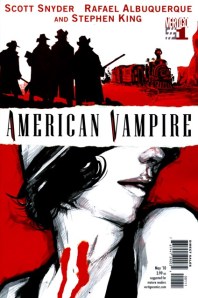
Stephen King on vampires with bite

american vampire by stephen king

It’s old news, but it’s worth another bite: Stephen King, the man who brought us Salem’s Lot, is at it again, this time with a comic — American Vampire (note the rather tantalising hardover collection being plugged on his site — how long till Xmas?). King’s contributed a story to the opening gambit of the series, helmed by writer Scott Snyder and artist Rafael Albuquerque, aimed at putting the red back into the red, white and blue, he tells the Guardian, a kind of ‘so there’ to the fangheads with issues rather than appetites. Bless!

Salem’s Lot is an ace book, and I can’t help but wonder how it would go today, given the gorgeous slow burn as he lays the whole town out on the table before ripping it to bloody tatters. Not much teen angst and/or suppressed sexual tension going on in the vampire world, there; just a good old-fashioned homage to Stoker’s Dracula, beautifully done.

The link to top vampire books is worth a look, too.

Brisbane Madigan Mine signing

kirstyn reading from Scenes from the Second Storey at Aussiecon 4
Kirstyn and I will be at Brisbane’s Pulp Fiction in Edward St from noon on Wednesday (Sept 15) where she will be signing Madigan Mine. She also has stories in the anthologies Macabre and Scenes from the Second Storey, both launched at this month’s Aussiecon4 (the World Science Fiction Convention). Please do pop in to say hello if you are able 🙂

Aussiecon4 highs and lows, Voyager blasts off

Cherie, Kylie, Lindy and Amanda keep me company at the signing desk - a kaffee klatsch without the kaffee!

Aussiecon4, the 2010 Worldcon, is over, and I’m home snuffling and coughing with a dose of persistent pre-Worldcon flu, feeling totally knackered but yet energised as well.

This was my first Worldcon and it was thoroughly enjoyable, even with the flu.
Downsides were:

  • Sean Williams being too ill to attend.
  • Ellen Datlow having to leave early due to sickness in the family — all the more poignant for her Hugo win.
  • The Christchurch earthquake was also worrying, a relief that there were no casualties. The Kiwis are bidding to host Worldcon in 2020.
  • Not catching *anything* involving China Mieville.

The program was massive, spread across ground floor auditoriums and an array of rooms on the second floor of the convention and exhibition centre, and it just wasn’t possible to attend everything of interest, nor report everything here. What I did catch was generally informative and at times downright inspiring. I particularly enjoyed hearing Peter Brett (The Painted Man) speak of his “survivor’s guilt” after having his novel picked up while pals were still striving to get theirs on the shelf. I also took heart from Will Elliott’s passion and Fiona Macintosh’s work ethic.

I was chuffed to have people I didn’t know attend my reading and that, despite my hoarse flu voice, they stayed to the end, and was very grateful indeed to have company at the signing desk while the most engaging guest of honour Kim Stanley Robinson made the day for a very long line of fans indeed. His self-interview, complete with coat on-and-off, was a delight. Kyla Ward, who organised the horror stream in which I took part, proved exceptional as an organiser — she also masterminded the horror ball that I sadly failed to attend, though I heard gushing reports. I also really enjoyed talking vampires with a bunch of clued up and inquisitive teenagers and talking taboos with Richard Harland, Deborah Biancotti and Catherynne Valente.

UK writer Robert Shearman performed a most entertaining reading of a rather poignant story about a boy and his love of love songs, and Kirstyn’s reading of her story from the Scenes from the Second Storey collection (launched at the con) also drew a pleasing response.

The Hugo awards (full list of winners here) also proved an enjoyable affair, running smoothly and not overlong, with a feeling of camaraderie rather than competition, and absolutely nil ego. MC Garth Nix was, as always, personable and engaging. Lovely to see, amongst others, Aussie artist and con guest of honour Shaun Tan recognised, and to see the splendid movie Moon score a gong.

My appreciation for George RR Martin has also been cemented thanks to his wit and delightful chuckle. (Do read his Fevre Dream if you haven’t already: one of the best vampire books evah!)

At the end of the day, after the launches (yay Angela Slatter and Kaaron Warren’s double launch, complete with publisher Russell Farr in a kilt doing the honours; and the massive collection of Aussie horror in Macabre, amongst others) and parties and panels and awards (some well-earned Ditmars were given out — the full list is here), it was the people who made the convention, and it was amazing bumping into so many friends from throughout Australia and overseas.

Let’s do it again — but not till I’ve had a nap!

There are some pictures at my flickr site.

Voyager going global

Voyager’s 15th birthday party held in conjunction with Aussiecon prompted this (annotated) announcement of a new global (or is that Orbital?) approach to marketing its genre fiction:

“Eos Books, a US imprint of HarperCollins Publishers, will be rebranded as Harper Voyager, joining together with the celebrated Voyager imprints in Australia/New Zealand and the UK. The move is anticipated to create a global genre-fiction powerhouse.
“This move enables us to offer authors a strong global publishing platform when signing with HarperCollins – whether the acquiring editor is in New York, Sydney, or London,’ said Brian Murray, president and chief executive officer of HarperCollins Worldwide.
“Two authors, Karen Azinger and David Wellington (writing as David Chandler), have recently been signed and are expected to publish with Harper Voyager and Voyager for a worldwide debut. The Eos imprint will officially change to Harper Voyager starting with the January 2011 hardcover, trade, mass market, e-book, and audio publications.
“The Voyager/Harper Voyager editorial leaders are: executive editor Diana Gill in the US; editorial director Emma Coode in the UK (working with publishing director Jane Johnson); and associate publisher Stephanie Smith in Australia.”

Exciting and interesting stuff with an apparent focus on breaking down the regional publishing territories, or at least making more effort to spread product globally. It’ll be interesting to see the impact this has.