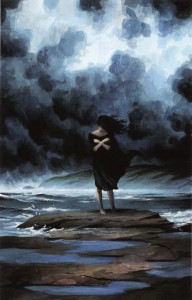


A belated note to acknowledge that the wonderful Dr Brains have picked my grey matter for ruminations on things writerly and vampiric over at their Lair — if the wonderful Kathleen Jennings illo is anything to judge by, I’ve truly gone out on a limb! (Because the Brains, aka Angela Slatter and Lisa Hannett both host — a kind of left and right brain thing, perhaps — I’m linking to them both!)
For those who haven’t seen the blog that this illo riffs off, Goths Up Trees is not only photographically interesting but comes with the kind of endearing snark one would expect — great fun.
This isn’t on my list of 10 for the Australian Women Writers 2012 National Year of Reading Challenge, but what the hey.
By Margo Lanagan
Allen & Unwin, 2012, ISBN: 978 1 74237 505 2

The short version: a witch finds revenge for being the subject of derision when she discovers the power to pull people out of seals. The women so brought forth are rather delectable, moreso than the common weather-beaten and life-worn specimens already available. The island’s menfolk are happy to pay for the privilege of a seal wife, a fairly docile offsider amenable to performing all the household chores and breed some sons as well.
In a kind of flip on the Lesbos tale, the women leave the men to their magical arrangement and the witch grows rich.
 I’m not entirely convinced I needed to read the before and after, the novella having proven quite enchanting in and of itself, but the opportunity to do so shouldn’t be missed. The novel is most enjoyable and provides a possibly more evenly rounded tale centred around that core; the set-up providing more insight and the denouement given more time to breathe.
And then there’s Lanagan’s wonderful prose, her playful way of recasting words and phrases, and describing things afresh. (See Sean the Bookonaut’s review for more on this.)
This is a gently told fantasy, presented unusually and quite beautifully in this Allen & Unwin paperback version, with a rather horrible narrative kernel.
This is the fifth book I’m reading as part of my list of 10 for the Australian Women Writers 2012 National Year of Reading Challenge.
by Marianne de Pierres
Random House, 2011, ISBN: 978 1 86471 988 8

It’s no surprise, as MdP knows how to put a story together, and this one comes in some truly cool trappings: a nocturnal, youthful party world watched over by vampire-like sentinels, and lots of secrets in the dark. Her heroine, Retra, has quite the journey too, right down to a name change, though by story’s end, one wonders if Naif is really so accurate. Clearly, she’s still got some learning to do, but she’s well on her way to adulthood. Yes, this book packs some powerful metaphors.
This first volume introduces Inoxia, a hilly realm of constant night in which the pursuit of pleasure is paramount for its young population who are runaways from other surrounding realms of various fantastic, and not so fantastic, proportions. In one, a hunter-gatherer society can trap bat-like creatures for mounts. In Retra’s, it’s Puritanism 101, right down to child abuse dressed up as moral policing.
Inoxia is a fantasy land, reached through a kind of vortex beset by pirates. If this sounds a little like Alice sliding down a rabbit hole, it’s a far updated version, and the lost boys and girls don’t so much stay young, as disappear once they reach a certain point in their early 20s. While the pirates are the nemesis of the land, the faires are also fearsome. Called Ripers, the vampire-like overlords police the young party animals, dolling out drugs, food and clothing as required. Of course there is no free lunch, and Retra discovers the true dark side of Inoxia’s society. Freedom, or at least escape, comes at a price.
Mdp has created a distinctive and believable world and her character work is a delight as Retra, through a transformative experience key to adolescent maturity, grows into a new individual. While the second half suffers from annoying, but perhaps unavoidable repetition of recent events, it charges towards its climax and the jumping off point – a new bright day – for book 2.
With Burn Bright, we’ve been given a strong starting point and an enticing look into a world where colonisation has taken some bizarre avenues. Quite the delight.
It was the gig I excpected it to be. The gig I’d waited 20 years or so for. The Sisters of Mercy — well, founder and main man Andrew Eldritch with a guitarist, bassist and laptop wrangler — live and loud at Auckland’s Powerstation on Wednesday night.
It was a no-nonsense set-up. A plain, industrial stage dressing of pipes, guitar, bass, smoke machines working so hard the band sometimes vanished. And holding court, Eldritch – bald, sunglasses, goatee, military blacks. Delivering virtual spoken word in uber cool style, cigarette in hand as he whispered and moaned into the mic. For an hour and a half. Song after song, notorious drum machine Dr Avalanche not giving a moment to pause.
They offered a playlist to die for: an assortment of hits, b-sides and a couple of unrecorded tunes including ‘Summer’, played to an ecstatic full house. A young crowd with a presentable smattering of overt goths. Not enough to rankle the infamous goth-shy Eldritch, or if so, he made no comment. In fact, he said barely a word that wasn’t a lyric.
‘Ribbons’ opened. There was ‘Dominion’, ‘First and Last and Always’, ‘Detonation Boulevard’, ‘Alice’, ‘Vision Thing’, ‘More’ (not the 12″!) … and two (albeit seemingly scripted) thumping encores featuring a highlight of the night in ‘Lucretia My Reflection’ and a strangely uninspiring ‘Temple of Love’ to close.
Underpinning it all were those familiar, at times repetitive beats, lashings of superb guitar, a stray wish for a drummer to help kick things up and around a bit. Eldritch was a little hard to hear early in the piece, but there was no denying the power of the constant battering to transport the listener. Twenty years in the waiting, and the Sisters did not disappoint, even if they didn’t surprise.
Bring on Melbourne, where they play two gigs at the Corner in their only non-Soundwave tour appearance Down Under!
It’s also worth noting that Aurealis is once again open to submissions. It publishes 10 issues a year in the newly adopted digital format.
This is the fourth book I’m reading as part of my list of 10 for the Australian Women Writers 2012 National Year of Reading Challenge
By Kim Westwood
HarperVoyager, 2011, ISBN: 978 0 7322 8988 1

Our journey into this well-rendered terrain is through the eyes of Salisbury Forth, a bicycle courier whose life has been characterised by a fight for acceptance of her transgender status. She identifies as androgynous, meaning even her family shun her. Sal (the story is told in first person, so eliminating annoying pronoun conflicts) found a measure of freedom inside the underground community of the inner city, ‘pedalling’ hormone and liberating factory animals; it’s only a matter of time, of course, till the wheels come off.
Intrigue on an almost cyberpunk level ensues as bad drugs are sold, corporate interests clash, desires stoke the belief that the ends justify the means.
Issues of sexuality and identity, and the prejudice levelled against the perceived ‘other’ by the ‘moral majority’, are key issues, and Westwood puts us firmly in the saddle.
The story is narratively more straightforward and the prose more accessible than in her previous, debut title, The Daughters of Moab, a post-apocayptic Australian tale which likewise evoked a most believable world.
It’s refreshing that in CNB there are no action heroes; while the world dips into science fiction concepts rooted firmly in the here and now – glow-in-the-dark pets, anyone? say no to battery farming? – the characters are uniformly of the average human variety. They get tired, they make mistakes, they hurt.
There were two minor speed bumps in my reading of the novel, and both probably reflect more on my reading habits than Westwood’s skill and style.
the first was a preponderance of info dumps filling in details about the back story, particularly early on as the stage was being set. There’s a certain level that fits the noir tradition that this story draws on so well, but there’s also a limit to just how much is needed at any one time without interfering with the story, or indeed, interrupting conversations.
The second, equally minor, annoyance was the Salisbury ‘voice’. For a young person who left home at 16, has limited formal education and lives an unsettled life, Sal’s vocabulary is extraordinarily wide and her knowledge of art likewise remarkable. Unfairly assumptive and prejudicial? Perhaps.
These quibbles can’t diminish the impact of Westwood’s world and the gender and social issues she explores. Atmospheric, considered, with likeable characters in a fascinating world: bravo.

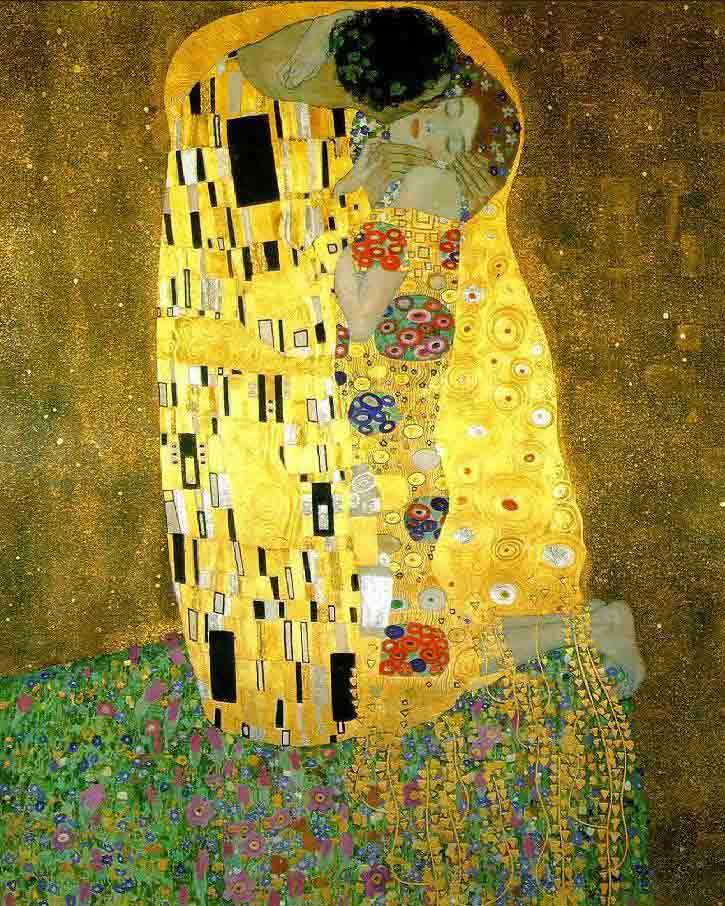
It was one of those yarns that popped up out of the ether, a happy collision between a visit to the gallery to see an exhibition about the Secessionist painters of early 20th century Vienna and the announcement of the anthology. In particular, a painting of Count Verona by Oskar Kokoschka and the unavoidable if enigmatic presence of Emilie Floge. It took a while to get this one to come together; I was dreading trying to reconfigure it if it missed the mark for the Bell Club. I realise now that, with last year’s riff on the disappearance of Harold Holt, I’ve definitely joined the ranks of alternative history; bless you, Emilie Floge, and your crazy band of artists! It will be interesting to see who else is rubbing shoulders in the Bell Club halls…

Emilie Floge

Count Verona, 1910
The TOC:
The Adventure of the Laboratory – Kathleen Brandt
Tell Tom Tildrum – Edward M. Erdelac
The Quarrantine Station – Lee Zumpe
A Gentleman’s Folly – Phil Hickes
The Kiss – Jason Nahrung
Divine Providence – Robert J. Santa
The Widow Dotridge – Jason D. Moore
Spawn Of The Crocodile God – John McNee
Life and Limb – Andrew Freudenberg
The Girl In The Cabin – Richard Barnes
The Wager – Jeff C. Carter
Sayuri’s Revenge – Helen Stubbs
Fluke (originally: untitled) – Lynne Jamneck
The Shrieking Woman – Doug Manllen
This is the second book I’m reading as part of my list of 10 for the Australian Women Writers 2012 National Year of Reading Challenge.
Book 2 of the Creature Court trilogy
by Tansy Rayner Roberts
Harper Voyager, 2011, ISBN: 9 780 7322 8944 7

It’s a complex world, with Italian Renaissance overtones, and both the workings of the magical world and its relationship with the physical are explored further in The Shattered City. Velody grows into her role on the great chess board, introducing a new regime of polite behaviour — of community — into the fractious, scheming Court, while her fellow seamstresses — Rhian, all but neglected for much of this story, and fiery Delphine — also find their place in the new world order.
The actual story that drives this book — an assassin in the ranks and the sense that the city faces its most deadly threat yet — takes a while to get going, but there’s no time for slacking off. There are so many points of view, often thrown altogether within each chapter, and some make only one or few appearances: it’s easy to lose track of just whose head you’re in.
It’s a strength that the immediate story arcs of books 1 and 2 are both resolved between their covers, while the larger story stretches across them. As with the first, the second delivers some delicious moments, beautifully dressed and dead sexy, and what a relief it is to finally have the plot point that kicked the whole thing off finally out in the open. Rayner Roberts is wise to not present it as a surprise, but use it as leverage for a greater goal. The Creature Court series offers a layered, detailed, credible world, peopled with a cast of complex, motivated individuals. How fortunate that, given the impending showdown foreshadowed here, that book 3, Reign of Beasts, is out now!
This review has also been posted at Australian Speculative Fiction in Focus, who made the review copy available.
Previous Challenge reviews:
My novella Salvage, a seaside Gothic, is available for pre-order in paperback from Twelfth Planet Press for $15 plus postage.
“Seeking to salvage their foundering marriage, Melanie and Richard retreat to an isolated beach house on a remote Queensland island.
“Intrigued by a chance encounter with a stranger, Melanie begins to drift away from her husband and towards Helena, only to discover that Helena has her own demons, ageless and steeped in blood.
“As Richard’s world and Helena’s collide, Melanie must choose which future she wants, before the dark tide pulls her under … forever.”