Collide, bent but far from broken

collide band

Listening to electro duo Collide is a little like walking by the ocean; a quiet, calming ocean. But as with that aquatic environment, beneath the surface, there are currents to pull you in unexpected directions, rips to take you deeper. And that is what the mammoth remix double album Bent and Broken (Noiseplus), kindly downloaded to me by the band, has explored, tagging the essence and developing the core of the music to take it further. So not just those calming rhythms, but the crash and foam as well.

Prime example is ‘Chaotic’, from the 2008 album Two Headed Monster, itself a rollicking, infectious tune. There are three versions on Bent and Broken — one mesmerising with strings, another yet more chaotic with electro pop and whizz, the third even further ramped up with the fuzz into a dancefloor firecracker.

There are also three versions of ‘In the Frequency’, making it equal favourite for remixing, and two of four others. All up, there are 26 tracks split 15/11 on Bent and Broken, mostly reimagining Two Headed Monster and last year’s Counting to Zero (reviewed here): two hours of largely dreamy soundscape. There is also a sprinkling of new material: ‘Orgy’, a worthy cover of a The Glove song that makes the most of kaRIN’s understated snarl; straight-up Collide-style ‘Bent and Broken’, and a cinematic cover of Queen’s ‘She Makes Me’ featuring acoustic guitar.

Matched with Statik’s musical chops — this album’s production rewards listening through headphones — kaRIN’s vocals are one of Collide’s assets: distinctive, seductive, malleable, swinging from seductive to ominous to pacific.

So I probably could’ve done without the fast-forward/rewind whimsy of ‘kaRIN, You’re Not Yourself Today’, but it’s a single blip on an otherwise smooth journey.

collide album bend and brokenA highlight is dreamy ‘Lucky 13 (Damaged mix)’, ramped up with industrial stylings that provide a darker, almost ironic cast. It doesn’t surprise it comes courtesy of Android Lust, whose next album is being Kickstarted towards completion.

‘Tears Like Rain (Cloudburst mix)’, such an awesome line from the movie Blade Runner, here drops the pace into maudlin territory, gentle keys creating the soft pitter patter of hopes and dreams slowly melting; the Psych-Nein mix transports ‘Tears Like Rain’ into a casbah discotechque.

‘Clearer (Serrated Edge mix)’ is smoother than the name suggests, but has one of the heavier beats and widest ranges, from an almost industrial attack to minimal electronic hand claps.

And so on, with extra beats here, trip hop there; candlelight anthem here, dancefloor there.

The album closes with a seven-and-a-half-minute meditation of ‘Utopia’. Ahh.

Hysteria: at the movies and in Emilie Autumn’s Fight Like a Girl

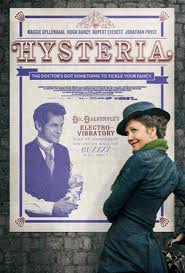
hysteria movie posterTHERE is a moment in the newly released movie Hysteria, which traces the invention of the vibrator in the late 1800s, where the humour to be extracted from doctors masturbating women to release their ‘hysteria’ runs into the horror wall: the feisty heroine, played brilliantly by Maggie Gyllenhaal opposite the rom com’s leading man Hugh Dancy, faces institutionalisation and forced hysterectomy. The engine of her dire straits is her father.

While the movie has its laughs, its social commentary, both of class and sex, is telling. The medical condition of ‘hysteria’ was only dismissed in the 1950s, the movie’s afterword tells us. It takes a lot of Rupert Everett’s hijinks as electrical experimenter and comic moments with mating ducks to relieve that uneasiness.

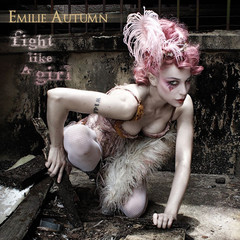
emilie autumn album fight like a girlSURGICAL maltreatment of women as a way of dealing with perceived hysteria, or lunacy, is very much to the fore in Emilie Autumn‘s new album, Fight Like a Girl, which landed this week. It offers a narrative, musical arc set in an asylum for women — some of the music is from a planned Broadway show — but this is not the home for wayward girls so endearingly and sexily brought to the stage in her previous live show. Rather, this is the surgery where those ‘wayward’ girls are locked away to keep their brash sense of self and identity from unbalancing the patriarchy. Women as objects to be used, as threats to be neutralised, is the theme.

The ranging styles of the songs, from the upbeat defiance of the titular single to the violin ballad of ‘What Will I Remember?’, the vaudeville of ‘Girls! Girls! Girls!’ to the funereal ‘Goodnight, Sweet Ladies’, is clearly rooted in the dramatic production. And what a dark show it promises to be, with drug therapy and incarceration, and threats of sterilisation, rape, mutilation and murder among the offerings.

Tellingly, the album opens with the strongest, most strident songs, giving the impression of a revolution being quashed as the songs then travel into the asylum. A number of shorter tunes, some instrumental, suggest bridges between scenes, before the album draws to a close with the military beat of ‘One Foot in Front of the Other’, a hint of recovery and the promise of round two.

Along the way, there are treats in the minimalist electro of quite terrifying ‘Take the Pill’, harpsichord-driven ‘If I Burn’ and the seven-minute menace of ‘Scavenger’.

She’s quite the multi-talented artist, Ms Autumn, and this album, a different beast with some familiar stripes to her breakout Opheliac, suggests, even after just a couple of listens, further rewards in store.


May there be Hammonds in Heaven for Jon Lord

Very sad to hear of the passing of Jon Lord, who rose to fame as the keyboardist for Deep Purple, pumping the instrument through the Marshalls to help make the band, in 1972, the loudest in the world. Lord finally quit the band in 2002. Classically trained, a composer as well as a rock pioneer, he was also a charming, gentlemanly person. I think myself lucky to have seen him with Deep Purple, sans Blackmore unfortunately, and with the Hoochie Coochie Men at an amazing pool-side blues gig on the Sunshine Coast. A true legend.

My 2003 interview with Lord is here

The Tea Party brew up a storm at Melbourne’s Palais

tea party band jeff stuart chatwood jeff martin jeff burrowsHow good was it to see Stuart Chatwood caressing those keyboards? Jeff Burrows going restrained Animal on the drums up the back, silhouetted by that spectacular backlighting beaming out across the Palais like some kind of mystical door opening? And Jeff Martin, being Jeff Martin, up the front of the Tea Party for the first time since they called it a day seven years ago?

Very bloody good.

Sure, the sound was always a pain with the feedback buzz and increasing muddiness. The lighting at times a little overbearing. The medleys a little ad hoc, not quite as smooth in the transitions as we’re used to.

Oh, there might be a few cobwebs still hanging off the trio, but after two hours of blasting out hits such as ‘The River’, ‘The Bazaar’, highlights in ‘Fire in the Head’ and ‘Psychopomp’, and on, to an encore culminating in ‘Sister Awake’/’Paint It Black’), they proved they’ve still got IT.

Throw in the theremin on ‘Lullaby’ (if memory serves), ‘Shadows on the Mountainside’ and a wee slice of ‘Hallelujah’ — more Cohen than Buckley — with ‘Heaven Coming Down’, ‘Release’, ‘Temptation’ and more, and last night’s opening gig of the Reformation tour in Melbourne was quite the emotional rollercoaster. More fun than Luna Park next door. And somehow, walking out into a cool, light shower of rain was the perfect end to what might be a new beginning for the Canadian trio.

They’re recording this Australian tour for a live album; will the studio follow?


Konqistador amps up world music with Suada

This is the promo video for the new album by Konqistador, late of Melbourne and North America, now of Istanbul, and it’s the barest taste of the thoroughly entertaining Suada.Fortunately, they’ve kindly made audio tracks of the album available at YouTube so you can indulge before you buy (have a listen, name your price, download away at bandcamp).

I’ve been thrashing it lately — four days of writing have been conducted largely to this, Kidneythieves and Android Lust; Gary Numan’s Jagged can’t be far off — so here’s a guided tour:

Suada is an intriguing album. Emotional, transportative, at times meditative, others stirring, a real sine wave of sparse and dense.

courage riot of konqistador‘Harcanan Kotu’ opens with a chop and change of percussion, bass and fuzz, borrowing a riff from ‘Evil Gotten Evil Spent’ on Konqistador’s ‘Courage Riot album which showed strong Middle Eastern influences.

There follows three tracks that are more obviously rock tunes: ‘Albastru’, gothic and seductive with a delicious hint of menace; ‘Suada’, showcasing the world music and electronic elements with a jaunty beat; and ‘Brancovan’, offering hints of poppy hair metal, a wonderful anthem that leaps from the speakers and demands attention.

There follows a more scenic second stretch, introduced by the low noise of ‘Izul’ that suggests a mysterious, perhaps spooky journey ahead. Wind noise and muted arabesque vocals further suggest a lost time or remoteness, slowly giving way to electro, almost SF, effects evoking the weird, the Gothic and the haunted. A superb introduction, it probably doesn’t stand alone as well as other pieces here.

This lends the album a feeling of being a collection of mini-landscapes, an anthology rather than a novel, and what an enjoyable journey it is.

Izul is followed by ‘With Eyes Shut’, a sweeping choral opening complemented by belly dance jangle and whispered lyrics, industrial sounds contrasting with the drums giving way to electric guitar-led cruise and some bursts of subdued electronica to provide some light and shade.

This is where I was most likely to drift off – not necessarily a bad thing – and ‘Rafqa’ pulled me back after the fade.
‘Rafqa’ bustles with percussion and vocals. It stands out for being a relatively straightforward song amidst the more atmospheric offerings of this section – a transition or perhaps demarcation between the more instrumental works?

The album jumps to ‘From the Ruins’, a comparatively sparse Greek guitar-and-synth instrumental that drops us back into a more desolate, though relatively pacific, landscape.

suada by konqistadorDreamy ‘Keykubat’ is much more lush; it brings percussion to the fore, with ethereal vocals, synths and a gradual building of tension. It wouldn’t have been out of place on Trent Reznor’s soundtrack to The Girl with the Dragon Tattoo. It hits a lot of my buttons thanks to the vocals and synth textures.

‘Huzun’ offers a quiet fall away to keyboard/electronic instrumental with choir, an interlude that gives way to percussion and then changes gear with swelling requiem organ under a driving percussive beat and then into fade.

And finally we have the closer ‘O Yar Katit Darom’, resetting yet again with its quiet start. The vocals add to its meld of Arabia and India; quite a contrast to ‘Huzun’. It’s a particularly long piece at 13 minutes, caught in its percussive groove before again we have the swell, reminiscent of Ministry’s ‘Khyber Pass‘. The SF effects add contrast, a flying saucer landing in the middle of a bazaar, perhaps with a windstorm in effect, indicating the end of a musical wander through varied yet complementary sonic terrain.

spaceships and dreamers (part one) by christopher antonIF something more retro is your style — say, ’80s dancey and all Depeche Mode-y / Human League-y — have a taste of Christopher Anton’s Spaceships and Dreamers (Part One). You have permission to boogie.

Snapshot 2012: Talie Helene

australian speculative fiction snapshot 2012 logoTALIE HELENE is a musician and writer, from Melbourne. She has poetry published in journals including Voiceworks, Avant and Inkshed, and Mary Manning’s About Poetry (Oxford University Press), and a co-authored short story (with Martin Livings) ‘The Last Gig of Jimmy Rucker’ in More Scary Kisses (edited by Liz Grzyb). Talie is horror editor for the anthology The Year’s Best Australian Fantasy and Horror (Ticonderoga Publications), and was news editor for the Australian Horror Writers’ Association for four years (2006-2010), for which she received a Ditmar nomination. She is a member of the SuperNova writers’ group. Talie has a background in music journalism – especially extreme genres – and has performed with many artists including The Tenth Stage, Wendy Rule, Sean Bowley, Saba Persian Orchestra, Maroondah Symphony, and Eden. She is currently developing a new audio arts anthology titled The Unquiet Grave. You can find out more at www.taliehelene.com.

What are the pleasures and perils of compiling the horror component of the Ticonderoga Year’s Best Fantasy and Horror?
One of the guiding principals I have is that the stories need to go to different emotional places, because horror is about hitting raw nerves. If you hit the same nerve too many times, you desensitise and the stories become emotionally monochrome. Horror is unique in that the genre is defined by emotion, rather than trope or context – you can have a completely supernatural story that is horror, and a totally realistic story that is also horror. So trying to keep the mix fresh and blow the readers away in different ways, keep the emotional impact – that is pure fun. Editing a Year’s Best is a bit like being a DJ. The works are already published and polished, so the job is to find that mix of hits and undiscovered gems and make the overall experience entertaining and powerful and surprising. It’s a kick!

Working with Liz and Russell at Ticonderoga is totally a pleasure. I was a dark horse choice for this editing job, and having them believe in my instincts is very humbling. They are also really understanding, and they’ve been very supportive throughout. Having a purpose that isn’t focused on my own headspace has probably been a saving grace for me. Just getting to associate with such fine writers is a buzz and an honour; meeting some of ‘my authors’ and having these instantly engaging conversations about narrative that I would never otherwise have is a delight.

The perils. Well, there should be perils in compiling horror, right?

I think probably the biggest peril is balancing literary horror and visceral horror; horror goes to places that connect with visceral responses, and it goes to places of deep trauma and danger and anger, and sex and death are so very tangled together. If the emotion overwhelms the form it can be incomprehensible, and if the form overwhelms the emotion you get cliche. The quality that lifts both aspects up is authenticity. I’m just one person, so I have to trust my own instincts as to which stories do which of those things excellently. Just entering that territory is perilous, because when people disagree they will disagree vehemently. Conversely, if I didn’t stick to my guns about my choices, I have no business editing horror.

I worship what I would call literary horror – writing that engages with top-shelf word craft and narrative constructs in the service of hitting those raw nerves. In the Capital L Literature world the idea of ‘literary horror’ is regarded as an oxymoron. The reality of any genre is you have to read through a truckload of mediocrity to find the amazing work. Go to a Capital L Literary spoken word night. You will have to endure an avalanche of bullshit to experience a few dazzling talents. But I think it’s harder for people to go the other way – from the literary world, to the horror world – because horror stories do contain exploded intestines! The bad ones have exploded intestines! The brilliant ones have exploded intestines! It takes a committed reader to learn to separate being repulsed by bad gory writing, and enthralled by brilliant gory writing – which is also repulsive! But repulsive in the service of some larger meaning.

Really great horror stories aren’t just about horror – there is always something else that makes you empathise. That’s the reason Stephen King writes so much about love and different kinds of relationships. If you write about death, you write about life. I think horror is the deepest genre because it speaks from that precipice of our mortality. But I’m not allowed to harpoon people who don’t share that view!

While I prize literary horror, I also feel very connected with visceral horror. There would be something really wrong if the horror selection in Year’s Best didn’t include some stories where things that are supposed to be inside people are splashed all over the page – maybe that is blood, or a terrible secret, or unbearable knowledge. I think there are people who read horror and appraise the shock value over the literary merit – that reader is going to roll their eyes at terror in sunlight stories or existential horror. For me, blood and the numinous are equally powerful. By making a broad selection, I’m demanding the reader be open to all of that.

Is that condescending? I don’t mean to be condescending to consider that a peril. My gut tells me horror writers feel that they put great demands on readers too, and that is one of the issues of commercialism (or lack of) for horror.

There is an amorphous danger zone of gender politics in the speculative fiction community in Australia, and in horror more than any other genre. It is in part due to a disparity in theorised feminism, because writers range from all walks of life – can I say thank fuck? That is something I can appreciate from both sides, because I’m not a theorised feminist myself. (I don’t have a degree, and while I do read feminist musicology with interest, I’m truant on Feminism 101.) I think the sticking point is that horror is often violent, and historically violence precedes from the patriarchy, so there has been confusion in separating confronting language from gendered language.

As horror editor of the Year’s Best, I’ve had to remain silent on feminist issues I might have otherwise been very vocal about, because I have conflict of interest – and I support people in their artistic practice who have completely contradictory views, including views that I don’t agree with. It doesn’t mean I’m not participating in the discourse, because I will recognise writers who are disrupting and interrogating those issues in their work, and that becomes an influence in my editorial process. I want the anthology to be a powder keg of awesome! My philosophy is stolen from an old 3RRR Radio Station ID: ‘Diversity in the face of adversity’.

A more personal peril is discovering if I don’t include a writer’s stories, I can hurt the feelings of a friend – and maybe give them the erroneous impression that they had ‘a bad year’. While the words ‘best’ and ‘horror’ are the stars by which I navigate in story selection, there are also other pressures on the selection process – and not every fine story on the shortlist makes it through. It does not always mean those stories aren’t as good – or that I am prejudiced against a certain flavour of horror and won’t ever include it. This is the arts. It is subjective. It has to be subjective. And the DJ part of the editorial process serves a mix, not just an evaluation.

The final peril is for me as an emerging writer. Donning the hat of gatekeeper threatens to crush my view of my own writing with 10,000 tonnes of neurosis. (And that’s what SuperNova is for?)

You’ve got a Ditmar-nominated short ghost story co-written with Martin Livings: is this a sign that we might be seeing more Talie Helene stories out in the wild soon, and is the supernatural likely to play a role in new material?
If by soon you mean ever, then the answer is ‘eventually’. It’s a sign! The stories I have in progress have supernatural elements, although that wasn’t a conscious choice. You can’t really marinate your brain in horror fiction without soaking up the supernatural – and it kind of crunches down to writing emotion. I was already into it, but how tumultuous and marginalised my life has been in the past few years has probably pushed me deeper into it. You can write emotion through the supernatural that might not translate if you tried to deliver it Capital L Literary style. I don’t want to jinx the writing by turning this into a publicity blurb for unpublished work. I need to submit an ‘unavailable form’ to my retail job for SuperNova Sundays, and be humble or shameless with bringing drafts to the table.


You’re known for being a musician and a writer, and ‘The Last Gig of Jimmy Rucker’ combines the two: in what ways do those two creative pursuits influence each other in your practice?
Your question makes it sound nice, Jason. My stock answer is ‘they are the two halves of my heart’ – but right now, fox-holed in a robotic random day job, wearing a plastic smile and folding knickers in a department store – music and writing feel like combatants! They both fight for time and energy I barely have, and one is always stealing time from the other, so of course the other claws in as an influence. Anything beyond writing, that a writer spends time immersed in – history, physics, maths, or philosophy – that is going to influence them. That goes both for social engagement – dialogue colour and character – and for soaking up information that ignites ideas. Whatever boards you tread – the squeaky boards there are your story. Especially if the dark stuff sings to you.

So that kind of influence… I’d like to think my diction and structural sense of drama are influenced by music. I’m definitely influenced by the more personal ways people use music, and that is always a place of story – to grieve, to love, to evoke memory, to escape, to heal, to endure, to mark time, to hide from or find themselves, as a mask, as a drug, as an excuse, as redemption, as Dutch courage, a mating cry, a war cry, a goodbye…

There is something really spooky about singing a Dorian mode with a bunch of other music students. It is intended as an aural drill, but sometimes it hits you that you are inside an ancient structure – and it gives you shivers.

What Australian works have you loved recently?
I’ll tell you about some things I didn’t anthologise. I had post-it notes plastered all over them – one saying ‘HELLYEAH!’ and one with a sad face and ‘NOT HORROR’.

Two stories from Cat Sparks – ‘The Alabaster Child‘ and ‘Beautiful‘ – were both completely immersive science fiction with a distinct visual style. Cat is one of the best visual stylists in Australia, which is not surprising given her involvement in design and photography. She studies colour and light all the time. Thoraiya Dyer‘s ‘Fruit Of The Peepal Tree‘ was the most delicately painted and subtly paced story I read from 2011, and I’m so glad it won the Aurealis in the Fantasy Short Story category, because I was shattered I couldn’t use it for Year’s Best. Even touching on dark themes of loss, environmental degradation, and female infanticide – it didn’t riff the emotion of a horror story, but it was an exquisite story.

The Rage Against The Night anthology Shane Jiraiya Cummings edited as a fundraiser – while under-the-radar locally, that was an impressive collection. The excerpts I’ve seen from Rocky Wood and Greg Chapman’s Witch Hunts: A Graphic History of the Burning Times (with Lisa Morton) look kickarse.

What have been some of the biggest changes in Australian speculative fiction in the past two years since Aussiecon 4?
Given that I have an Atheling nomination for a 2010 Year in Review essay (co-authored with Liz Grzyb), and I’m gap-filling the 2011 review essay right now – it is absurd, but I don’t feel that qualified to answer this question, because I only really follow the horror. I’m kind of new as a writer and an outsider in the Australian speculative fiction enclave – and I’m tremendously self-involved. The PR Bitch answer would be to say Ticonderoga Publications launched a Year’s Best Australian Fantasy & Horror series, right? The size of the two boxes of Year’s Best reading – 2010 and 2011 – 2010 weighs in as a year of bigger output, but the marketing impetus of a Worldcon makes that almost a given.

Australian spec fic had an international profile boost with all those international practitioners visiting Melbourne. While I’d never dream of suggesting it was the reason Alisa Krasnostein and Twelfth Planet Press scored a World Fantasy Award, I think the wave of Aussiecon4 helped an already deserving and enterprising nominee – and this is a good and natural development, and I’m cheering that success on.

The bowing out of Brimstone Press certainly changed the playing field for local horror writers. Bummer. The AHWA seems to have lost cohesion, but I can see a rallying point emerging with Marty Young executive editing Midnight Echo.

The unfortunate melee that Robin Pen hilariously sketched as ‘Ballad of the Unrequited Ditmar‘ seemed to cause a lot of hurt – factions seem delineated, which I think is a pity because in a scene this small we all move forward together. (Who knew I was such a hippy?)

I think the true biggest change – to paraphrase the words of Bren MacDibble – there is a Paul Haines shaped hole in the world. For the broad generation of Paul’s contemporaries, the wave of writers around him, that loss is going to be felt for a long time. Art doesn’t evolve in a slow creep, it leaps forward with bold thinkers and original voices, and then other practitioners play catch-up. I’m not saying he is the only trailblazer in Australia, but that ego Paul always talked about having – to my mind was just that awareness. He was a leap forward kind of artist. He was special. He knew it. The curtailing of that brave talent is the biggest change I’ve seen, and the saddest.

* * *

THIS interview was conducted as part of the 2012 Snapshot of Australian Speculative Fiction. We’re blogging interviews from 1-8 June and archiving them at Australian Speculative Fiction in Focus. You can read interviews at:

The Cult’s Choice of Weapon is bang on target

the cult album choice of weaponThe new album from The Cult, Choice of Weapon, is now on repeat in the office. It rocks. Oh my, how it rocks.

Ian Astbury and Billy Duffy have embraced their rock ‘n’ roll roots (even riffing off ‘She Sells Sanctuary‘) and delivered a punchy 10-track album. I haven’t had time to dissect it properly — lyrically, there’s plenty of the usual spiritualism and imagery, and I suspect some reflection on the shadowy side of celebrity and society — but it sure does chug along. The rhythm section is massive and Astbury gives his all on vocals.

Adding to the shiny is the packaging of the two-disc version: it’s a wee hardcover book packing an extra disc with four previously released EP tracks — absolutely brilliant presentation that makes the album a splendid artifact with lyrics and artwork.

Allmusic.com said ‘Choice of Weapon is the Cult’s finest moment in 23 years’ — read the full four-star review — and as much as I enjoyed Born Into This, it’s hard to disagree if it’s four-on-the-floor you’re after.

The track ‘Lucifer’ is currently available at the band’s website as a free download. Truly tempting!

  • An interview with Ian Astbury from 2007

  • Johnette Napolitano at the Spiegeltent: night 3

    johnette napolitano at melbourne's spiegeltent

    Johnette Napolitano during her Night 3 performance at the Spiegeltent. Picture: Kirstyn McDermott

    The final night of Johnette Napolitano’s stint at the Spiegeltent in Melbourne, and as with the previous two nights, it was an outstanding hour.

    Napolitano, in her top hat and be-ribboned home-made dress worn over trousers, had anecdotes aplenty, starting with a ‘frog on a log’ song she wrote at age 12 — her first — to entertain a sick sister. Marc Moreland (of Wall of Voodoo, and Napolitano collaboration Pretty & Twisted with Danny Montgomery; he died in March 10 years ago) and ‘Joey’ featured. A superbly delivered poem from her Rough Mix book that had her harking back to the Rat Pack and the Hollywood of her youth. Those interjections within songs: priceless.

    The Spiegeltent encourages that lounge room conversation atmosphere and this was a very comfortable house party indeed.

    I’ve not heard versions of ‘Joey’ and ‘Tomorrow, Wendy’ (by Wall of Voodoo’s Andy Prieboy) more impressive than tonight’s renditions. Quite remarkable, given the guitarist has fractures in both hands.

    Again, though the songs were much the same as previously, the order was changed around and each was given its own treatment. Finale ‘Bloodletting’ was more comical — Napolitano has a wonderfully expressive face; ‘I Don’t Need a Hero’ rang heavy with emotion — I suspect there were ghosts in the house, haunting those lyrics, as one might expect from a gig with an autobiographical intention.

    Johnette Napolitano 2002 interview

    The audience, as last night, provided the rhythm section for ‘Roses Grow’, and how Napolitano can hold a note… I can’t even hold my breath that long, and she’s got a good 10 years on me. The sell-out crowd again got to put their hands together to bolster the encore, a cappella ‘Mercedes Benz’.

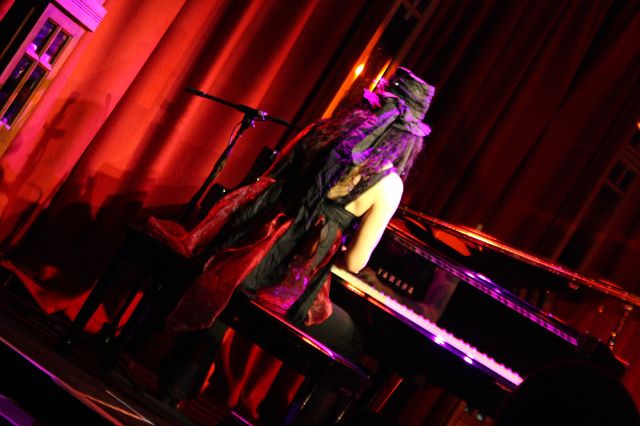
    Other songs included ‘Don’t Take Me Down’ with Napolitano on piano — man, it ripped — ‘Ghost Riders in the Sky’, ‘the Wedding Theme from Candy‘, ‘Rosalie‘, ‘New Orleans Ain’t the Same’ (so gorgeous, a favourite for this French Quarter tragic) and “Take Me Home/Rehab’.

    On Thursday night we had the rain, and last night there was a woman in the audience, apparently on her way to a party, dressed as Marilyn Monroe, which was the perfect window dressing for ‘Roses Grow’ (which references the actor). No such ‘extras’ tonight*, just honest, at times affectingly raw, music, that drew a standing ovation.

    I hope her hands heal soon, that she continues to make wonderful music and lets us experience it in person like this. I saw Concrete Blonde twice on 2010’s Bloodletting tour (Melbourne and Brisbane) and they totally tore it up, but this series was something else again. Bravo; fucking bravo!


    johnette napolitano at the spiegeltent

    Pic: K McD


    * Addendum: There was an inopportune low-flying helicopter that leant itself to a joke about being on the run, like Ray Liotta in Goodfellas was it, that totally cracked Napolitano up.

    Johnette Napolitano at the Spiegeltent: night 2

    johnette napolitano at the spiegeltent, night 3

    Johnette Napolitano on the third night of her Melbourne Spiegeltent run. Picture: Kirstyn McDermott

    After breaking the ice last night, Johnette Napolitano presented a more relaxed figure at her Spiegeltent gig in Melbourne tonight. Still humbled by the full house, but a little stumble-fingers too, stalling two songs — ‘how do you fuck up ‘Joey’?, she asked at one stage with an endearing chuckle — and tumbling her wine glass.

    Thing is, when you’re personable and natural, you can get away with the odd fumble. It’s refreshing to be reminded that not everyone has to be polished and Photoshopped to the sheen of ceramic in order to entertain. Cracks are allowed. Crack-ups are divine; Napolitano’s humour won through. ‘I’m a mess,’ she said; ‘thanks for your patience’. Pshaw. When you can bring tears to the eyes with a rendition of ‘New Orleans Ain’t the Same (Since You’ve Been Gone)’, you get all the patience you need.

    The set list was tweaked from the previous, again opening with ‘Rosalie’, and finishing early with the a cappella ‘Mercedes Benz’ before an encore of ‘Roses Grow’ to the accompaniment of audience percussion, ‘(You’re the Only One) Can Make Me Cry’ and the finale, ‘Bloodletting (The Vampire Song)’.

    Napolitano, in hat and ankle-length sleeveless black dress, was in good spirits, wisecracking, rendering slightly different takes on some songs, making each one fresh within its moment. The set list also included ‘Tomorrow, Wendy’, ‘Ghost Riders in the Sky’, ‘(You’re the Only One) Can Make Me Cry’ with a snatch of Amy Winehouse’s ‘Rehab’, ‘Don’t Take Me Down’ on the piano and ‘the wedding theme from Candy‘.

    There were anecdotes of Wall of Voodoo’s Marc Moreland and Melbourne (the inspiration for the hit ‘Joey’), of overflowing bath tubs and nanna naps, references to being old belied by a voice that took us far, far away from the canvas and mirrors of the elegant Spiegeltent. Great sound, too.

    Napolitano is donating all proceeds of merch sales to the Lost Dogs Home, with one more night to run in her three-night appearance.

  • Night 3 review
  • Johnette Napolitano at the Spiegeltent: night 1

    johnette napolitano at the melbourne spiegeltent

    Night 3 performance. Pic: Kirstyn McDermott

    Please, memory gods, don’t let this one fade: Johnette Napolitano, bathed in blue lights, bare arms showing muscle and tattoos, sleeveless red-and-black gothic dress over black trousers, black hair curling freely around her face, funky top hat with shiny pins; there’s rain on the canvas roof of the Spiegeltent and the leadlight windows are aglow from without; she’s singing to the accompaniment of only her guitar, strumming a low stalking beat, her voice infused with a blues note — ‘going all Louis Armstrong on your arse’, as she says in a breathy undertone with a hint of chuckle — and the song is ‘Bloodletting (The Vampire Song)’, and it encapsulates everything, absolutely everything I’ve come here for.

    Oh yes, I’m a fan, and last night — the first of a three-gig run — was a demonstration of why. That face, lined and shadowed with a life at the lower end of the rock biz, an uncompromising life, that voice that carries so much emotion; and then that cheeky peek from under the hat’s brim, the eyes alight and round with amusement and wonder, and she could be 20, or 12.

    I love her shyness, her humility, her quirkiness, her freedom to make mistakes and to interrupt her songs to interject a comment or a laugh. I love the way she plays her way into a song and then — oh — she’s in it, and it’s real, rasping low notes that make you shiver, those highs that make you tremble. She looks, sounds and acts real — ‘I like … my stories true,’ she says at one stage, quoting a passage from her Rough Mix chap book, a smattering of autobiography and lyrics and behind-the-scenes that’s only crime is being too short.


    Last night’s gig opened with the recent Concrete Blonde release ‘Rosalie’, thrilled with ‘Ghost Riders in the Sky’, then sent a frisson with a spectacular version of ‘Mexican Moon’ — some flamenco notes, some Spanish, all heartfelt.

    She sang a song about a frog on a log that she wrote when she was 12 — pretty good little ditty, that — and the wedding song from the Aussie movie Candy, the first time she’d performed it, she said (‘I was shitting myself up here; I’m still shitting myself’).

    It was a freestyle playlist, snippets of tunes here and there including a grab of Amy Winehouse’s ‘Rehab’ , anecdotes, requests, stretching back across her bands (primarily Concrete Blonde, her most successful venture) and solo work.

    The Pretty & Twisted tune ‘Don’t Take Me Down’ was stunning on the piano. There was a strong showing from the Bloodletting album, in addition to the titular song: ‘Joey’, Concrete Blonde’s big hit, and ‘Tomorrow, Wendy’, the Marc Moreland song that Johnette virtually owns due to her stirring renditions over the years, and a strident ‘I Don’t Need A Hero’. Her wonderful solo album Scarred was represented by ‘Just Like Time’. The gig ended with an a cappella rendition of ‘Mercedes Benz’, completing an earlier impression of a Joplin-like presence.

    Lord knows what I’ve missed. An hour was too short but deliciously long. She has two other gigs at the elegant, intimate Spiegeltent, an ideal venue for an acoustic performance from a genuine, and genuinely talented, performer.


  • Night 2 review
  • Night 3 review
  • Note: I’ve replaced an old PR shot of Johnette used in the original post with one taken on the third night after the audience was given permission to take photos for a period.