
Canberra’s Nicole Murphy (The Secret Ones) had me over at her blog recently to gab (in two parts) about the technical stuff — how to organise a writing schedule, look after health and get stuck into the words. It’s always fun, though perhaps also confronting, answering questions such as Nicole’s, because it makes you check the balance between intentions and practice. Note to self: must get act together and get nose to writing grindstone.
writing
Aurealis #47 in the wild
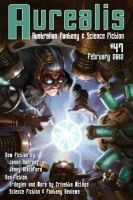
It’s also worth noting that Aurealis is once again open to submissions. It publishes 10 issues a year in the newly adopted digital format.
Tales from the Bell Club TOC
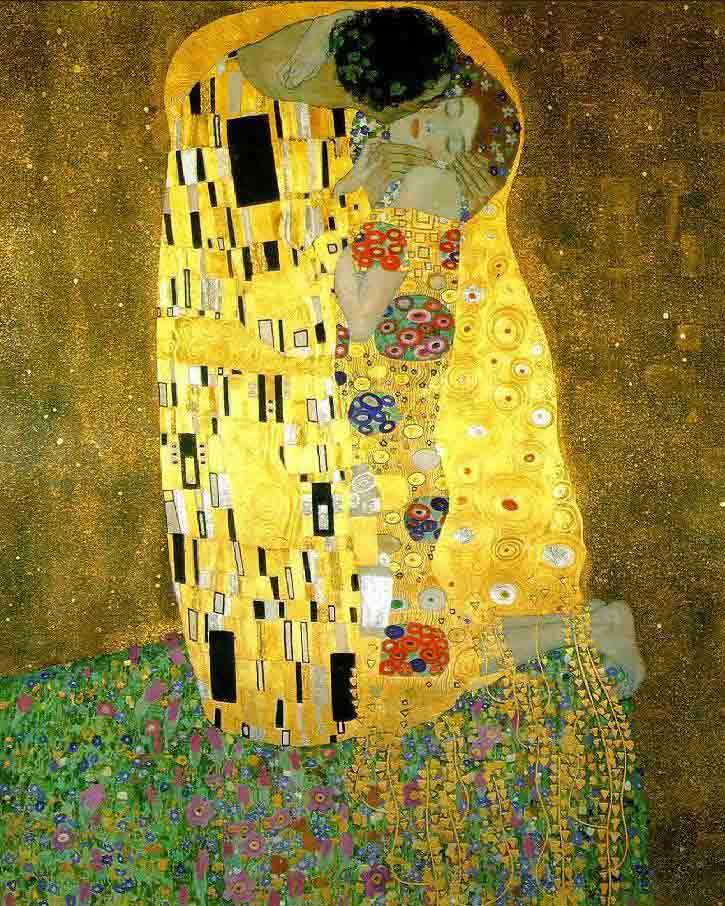
It was one of those yarns that popped up out of the ether, a happy collision between a visit to the gallery to see an exhibition about the Secessionist painters of early 20th century Vienna and the announcement of the anthology. In particular, a painting of Count Verona by Oskar Kokoschka and the unavoidable if enigmatic presence of Emilie Floge. It took a while to get this one to come together; I was dreading trying to reconfigure it if it missed the mark for the Bell Club. I realise now that, with last year’s riff on the disappearance of Harold Holt, I’ve definitely joined the ranks of alternative history; bless you, Emilie Floge, and your crazy band of artists! It will be interesting to see who else is rubbing shoulders in the Bell Club halls…

Emilie Floge

Count Verona, 1910
The TOC:
The Adventure of the Laboratory – Kathleen Brandt
Tell Tom Tildrum – Edward M. Erdelac
The Quarrantine Station – Lee Zumpe
A Gentleman’s Folly – Phil Hickes
The Kiss – Jason Nahrung
Divine Providence – Robert J. Santa
The Widow Dotridge – Jason D. Moore
Spawn Of The Crocodile God – John McNee
Life and Limb – Andrew Freudenberg
The Girl In The Cabin – Richard Barnes
The Wager – Jeff C. Carter
Sayuri’s Revenge – Helen Stubbs
Fluke (originally: untitled) – Lynne Jamneck
The Shrieking Woman – Doug Manllen
Aussies on Locus recommended reading list
A few Australian writers appear on Locus magazine’s list of recommended reading from 2011 — novels by Kaaron Warren, Alison Goodman, Jo Anderton, Scott Westerfeld (who straddles the Pacific divide); collections from Margo Lanagan, Tansy Rayner Roberts and Lucy Sussex; anthologies edited or co-edited by Jack Dann and four (!) by Jonathan Strahan; novelettes by Peter M Ball, Isobelle Carmody and Margo Lanagan; and short stories by Peter M Ball, Damien Broderick, Terry Dowling, Thoraiya Dyer, Margo Lanagan, Chris Lawson, Tansy Rayner Roberts and Kaaron Warren.
Apologies for anyone I’ve missed through oversight or ignorance.
Angry Robot opens its doors again, and other writerly news
Hot on the heels of Penguin’s new open door program, British press Angry Robot is again appealing to unagented authors — they signed three debut novelists from last year’s program — but this time are being quite specific about what they want: classic fantasy and YA SF and fantasy. The submission period is April 16-30 using a website uploader. Details are here.
Parkes laments what is essentially a globalisation of literature in which novels provide no authentic sense of place at all, but are instead tailored to a global market by dealing with ‘universal’ – read: more widely marketable and international prizewinning – themes.
This is partly why I took up the pen with a view to being published — to see my country, my culture, reflected in the types of stories that I like to read. It’s heartening to see authors such as Trent Jamieson able to set their fiction in Brisbane — Brisbane! — and still find not only a wider audience, but an overseas publisher willing to run with it. It’s pleasing to see someone send some Aussie sensibility across the water, rather than regurgitating a trope-laden backdrop of New York or London.
It’s not just eucalyptus trees (hey, they have plenty in California, anyway) — it’s viewpoint. It’s attitude. It’s how we see the world. Sharing these things is how we help us all to understand each other — not just the different priorities or approaches we might take, but also the similarities: parents what a better world for their children, for instance. Language plays an incredibly powerful part in informing culture, and where else to find its evolution than in literature?
Parkes is talking about more than setting: he’s talking about themes and those, he suggests, can be culturally specific and deserve attention. Sure, though I’m not convinced that domestic themes don’t have wider resonance.
Australia doesn’t have the history of European countries in dealing with certain social ills, for instance — no civil war, no religious schisms — but the social history of those events can still impact on us; we can see movements here, we can relate to the humanity of the issue, we can learn a lesson.
And I wouldn’t be so quick to dismiss universal themes. Harking back to Australia Day, is the Australian experience of colonialism, from invader or invaded viewpoint, any different to that of Canada or South Africa? How? What does it do to us? Perhaps a culture’s, or a subculture’s, response to those universal themes is equally important as those purely domestic discussions (assuming they exist).
Penguin opens the door to unsolicited manuscripts, and oh yeah, Disney sux
UPDATE: a list of major publishers open to unagented submissions is on the website
The good news: Penguin has joined the open call of Allen & Unwin and Pan Macmillan with its Monthly Catch. You can email an MS and synopsis during the first week of each month. It’s almost like the good old days when you could send your creature to the slush pile most any time of the year, but this is likely to get a reply a lot faster. Poetry, text books and scripts/plays not eligible.
The ugly: Disney, you suck. Corporate wankers corrupting Joy Division’s iconic Unknown Pleasures cover art with your pathetic mouse. Sod off back to screwing over fairtytales, you gits. And no, I’m not linking to it.
Dymocks still fumbling the D Publishing ball, and other writerly news
It has been a case of third time unlucky for Dymocks, which has presented three versions of its author contract for those wanting to publishing under its imprint — and been criticised each time for imposing unpalatable terms on the author. Crikey’s Lit-icism blog provides a nice overview of the continuing reservations about the service. Perhaps check for version four and, as with any contract, check the fine print, decide if the service is worth the price, be aware of what it might mean down the track…
Also on the nose, but in a rather more fetching manner, is Kim Wilkins, polishing off another manuscript in her ‘fetid nightie‘.
And now for the fresh air:
Last week, I had the pleasure — I guess that should be the joy, really — of umming and ahing my way through a wonderful episode of Scifi and Squeam with Joy94.9 host Sonja and fellow guest Rob Radcliffe. We gushed over Gothic movies and paid special mention to the late Ken Russsell, in particular his Gothic and Lair of the White Worm.
Also: Jay Kristoff reports there was a kerfuffle over at Goodreads, once again delivering the message about being ever so careful when replying to or commenting on unfavourable reviews; Louise Cusack shares the sharp covers of the new e-versions of her fantasy trilogy; and Sean the Bookonaut speaks up for the Stellas in an argument I’m still catching up with…
Ready, steady, go … some Tuesday Therapy for the new year
The calendar is flipped, the clock is ticking. Welcome to 2012.
Back in the year just gone, Lisa Hannett was canvassing for inspirational sayings of a writerly bent for her Tuesday Therapy. I came up with a mere word, which Lisa has just published at her blog.
Here, gathered sweaty and very non-new yearly limp around the water cooler — not much vim and vigour in the high 30s, I’m afraid, new year or no — the word, perseverance, sparked a discussion about the subtle difference between it and persistence; a degree of resistance to be overcome in one, an inner spring of tenacity in the other. It probably comes down to how you approach your writing challenges. The main point being, that you keep going.
Of course, what I *could* and possibly *should* have sent Lisa was my favourite quote — I don’t know why it didn’t jump immediately to mind, it wasn’t even outrageously hot at the time; and yes, I am also shite at witty rejoinders. So here’s a bonus Tuesday Therapy and a rather timely one for this time of year, all those blank squares on the calendar, scribbled resolutions and what not:
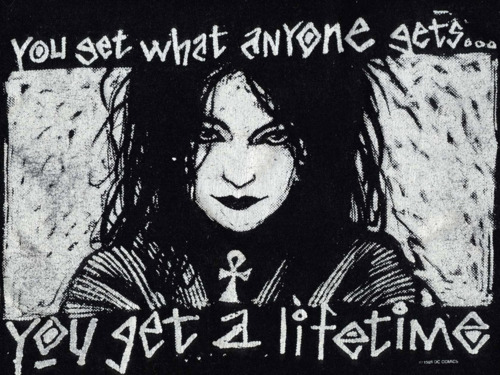
It is Neil Gaiman’s Death and a wonderful saying that I’ve taken to heart, ever since I first saw the motif on a t-shirt. It speaks for itself.
Tick, tock.
Brimstone stokes the embers, and other writerly news
Brimstone Press is showing a pleasing glow of resurgent life after a meltdown earlier this year which saw press releases announcing much pulping of stock. The website carries three available titles, announces an Australian distributor and promises further titles to come.
Another Aussie publisher specialising in the dark side is Dark Prints Press, who has announced a new anthology of supernatural crime stories and has also opened its doors to novellas.
Which is a timely reminder that Twelfth Planet Press is looking for novels — send submissions throughout January.
WA writer Martin Livings has flagged the cover of his forthcoming anthology Living with the Dead and it’s a beauty — just what you want for a 20-year retrospective.
And you can get some insight into the issues surrounding the e-publishing revolution with a collection of essays commissioned by if:book Australia — High Tech Hand Made is free!
And non-writerly but wonderful is the new single from Brissie band Felinedown, playing a New Year’s Eve gig with Tycho Brahe — damn shame to be missing that gig.
Writerly round-up: D Publishing still doesn’t quite get it, and the quest for quality and equality
[Update, 18 December: Steve Rossiter reports (in the comments section here) a third version of the D Pub contract is promised [Dec 24: Rossiter still finds holes in the new Dymocks’ contract, calling it a wasted opportunity]. Meanwhile, Writers Beware has posted this succinct summary of some of the concerns sparked by the original contract, which presumably will be addressed in the amended agreement for those wanting to use Dymocks’ distribution.]
[Dec 24: Crikey has interviewed Rossiter, and also provided a handy synopsis of the D Pub issue including links to the various criticisms levelled at the original contract.]
Dymocks’ D Publishing has been doing the PR rounds trying to hose down the criticism of their contracts — the ones you have to dig through their help menu to find — for those who want to use the service to not only print their work, but have it distributed. Those two arms of service do seem to have blurred in commentary, perhaps because D Publishing isn’t staking out that division strongly enough. It’s something they’re trying to address with PR, rather than website design or clarity. Still, early days…
Steve Rossiter, who issued a warning about the terms and conditions when first announced, and wasn’t wholly convinced by the second pass, has since had a chat with D Pub and seems somewhat mollified.
And over at Bookseller + Publisher, Dymocks has played serve and volley with contracts expert Alex Adsett, and has done a fairly good job of avoiding the actual issues she raises about Dymocks’ rights policy while playing the line that Dymocks is there to serve the author. In which case, they’d put their terms and conditions up front and centre for those considering publishing with them (as opposed to merely printing), and remove the ambiguity that Adsett has identified. But, you know, as I said, early days…
As always, it’s a case of ‘let the buyer beware’: shop around for the service that offers the quality, product and cost-effectiveness that best suits your needs, and mind the small print. One thing you can’t argue about: being publisher, distributor and sales outlet is a great example of vertical integration.