Cradle Mountain: it reigns

Cradle Mountain Lodge, Tasmania

Cradle Mountain Lodge, Tasmania


It rained. A lot. And it was perfect. The weekend was designed as a laid-back getaway, and that’s what we got at Cradle Mountain Lodge.

The Lodge sits just outside Tasmania’s Cradle Mountain-Lake St Clair National Park, an area of such awesome natural beauty and value it’s World Heritage listed.

Sun shone on the English fields of sheep and cattle on the two-and-a-bit-hours drive from Launceston, but as the altitude climbed, the clouds came over, until we were winding through misty-rainy moor and edging sheer gullies choked with eucalyptus forest.

The clouds never left for the duration of the weekend, even threatening to snow at one point. But the rain showed mercy, breaking long enough for us to not only appreciate the bounty around us, but work up an appetite: there was the half-hour Enchanted Walk, with its duckboards running beside a fast-flowing stream and taking us from open grass paddocks to moss-covered forest; and there was a wee taste of the Dove Lake track, with a side trip to “the boatshed”, down to Lake Lilla. There was even a brief rainbow on the return trek!

More pictures of rainy Cradle Mountain

Our accommodation, a sprawling estate run by Peppers, was ideal for the stay: next door to our friends, spacious with an airlock to keep the dripping wet out and the warmth in, no television, a gas fire. The staff were uniformly friendly, too.

A short stroll to the lodge — it’s made out of a lot of timber — yielded close encounters with wombats and pademelons. In the no-fuss bistro, there was wood-fired pizza and other pub grub; in the restaurant, more elegant fare, including a walk-in wine cellar.

A buffet breakfast was included, and it offered a pleasing range of hot and cold tucker, and all fresh.
A lower bar, for guests only, had one of the best wood fires to dry out beside.

Our excursions included a joint win at the bistro’s short and sweet trivia night, and a little more romantic, and included in the accommodation price, a tour of the nearby Tassie Devil sanctuary, where the besieged critters are, along with two kinds of very cute quoll, available for viewing.

We dodged rain to see the cute little dudes fed pieces of wallaby, and didn’t they get stuck in. Devil screeches are something to be heard, especially in the dark and rain.

It’s great that there’s hope for the species, at least once the population suffering from lethal tumours has died out.

Boat Shed, Dove Lake, Cradle Mountain

Boat Shed, Dove Lake, Cradle Mountain

There was sun on the way home, of course. On the way in, we stopped at Sheffield for honey and fudge — the fudge did not make it home — but on the way out, it was a straight run back to Launceston for lunch at Blue Cafe — noms the sweet corn fritters — before flying out.

What really impressed, other than the landscape and sheer comfort of the resort, was the ease of access. A short flight from Melbourne, a short and very pleasant drive, a wilderness-embedded resort with its own walks, and the whole national park at the doorstep.

A fly, a drive, a walk, a feed, wombats (!), even an afternoon nap. Just lovely, rain or shine.
Honourable mentions by Ellen Datlow

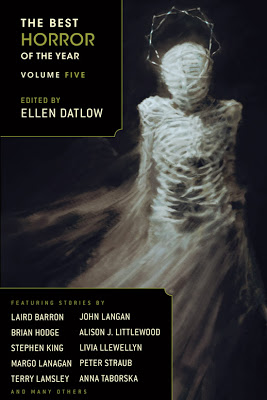
best horror of the year volume 5 edited by ellen datlowEditor extraordinaire Ellen Datlow has released the LOOOOONG list — and it’s true to label, appearing in two pieces (Alexandra to Johnstone, Jones to Yolen) on her blog — to go with the short list of honourable mentions of short stories from 2012, anchored by her Best Horror of the Year Volume 5. The short list appears in the book; the long list doesn’t. Despite the collapse and sale of publisher Night Shade, the book’s listed as available on Amazon.

So why am I mentioning this? Because Datlow has seen fit to list three of my yarns in the long list — ‘The Kiss’ from Tales from the Bell Club, ‘Last Boat to Eden’ from Surviving the End, and ‘Breaking the Wire’, from Aurealis #47 — and ‘Eden’ made it through to the short list.

There is a whole posse of Aussie talent in the lists, and stories by Margo Lanagan and Terry Dowling made it into the collection.

To get a pat on the back from anyone is always a warm and fuzzy moment; to get it from someone with Datlow’s pedigree, and knowing just how widely she reads to compile these lists, well, that’s very nice indeed.

It’s especially cool to see ‘The Kiss’ get a mention: writing in the voice of a turn-of-the-last century Austrian suffragette was quite fun, and one of the first yarns I’ve written involving historical figures. If you go to the link above, you can read the little sucker in the ‘look inside’ feature!

Ticonderoga’s recommended reading list: we have squee!

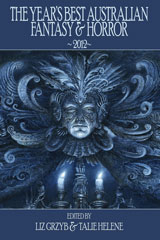
years best fantasy and horror 2012Just a wee note to say, yay, ‘Mornington Ride’ from Epilogue and ‘Breaking the Wire’ from Aurealis #47 have been included in the recommended reading list from Ticonderoga Publications’ forthcoming Year’s Best Australian Fantasy and Horror 2012. ‘Last Boat to Eden’, from Surviving the End, is included in the volume (I blogged the full contents of this packed volume here). My ego aside, it’s a good place to start if you’re looking to take the pulse of short Aussie dark fiction. The book is available for pre-order.

The Burial: uncovering some natural talent

the burial by courtney collinsThe Burial is the debut novel from Courtney Collins, and it has been received well enough – short listings for the Stella Prize and the NSW Premier’s Literary Awards, a long-listing for the Dobbie – to earn her a place in Australia’s literary delegation to the UK.

The voice is a large part of its appeal, one suspects. Narrated by a dead baby who’s been buried in the earth, it might not surprise that a large part of the story concerns relationships with the earth: a part-Aboriginal stockman cum tracker, a city-trained policeman with his own destructive obsessions, and the heroine of the piece: outlaw Jessie Hickman.

Jessie is based on a real person, one who had a vague legendary status in the area of NSW where Collins grew up. Few details of her life were available, but there were police records and a mug shot.

Jessie was a circus rider, a wild child, a horse thief.

Her life in 1920s Australia, as imagined by Collins and recounted by Jessie’s dead child, is one of displacement and discomfort, of trying to find one’s place. For Jessie, that happiest place seems to be on horseback.

Backgrounding the tale is life in the rural back blocks, still a frontier post-World War I, with broken soldier settlers eking out their livings in the wild country, the law mistrusted by all, and women – those hardy few – getting the rough end of the stick.

It a place where Jessie is indentured to Fitz, whose brutal hold on Jessie sets up the core of the story: a protracted pursuit that gathers pace as the tracker and the copper get their act together, drawn together by their mutual history with Jessie, who wants only to be free — even if she isn’t entirely certain what that freedom might entail.

australian women writers review challenge logoThe story of Jessie’s flight into the high country is interspersed with flashbacks of her journey to these straits, and insights into why these two men pursue with such persistence.

But it is the bush that is the major backdrop and a key character, shaping these lives on the edge of civilisation, offering both threat and succour.

Collins’s prose has a cadence, with drawn-out sentences clopping along with conjunctions to offer a folkloric, lyrical atmosphere. The sense of the tale being narrated in an otherworldly fashion is enhanced by the use of italics for dialogue, rather that punctuation marks. The story could have afforded to lose a few extraneous scenes, but overall it draws the reader on as pursuers and pursued head to their inevitable resolution.

There is, however, no historical conclusion to The Burial; with the focus on the environment and adapting to it, its conclusion possibly owes a debt to Picnic at Hanging Rock and that fascination with civilisation vs nature, that throwing off of social binds and embracing the environment. Certainly, The Burial is a worthy companion to that section of Australian literature that examines our place in this environment. I wonder what the Poms will make of it.

A most Delicate Truth from John le Carre

delicate truth by john le carreJohn le Carre‘s spy novels were always a cut above for me; him and Frederick Forsyth ruled my thriller firmament in my teens, when the second-hand book stores were raided for the Colin Forbes, Len Deightons, Adam Halls, the Bond books, and soforth.

It was le Carre’s mood that won me, the sheer honesty of his tales in which grey was the colour de rigeur and the good guys, if you could find them, were never guaranteed of victory. As with the Cold War, everyone was playing for a draw.

In A Delicate Truth, his latest, he examines matters of conscience and political expediency, as a former British diplomat and a serving public servant find an incident on Gibraltar has not so much a delicate truth but a damned inconvenient one for Her Maj’s government. Against the backdrop of terrorism and rendition, mercenaries and dirty tricks, it’s a fraught tale of men unable to sleep easily with guilt and the ways in which the system seeks to silence them.

The characters are stoic, suitably reserved, in their dealings, and the dialogue is brilliantly esoteric, with echoes of phrases used to at times Yes Minister levels of cutting effect within the overall atmosphere of growing malevolence. Le Carre knows when to be sparse and when to use his astute descriptions of setting, a wonderful example of crafted world building.

While the end note was superb, the actual climax felt a little convenient, just a touch, but in no way undermined the story or the carefully presented character arcs that brought it about.

It’s been a long time since I devoured The Spy Who Came in from the Cold and Tinker Tailor Soldier Spy — the Tomas Alfredson movie was beautifully realised — but A Delicate Truth takes me right back to the joy of those masterpieces. Le Carre is as foxy as he ever was.

Pacific Rim: One for the dinosaurs

pacific rim posterIt could have, and should have, been superb: Pan’s Labyrinth director Guillermo del Toro (see also Devil’s Backbone, Cronos and Hellboy) helming a big-screen flick in which giant mechs — human-driven robots — battle giant monsters — ‘kaiju’ — for dominance of the Earth.

Pacific Rim is a pretty movie. It has some comedy moments. Ron Perlman’s appearance got a chuckle from the cinema. But that can’t save it.

Oh hackney! Where is your plot? Your logic? Where are your characters? Where is your time limit, for pity’s sake?

No more stereotypes, I beg you. Neither racial nor gendered. Isn’t it time we left this boyish, dinosaur-aged bullshit behind?

Look to anime, to Evangelion … see? See how something can be pretty and still tell a story?

Women can pilot mechs and don’t need to be protected by oafish, testosterone-fuelled males. What a great excuse for a punch-up — ‘apologise to the lady’. FFS, the ‘lady’ could’ve kicked both their arses.

Oh mechs, your tactics are flawed, and writers, your world building so thin I could ride a daikaiju through it as easily as they crash through your ludicrous sea wall.

I could go deeper, dissect the many aggravations and sheer occasions of stupid evident in this half-baked, pedestrian effort, but I’ve already given it more than two hours of my life.

In a mech shell: an irrelevant comedy side act, boorish leads — what the hell is Hollywood doing to Idris Elba? — and flimsy plot devices make for a monster of a flop.


Black Spring by Alison Croggon: revisiting Heathcliff for a spell

black spring by alison croggonAlison Croggon, whose fantasy novel The Gift (first of the Pellinor series) floated my boat way on release in 2002, has done a fine job of cutting to the chase in Black Spring (Walker Books, 2012), which makes no bones about its strong foundation in Emily Brontë’s Wuthering Heights.

Croggon takes the structure — a narrator arrives, meets some of the players and receives the story in a monologue from someone in the know — the mood and the cornerstones of the plot about thwarted desire, class and revenge, but does some elegant re-imagining.

UPDATE, VIDEO: Alison Croggon talks Wuthering Heights, Emily Brontë and Black Spring at the Wheeler Centre

The moors are out; instead, it’s a highland plateau — just as isolated, just as windswept — with a touch of the fantastic.

Narrator Hammel, a writer, begins in an almost New Weird setting of hedonistic city, where the literati have their own guild and a certain social sway. It might bring to mind the shenanigans of the Romantics wine bar crowd. Hammel retires to the north, a rented manor in sight of the Black Mountains. The plateau is a land of mystery, a kind of Transylvania meets Sicily, with changeable weather and a certain harshness, just right for this dark tale. It’s a land of small villages, of priests vying with magicians for the fear of the populace if not their hearts, of rampant superstition … and the vendetta, a way in which the king’s coffers are enriched and the male population is culled.


It might be a fantastical setting but for the incongruous presence of the Catholic church, uncomfortable in a land where magicians really can burn people from the inside out, send curses and engage in psychic combat, making this more of an alternative realm.

Hammel meets the Heathcliff analogue, Damek; has a suitably wonderful paranormal experience in line with Lockwood’s dream of Cathy in the Brontë version; and then is told the tragic story of Damek’s obsession with Lina, the daughter of the local lord both blessed and cursed with royal and witch blood.

Perhaps the most notable departure from Brontë’s text is in the ending — this isn’t called Black Spring for nothing!

The characters are all suitably flawed, each unable to prevent the inevitable tragedies that drag them all down.

Croggon uses suitably prose of the era with all her poetic might, delivering a satisfying if — as I recall the original — slow-paced recounting of love and revenge.

  • This is my fourth review as part of the 2013 Australian Women Writers Challenge — the first was Glenda Larke’s Havenstar; the second, Krissy Kneen’s Steeplechase; the third, Christine Bongers’ Dust — and completes my commitment to review four titles. There are, however, more on the shelf — let’s see how I go!
  • Dust, by Christine Bongers: easy to take a shine to

    dust by christine bongersIt’s not hard to see why Dust (Woolshed Press, 2009) was named a Children’s Book Council of Australia notable book, among its many accolades. It’s a simple, powerful coming-of-age story, the sort of thing that’s just the ticket for school libraries. Fairly subtle, too.

    Chris Bongers grew up in Biloela and she taps that experience in this tale set in the countryside of her childhood. Like heroine Cecilia, Bongers had a mob of brothers to run amok with, too: how many chinese burns, corkies and horse bites did she trade? Droughts and flood and heaps of strine are, however, only the wonderfully drawn backdrop of this tale, set in the 1970s with a modern bookend.

    Cecilia is on the cusp of moving from primary school to high, and there’s a steep learning curve to do with being yourself, of making choices, of caring for those on the fringes who have no one to care for them.

    Working up ways to dodge the worst of penance in the confessional is just the start of it.

    There’s the mysterious Kapernicky sisters, chalk and cheese and both just a little off; and the new girl, peaches-and-cream Hayley in her revelatory knee-high white boots; and Glenda with her ciggies and alluring coterie of no-gooders … and just what has got into Cecilia’s brother, Punk?

    australian women writers review challenge logoBongers has the knack of flipping the switch from larrikin humour to pathos. Of painting her characters in human strokes, the good with the bad with the damn frustrating. Of letting the time go by, incident by incident, letting the allusions grow as the illusions slowly fade.

    She perfectly captures that onset of maturity, young people trying to make sense of the world. Coming to realise that the dust of regret accumulates, seeking a way to keep the surfaces clean or at least keep the rug in its place; discovering the power of compassion.

  • This is my third review as part of the 2013 Australian Women Writers Challenge. The first was Glenda Larke’s Havenstar; the second, Krissy Kneen’s Steeplechase.
  • Headstones and lake reflections in Ballaratia

    Ballaarat Old Cemetery, Ballarat

    Ballaarat Old Cemetery

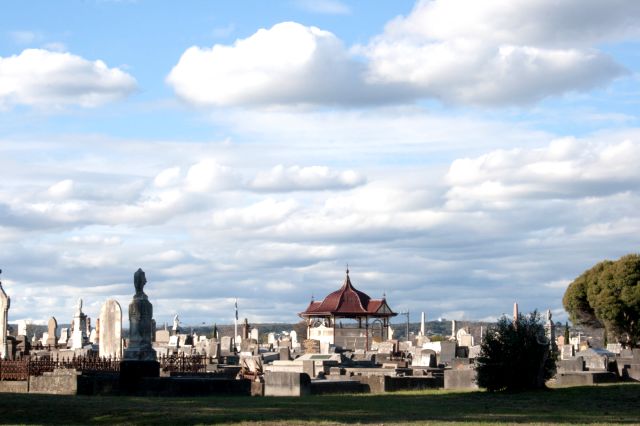
    Friday was sunshine and fluffy clouds, little breeze, the typical Ballaratian winter’s day, we are told, but the first we’ve been able to enjoy. So Kirstyn and I took the day off and went to the Ballaarat Old Cemetery.

    The city fathers were indeed wise to commission a second, with the city being a boom gold town and all, and the cemetery quite compact — population, about 25,000 (according to a sign board at the graveyard).

    Here a lawn of unmarked pioneer era graves, here the Jews, here the Irish, the Germans … here the Chinese with the only oven I’ve seen outside of Mt Morgan.

    Diggers' Eureka memorial, Ballaarat Old Cemetery, Ballarat

    Diggers’ Eureka memorial, Ballaarat Old Cemetery

    Probably the boneyard’s greatest claim to fame is the Eureka rebellion, with separate monuments for soldiers and rebels who died in the uprising, the insurgents so popular a jury would not convict them for treason. Interesting wording on the monuments, too. Fascinating insight.

    We were struck by the number of children and infants mentioned on the stones, a sign of the harsh conditions in the late 19th century, no doubt. Those simple engravings conveyed so much sorrow.

    Others blustered with Christian piety or simple resignation and hope; some struck more affecting messages: my beloved has gone down into the garden to gather lilies in the garden.

    More cemetery pictures

    The cemetery is well tended, sparkling with wafting strands of cobweb glistening like fishing line. An information building offers some insights. There are few grand monuments, defying expectation of a wealthy town’s significant departures; maybe the toffs have got their pillars out at the ‘new’ cemetery … We will investigate!

    Eclectic Tastes Cafe, Ballarat

    Eclectic Tastes Cafe, Ballarat

    Next to the cemetery is the Eclectic Tastes Cafe. This converted home is one of those cafes that is welcoming as soon as you walk through the door — eclectic in decoration through its various rooms, a proudly parma-free zone, and a darn tasty menu with good coffee. I knocked back a sensational skillet of kidney beans and cheese and stuff, gently spiced, served with sourdough for sopping up the sauce. Kirstyn had a vegetarian pizza that even tempted me, thanks to nuts and blue cheese sauce. It’s the favourite eatery we’ve come across here so far.

    Boathouse Restaurant, Lake Wendouree, Ballarat

    Boathouse Restaurant, Lake Wendouree

    Later in the afternoon, we headed for Ballarat’s defining geographical feature: Lake Wendouree. It’s been a site for rowers since 1864; now it’s dotted with boatsheds and cafes and parkland. We’ve yet to do a proper tour of the lake, and on Friday were content to just hover around one part where the Lake View Hotel enticed with its second-storey balcony … but we opted for cake and coffee on the deck at the tad pricey Boathouse Restaurant, right on the water, with a wonderful willow tree for extra scenery. There we could take in the water birds and joggers, rowers and paddlers and anglers as the sun sank and chill came down. One couple in a canoe pulled up at the cafe for coffee.

    We snapped off a bunch of photos and retreated to home in the gloaming, appetites whetted for further exploration of Ballaratia.

    More sunset pictures

    Lake Wendouree sunset, Ballarat

    Sunset, Lake Wendouree

    Abbe May, leader of the CD stacker

    kiss my apocalypse by abbe mayPerth singer-songwriter Abbe May blasted onto my radar with 2011’s Design Desire, a rockin’ album, blistering and sexy. So blistering in places I’d quite forgotten its tender, electronic moments that have been further explored on Kiss My Apocalypse.

    This album is insanely slinky, sexy, cool. DD‘s bluesy, rock guitars are eschewed for synths and beats: steamy, savvy, invasive… the title track and Karmageddon are the kinds of tunes that you find yourself humming hours after.

    Throughout, with the amps down, May’s voice is allowed to roam through her impressive range. It’s pop meets electro meets attitude. There’s even an undertone of flamenco.

    Outside the couple of atmospheric bites and minute-and-a-bit F**k/Love, each song carries its own weight on what is a fairly even-tempo collection.

    There’s an inner city or inner suburban feel; a sense of melancholy, of waiting, of love on hold or disappointed; of frustration and defiance and a will to overcome. That we will not fall into the cracks in the pavement, we will not go quietly, we will not accept the betrayal and the inadequacies; we will demand respect.

    Maybe the message of the album is that, when love lies bleeding, we will rise above. And if not, well, this is a damn fine album to go down to.

    Other new music of 2013 on rotation:

    savages album silence yourselfWild ‘n’ arty England four-piece Savages‘ debut, Silence Yourself. If Abbe May is seducing you into the end of the world, then these gals are tearing it down around your ears. There are clear roots to the 80s — Joy Division, Siouxsie Sioux, Bauhaus — but there’s a modern polish, aided in no small measure by the vocals of Jehnny Beth. Getting slammed shouldn’t feel this good, should it?

    Yeah Yeah Yeahs‘ newish album Mosquito provides a pleasant mix of textures, none tastier than the title track. Opener ‘Sacrilege’ feels almost like a bridge from previous, electro outing It’s Blitz until the guitar buzz opens up on the way to a gospel conclusion, and the suggestion of Blitz 2 is left behind. ‘Subway’, backed by train-on-sleeper rhythm, shows they can tone it down, too. Eminently listenable, but then, Karen O is, ain’t she?


    I helped kick-start Free Dominguez‘s Volcano and the Sea, based on the ear-grabbing awesomeness than is her band Kidneythieves. Alas, the poppy solo outing isn’t quite as grabby, sliding by innocuously and pleasantly enough with plenty of style, but failing to announce its presence. There’s a remix ep that features a cracking KMDFM version of ‘The Wolf’.

    Likewise, Helalyn Flowers‘ new album, White Me In Black Me Out, sports a couple of wonderful tracks — the title song’s one of ’em — but too much of this new album from the ’80s-loving Italian electro-goths does too little.


    Into that same territory of passing good but unexceptional are The Next Day from David Bowie — extra points for using the word ‘gormless’ in a song — and Depeche Mode, following up the meh of Sounds of the Universe with equally meh Delta Machine. Black Celebration feels like such a long time ago. Oh, crap, it was!

    falling echoes album counterclockwiseAnd finally, fresh out in cyberspace, is the debut album from Falling Echoes, being my mate Aaron R Walker of Wretched Villains fame and his mate Cristian Matheson (not to be confused with the writerly son of Richard Matheson, Christian with a h). Those familiar with the Villains’ foot-tapping gloom rock will appreciate this outing, though might miss Peter Green’s axe. The album, Counterclockwise, is a rhythm-led, simmering affair with touches of Cure-like joie de vivre. Ideal for walking home from the station on foggy nights.


    Check these out on bandcamp:

  • Attrition: album The Unraveller of Angels electro-industrial goodness, hovering between the sensuous delights of sex and death
  • Nicki Jaine: Her album Of Pigeons and Other Curiosities should please Jill Tracy fans with its gritty cabaret sound — ‘untitled’ is particularly suitable in these days of depressing headlines, filling my head with noirish imagery of sweaty bedroom sheets and barely turning fan and, on the other side of the dusty blinds, streets descending into bedlam.


    Retro buy:

  • Dr John‘s 1968 debut, Gris Gris. Swamp blues comin’ at you, bone-shakin’ and bayou drippin’. Play it with the lights down low and go, baby, go.